


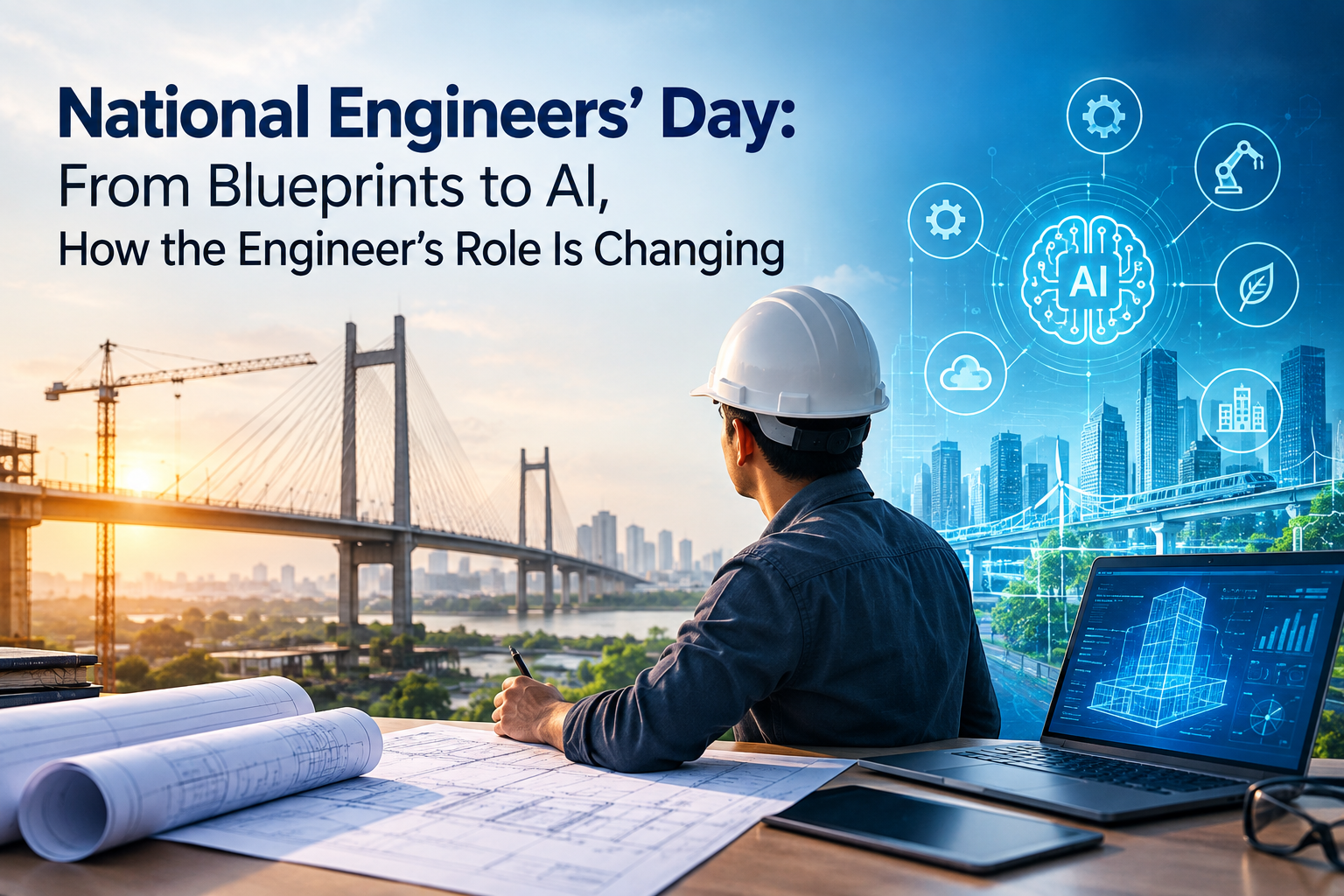
Sept 15: Every year on September 15, India celebrates National Engineers’ Day in memory of Sir Mokshagundam Visvesvaraya, one of the country’s most celebrated engineers and statesmen. For many, the day brings to mind bridges, machines, buildings, software and complex technical drawings. But perhaps engineering deserves to be looked at differently. What if some of the best engineering is the work we never notice? When a payment happens in seconds, a train reaches its destination safely, electricity reaches our homes, or a delivery arrives at the right address, most of us simply see the result. We rarely think about the engineering that makes it possible. And that is precisely what makes engineering so fascinating.
The traditional image of an engineer is changing rapidly. Engineers today are working across artificial intelligence, renewable energy, electric mobility, cybersecurity, robotics, healthcare technology, telecommunications and digital infrastructure. They are not just building things. They are designing systems, improving processes and solving problems that can sometimes be invisible to the people who use them. The question is no longer simply, “How do we build it?” It is increasingly, “How do we make it smarter, safer, faster and more sustainable?” That shift is changing what engineering means in the modern economy.
The changing role of engineers is reflected in the World Economic Forum’s Future of Jobs Report 2025. The report identifies roles such as AI and Machine Learning Specialists, Big Data Specialists, FinTech Engineers, Software and Application Developers, Environmental Engineers and Renewable Energy Engineers among the fastest-growing occupations towards 2030. It also highlights AI and big data, networks and cybersecurity, and technological literacy among the fastest-growing skill areas. The message is clear: engineering is becoming closely connected with some of the biggest changes taking place in the global economy. The engineer of tomorrow may be working on a physical structure. Or they may be developing an algorithm, designing an energy system, securing a digital platform or finding a more efficient way to use resources.
Think about ordering something online. You see a product catalogue, click a button, make a payment and track the delivery on your phone. Behind those few clicks is a complicated chain of engineering involving software, payment systems, databases, cybersecurity, location technology and logistics. Digital banking works in much the same way. For customers, transferring money can feel almost effortless. Behind the scenes, engineers are making sure that systems communicate, information is protected and transactions happen reliably. This is the invisible side of engineering, and perhaps it is one of the most important.
Engineering has always been about solving problems. But today, engineers are also being asked to imagine what is possible. Take electric mobility. Building an electric vehicle is not simply about replacing a petrol engine with an electric motor. It involves batteries, charging networks, software, power management, safety and manufacturing. Renewable energy presents a similar challenge. Generating clean energy is only one part of the equation. Engineers must also think about storage, distribution, grid stability and efficiency. Every solution creates another question, and that is where engineering thrives.
There is another interesting shift taking place. Technology is becoming more powerful, but that does not make human thinking less important. In many ways, it makes good judgement even more valuable. Engineers have to understand a problem, identify constraints, test solutions and decide what works in the real world. The World Economic Forum’s report also points to the continued importance of human skills such as creative thinking, resilience, flexibility and collaboration alongside rapidly growing technical skills. That combination could define the next generation of engineers. Technology may provide the tools, but engineers still have to decide what to do with them.
Engineering is also playing a growing role in tackling environmental challenges. From energy-efficient buildings and electric vehicles to water management, waste reduction and renewable energy, engineers are increasingly being asked to create solutions that do more with fewer resources. UNESCO’s work on engineering and sustainable development similarly highlights the profession’s role in addressing challenges ranging from clean water and energy to resilient infrastructure and emerging technologies. This changes the definition of progress. It is no longer enough to build bigger or faster. The challenge is to build better.
National Engineers’ Day is observed on September 15 to commemorate the birth anniversary of Sir M. Visvesvaraya. His contributions to irrigation, infrastructure and nation-building remain an important part of India’s engineering history. But his legacy can also be viewed through a modern lens. Engineering is ultimately about taking knowledge and turning it into something useful. That principle has not changed. Only the problems have become more complex.
Perhaps the best way to celebrate National Engineers’ Day 2026 is not simply to talk about spectacular bridges, machines or technological breakthroughs. It is to appreciate the ordinary things that work because someone designed them to work. The traffic signal that keeps an intersection moving. The network that connects a phone call. The software that protects a transaction. The machine that makes production more precise. The infrastructure that delivers electricity and water. The technology that helps a business operate more efficiently.
Good engineering rarely demands attention. In fact, when it works perfectly, we may never think about it at all. And perhaps that is the real twist behind National Engineers’ Day: the greatest engineering may be the kind we stop noticing—the technology, systems and infrastructure that quietly make modern life possible.