


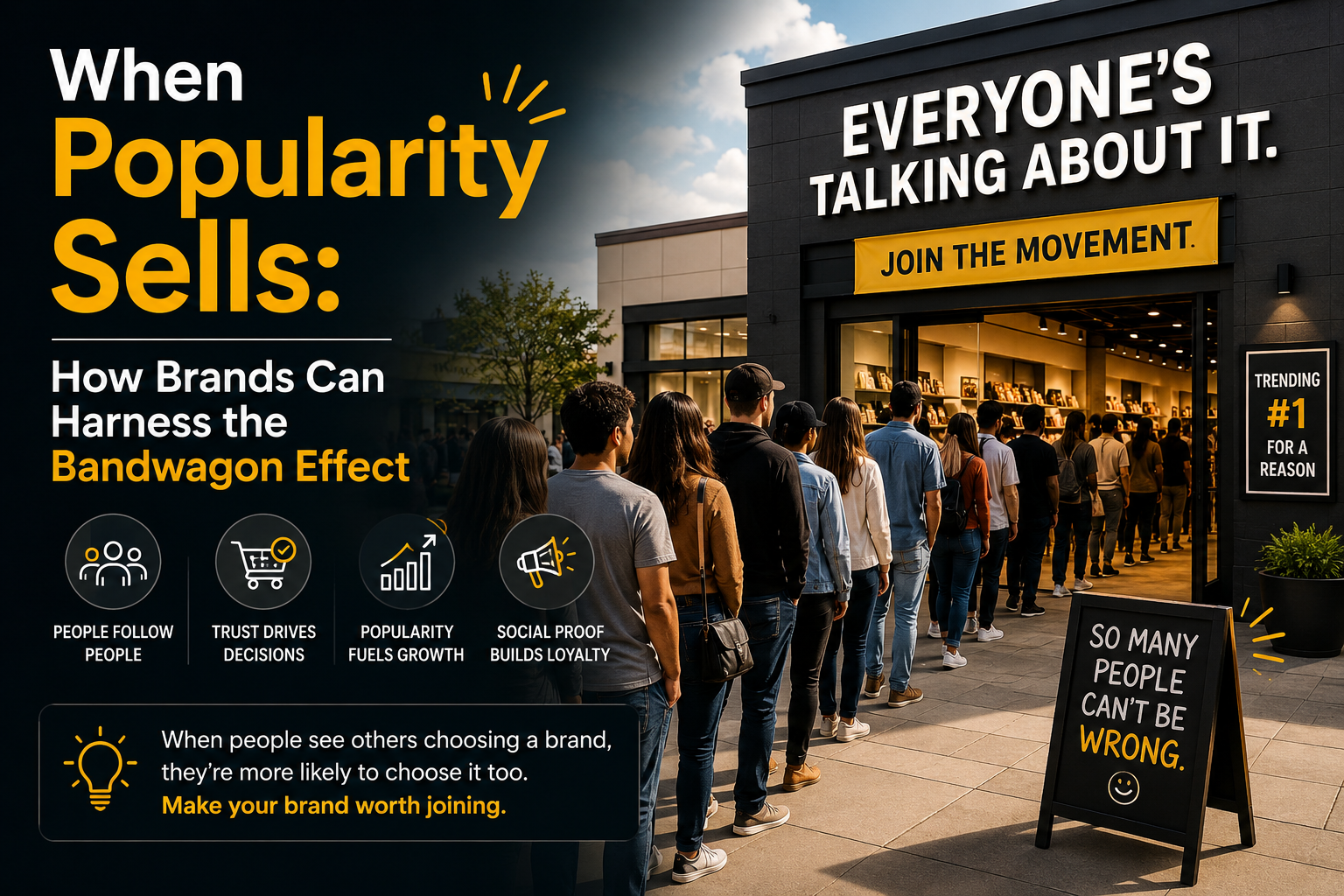
Why do people suddenly want the sneakers everyone is wearing? Why does a restaurant with a long queue seem more appealing than an empty one? And why can a product with thousands of positive reviews feel safer to buy?
The answer lies partly in human psychology. People often look at what others are doing when deciding what to do themselves.
Known as the bandwagon effect, this behaviour can be a powerful marketing tool. When consumers see a product being widely used, discussed or recommended, they may perceive it as more trustworthy, relevant or desirable.
For brands, the opportunity is to turn genuine popularity into visibility—and visibility into customer action.
What Is the Bandwagon Effect?
The bandwagon effect describes the tendency to adopt an idea, behaviour, product or trend because many other people appear to be doing the same thing.
It is not always about blindly following a crowd. Often, it is about reducing uncertainty.
Consider a consumer discovering a new skincare brand. The company can claim that its product works, but that remains a claim from the seller. Seeing hundreds of customers sharing their experiences, posting photographs and leaving positive reviews creates a different kind of reassurance:
“Other people are already choosing this.”
That simple perception can influence a purchase decision.
Why Social Proof Matters in Marketing
The bandwagon effect is closely connected to social proof—the tendency to use other people’s experiences and behaviour as a guide when making decisions.
Digital platforms have made social proof particularly visible. Consumers can now see ratings, reviews, comments, testimonials, influencer recommendations and user-generated content before buying almost anything.
Research shows just how important these signals have become. BrightLocal’s 2026 Local Consumer Review Survey found that 97% of consumers read reviews for local businesses, while 41% said they always read reviews when browsing for businesses. The average consumer also uses six different review sites when choosing businesses.
The same research found that 93% of consumers have made a purchase after reading reviews, demonstrating that social proof can influence consumers beyond awareness and into actual buying behaviour.
The takeaway for brands is straightforward: consumers are not only listening to what companies say about themselves. They are increasingly paying attention to what other customers say too.
How Brands Can Use the Bandwagon Effect
1. Make Genuine Popularity Visible
One of the simplest ways to create social momentum is to show that other people are already choosing the brand.
Companies can highlight genuine milestones such as:
- 100,000 customers served
- One million downloads
- A bestselling product
- Thousands of orders fulfilled
- A rapidly growing community
Such signals can reassure potential customers that they are not taking a chance on an unknown brand.
But authenticity matters. Popularity should be demonstrated with real data rather than manufactured numbers.
2. Turn Customer Reviews Into Marketing Assets
A brand saying “we are the best” is advertising.
A customer saying “this worked for me” feels more like a recommendation.
That distinction makes customer reviews valuable promotional assets.
Brands can incorporate genuine testimonials and reviews into websites, social media campaigns, email marketing, product pages and advertising.
The objective is not to replace brand messaging, but to complement it with voices that consumers may find more relatable.
3. Create a Sense of Momentum
Consumers are naturally curious about what is becoming popular.
Phrases such as “trending now,” “customer favourite,” “bestseller,” “most popular” and “back by popular demand” can encourage consumers to investigate a product.
But the strongest campaigns are based on actual consumer behaviour.
If a product is genuinely selling quickly, generating strong engagement or becoming a customer favourite, brands should make that momentum visible.
4. Put User-Generated Content to Work
User-generated content can turn customers into part of the marketing campaign.
A fashion company can encourage customers to share how they style its products. A travel brand can invite travellers to post photographs. A fitness company can build a challenge around its community.
One person’s post creates awareness.
Several posts create a pattern.
Hundreds of posts can create the impression that something significant is happening.
That is the bandwagon effect operating through community participation.
The cycle can be powerful:
Customer experience → Social content → Visibility → Curiosity → New customer → New content
5. Build a Community Around the Brand
The strongest bandwagon strategies do not simply tell people that a product is popular. They make consumers feel that they are joining something.
Brands can create:
- Loyalty communities
- Membership programmes
- Social challenges
- Hashtag campaigns
- Creator communities
- Brand ambassador programmes
- Customer events
The message changes from:
“Buy our product.”
to:
“Join the people who are already part of this.”
That emotional shift can make a brand more engaging and memorable.
6. Choose Influencers for Trust, Not Just Reach
Influencer marketing can accelerate the bandwagon effect because creators already have established communities.
However, the biggest audience is not necessarily the most valuable one.
A creator with a highly engaged audience interested in sustainable fashion, for example, could be more effective for an eco-conscious clothing brand than a celebrity with millions of followers but little relevance to the category.
Brands should therefore evaluate:
Relevance + credibility + engagement + audience fit
rather than relying solely on follower counts.
7. Make the Customer Part of the Story
The most valuable form of bandwagon marketing happens when customers voluntarily become advocates.
A memorable product experience, distinctive packaging, personalised service or engaging campaign can give customers something worth sharing.
Instead of creating an advertisement that customers simply watch, brands can create experiences that customers want to talk about.
That turns word-of-mouth into an extension of the marketing strategy.
8. Use Scarcity Carefully
Popularity can become even more persuasive when combined with genuine scarcity.
Limited-edition products, exclusive collections and genuinely low-stock items can create urgency.
But brands should avoid fake countdowns, artificial stock shortages and misleading claims.
Short-term sales generated through manufactured urgency may come at the cost of long-term trust.
Real popularity combined with real scarcity is far more sustainable.
Social Media Has Changed the Bandwagon Effect
Social media has made consumer behaviour highly visible.
A potential customer can instantly see:
Who bought it.
Who reviewed it.
Who recommended it.
Who is wearing it.
Who is talking about it.
How many people liked it.
How many people shared it.
This visibility can accelerate consumer trends.
The BrightLocal 2026 research also shows that consumers are no longer relying only on traditional review platforms. Video platforms and AI tools are becoming increasingly important sources of recommendations, while consumers continue to cross-check information across different channels.
For marketers, that means social proof needs to exist across the wider digital customer journey—not just on one review page.
Popularity Can Open the Door, But Quality Keeps Customers
There is an important limitation to the bandwagon effect.
Popularity can encourage someone to try a product. It cannot guarantee that they will remain a customer.
If the actual experience fails to match expectations, the same networks that created positive momentum can quickly spread criticism.
This makes product quality and customer experience the foundation of any successful bandwagon strategy.
The ideal cycle is:
Good product → Positive experience → Customer advocacy → Social proof → Wider adoption
Not:
Artificial hype → Purchase → Disappointment → Negative word of mouth
Brands should therefore use the bandwagon effect to amplify genuine customer satisfaction, not to hide weaknesses.
The Business Opportunity
For brands, the bandwagon effect is ultimately about reducing the perceived risk of choosing something unfamiliar.
A new customer may hesitate when faced with an unknown brand. But seeing thousands of customers, strong reviews, active communities and genuine recommendations can provide reassurance.
That makes social proof particularly valuable across industries—from fashion and beauty to technology, travel, hospitality, education and professional services.
The strategy is not simply to say “everyone is buying this.”
It is to give consumers enough authentic evidence to think:
“People like me are choosing this—and maybe I should too.”
The Future of Bandwagon Marketing
As consumers spend more time discovering products through social platforms, creators, communities, reviews and AI-powered recommendations, the visibility of other people’s choices will continue to influence purchasing behaviour.
For brands, the opportunity is not to manufacture popularity.
It is to create something worth talking about and then make those conversations visible.
The most effective bandwagon marketing is therefore built on genuine experiences, authentic advocacy and strong communities.
When customers become advocates, reviews become recommendations and communities become part of the brand experience, promotion can begin to move beyond traditional advertising.
In the end, the most powerful bandwagon a brand can create is one driven by people.