


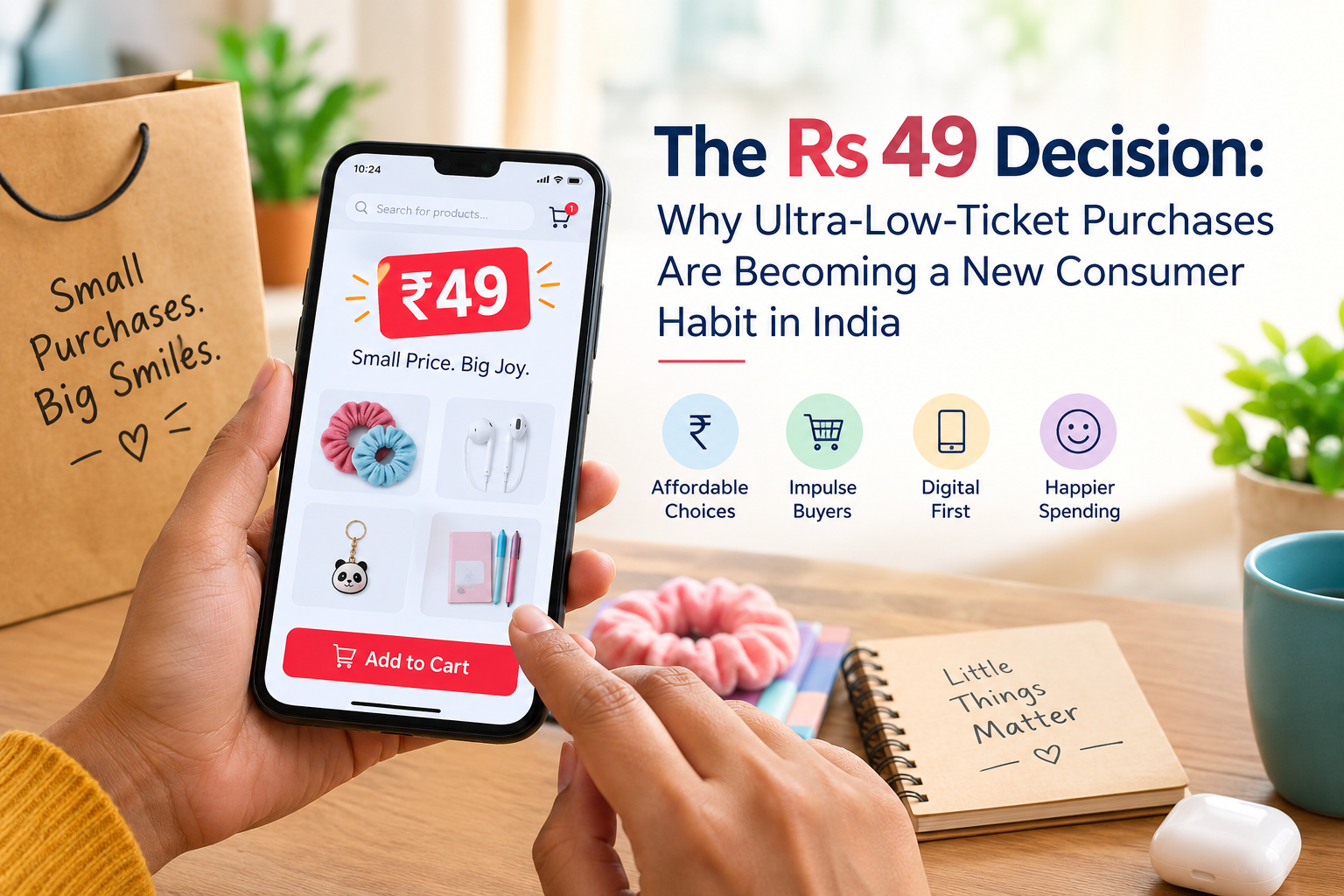
When ₹49 Becomes an Easy Yes
The ₹50 price hike doesn’t seem like much to India’s price sensitive population. This can make or break the sale.
The ₹ 49 product is an affordable product to purchase without any hesitation. It might be an item you eat as a snack, an item you use for beauty, an item to use for stationery, an item to use on your phone, a small household product or it could be a trial sample of a personal-care product. They may not have had it in mind when they were out on a shopping trip but the low price makes it simple to say yes.
This is an interesting scenario that Indian businesses are finding themselves in. Greater consumer exposure to new products, rapid digitisation, and hyperconnectivity are making ultra-low-ticket purchases an increasingly important segment of India’s consumption economy.
The Psychology Behind the Small Purchase
Spending less on products, reduces the risk of trying something new.
A consumer might be hesitant to invest ₹300 on buying a new skin care product but might be ready to try a mini-pack of skin care product costing ₹49. It’s when the experience is good, but the customer may be tempted to upgrade to a larger pack or higher-priced product over time.
This is why low-ticket items are useful for customers to acquire and learn about products.
The goal for businesses is not to make significant profits from each ₹49 sale. It is to spur on trial, promote repeat buying and develop a greater customer relationship.
Small Aspirations Are Driving Consumption
There is also a strong tie between the affordable economy and the emerging culture of affordable aspiration in India, the ₹49 economy.
Consumers are increasingly seeking access to products and experiences that were once thought of as premium. But they’re not always aiming for a high price ever.
Whether it’s a small dessert, a popular accessory, a fragrance, a beauty product or a speciality snack, it can be an inexpensive moment of indulgence.
Each of these purchases may seem small but multiply by millions of consumers who buy it regularly and it becomes a sizeable market.
FMCG Has Long Understood the Power of Small Packs
Low price packs have become a practice in FMCG industry in India for decades. Some of the products have been able to reach the consumers across income groups and geographies with the help of small sachets and mini-packs. Not all consumers need to buy a big bottle or family pack to get a branded product.
The pricing of ₹49 does just replicate this behavior and bring it to new categories. Low cost formats can be used in beauty, wellness, food, home, accessories and even lifestyle products to get consumers thinking more about trying something new.
It can be especially beneficial for new brands, as the initial buy is the most difficult purchase to make.
Quick Commerce Is Making Impulse Buying Easier
The fast commerce phenomenon is making things more complicated with regard to ultra-low ticket consumption.
If products can be accessed quickly, a small purchase will be easier to make. A customer can add a ₹49 snack, beverage, dessert or household item to an order just because it’s convenient and low cost.
This is a very interesting link between small baskets and regular purchases.
The challenge for the retailer is to make these low value transactions commercially viable. The convenience can make the purchase of items feel frictionless to consumers.
The ₹49 Product Can Be a Gateway
A low ticket item can provide an introduction to an entire brand. Imagine an imaginary personal-care company rolling out a new face cleanser. This could be a better option than selling a ₹399 full-size product to a customer and then asking him to buy a larger size, to try it.Instead of selling products of ₹399 directly to the customer, it could have sold ₹49 trial pack.
If the customer enjoys it, the next time they buy, they might want to buy the big one. The company will have the potential to eventually expand into other skin care products, increasing the CLV of each customer.
Then the small purchase turns into a marketing strategy, in the guise of a product.
India’s Smaller Cities Are Important
The ultra-low-ticket model is very relevant outside metropolitan India. Consumers in Tier-2, Tier-3 and smaller towns are becoming more and more digitally connected and more and more vulnerable to the national and international consumer trend. Meanwhile, cost is a factor to take into account.
Product experiments can be done with ₹49 or ₹79. It’s a chance for businesses to create products targeted to a regional market instead of selling smaller versions of their products offered in metropolitan areas.
The Business Challenge: Low Price Does Not Mean Low Cost
The price of ₹49 does not necessarily reflect the price of production and distribution. Packaging, raw material, labour, logistics, retail mark-up, taxes, platform fees and marketing costs can eat into the retail price almost as quickly as it is added.
For businesses to make ultra-low-ticket products profitable, they have to have extremely efficient supply chains. Often high volume distribution is necessary. Crucially, packaging needs to be well designed, otherwise a very small size product with vastly higher packaging cost may kill margins.
Digital Payments Make Tiny Transactions Easier
Digital payments have also become a norm for small transactions in India. Now consumers can pay for relatively modest purchases without cash or making change. This has helped to decrease friction at online and offline retail sites.
Digital payments also generate transaction data for businesses to analyse and use to identify purchasing habits, regular customers and favourite prices.
Thus the small transaction is becoming increasingly easy to both execute and analyse.
Sustainability Could Become the Weak Point
The same question arises in relation to the growth of ultra-low-ticket products.So comes the important environmental question in relation to the growth of ultra-low-ticket products. Smaller products typically need to have a higher packaging ratio to the product sold. If the heavily-used single sachet or mini plastic packet is a vital part of a business, more consumption could also mean more waste.
Thus, a sustainable development of this product is going to rely on the development of affordable packaging that will minimize the environmental footprint. Maybe there are some solutions in recycled materials, refill models and concentrated formulations.
The Bigger Business Lesson
The ₹49 decision brings into light an important aspect about the changing consumer market in India.
Consumers don’t necessarily have to be reckless spenders. They have started to be more adventurous in small doses. A ₹49 purchase might be a first exposure to a new brand, it could be a habit, it could be a repeat sale and it could be a significant sale. That’s the challenge for businesses: make that initial positive decision so they become loyal, but don’t sacrifice margins.
With an expanding economy for consumers in India, the next big opportunity could not necessarily be in the sale of high-dollar items to a small number of customers. It could be a low-cost product being sold to a large customer base, often at high volumes and on a regular basis.