


New Delhi, Sep 8: India’s fisheries and aquaculture industry is undergoing a significant transformation as advanced technologies, rising investment and growing demand for seafood push the sector towards more efficient and commercially viable production models.
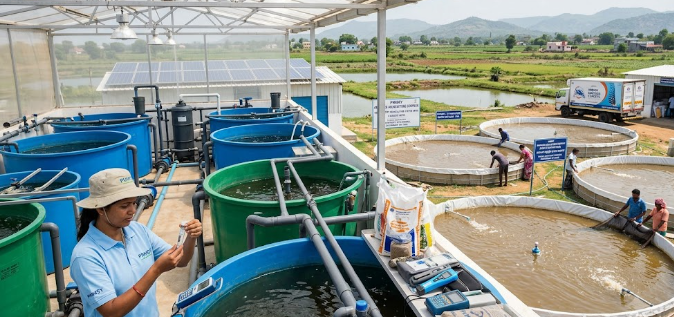
Technologies such as Recirculatory Aquaculture Systems (RAS) and Biofloc are emerging as important tools in this transition, enabling fish farmers to produce more in controlled environments while making better use of water and other resources. The shift is also opening new opportunities for rural businesses, employment and investment across the wider fisheries value chain.
The fisheries and aquaculture sector already plays a major role in India’s rural economy, supporting the livelihoods of nearly three crore fishers and fish farmers. Its economic footprint extends well beyond primary production, encompassing feed, equipment, processing, cold-chain infrastructure, transportation, packaging, retail and exports.
India is now the world’s second-largest fish producer, contributing around 8 per cent of global production. It is also the second-largest aquaculture producer, the world’s largest producer and exporter of shrimp and the second-largest producer in capture fisheries.
Sustained public investment has helped accelerate this growth. Since 2015, more than ₹39,272 crore has been approved or announced through various government initiatives aimed at strengthening fisheries infrastructure, improving production, encouraging technology adoption, expanding market access and boosting exports.
The results are reflected in the sector’s production performance. Annual fish production has more than doubled from 95.79 lakh tonnes in 2013-14 to a record 198 lakh tonnes in 2024-25. Inland fisheries and aquaculture have been at the centre of this expansion, with output increasing 147 per cent from 61.36 lakh tonnes to 151.60 lakh tonnes over the same period.
India’s seafood export performance has also strengthened considerably. Exports rose from ₹30,213 crore in 2013-14 to a record ₹73,890 crore in 2025-26, underlining the growing importance of fisheries to India’s export economy and its integration with global seafood markets.
Technology is now expected to play a larger role in sustaining this momentum. Under the Pradhan Mantri Matsya Sampada Yojana (PMMSY), RAS and Biofloc systems are helping shift aquaculture towards controlled, intensive and resource-efficient production.
RAS relies on water treatment and recirculation, enabling farms to reuse a large proportion of their water. The systems can recycle up to 90-95 per cent of water, reducing freshwater requirements and making aquaculture possible in locations where conventional farming may be difficult. Production units can also be established closer to urban consumption centres and major markets, potentially improving supply efficiency and reducing logistical distances.
Biofloc technology takes a different approach by using beneficial microorganisms to maintain water quality and support fish growth. The system can help farmers make more efficient use of resources while creating controlled production conditions.
Under PMMSY, 9,467 RAS units and 4,573 Biofloc units have been approved, backed by an investment of ₹4,120 crore. The expansion of these systems is helping promote year-round production and extend aquaculture beyond conventional farming regions.
The economic impact could extend well beyond fish farms themselves. As technology adoption increases, demand is likely to grow for aquaculture equipment, specialised feeds, water-treatment systems, farm automation, digital monitoring, cold storage, logistics, processing and technical services. This creates space for both established businesses and new rural enterprises to participate in the emerging aquaculture ecosystem.
Technology-led production could also strengthen India’s position in high-value seafood markets. Controlled farming environments can offer greater consistency in production, improved biosecurity and better traceability, all of which are becoming increasingly important as international markets place greater emphasis on quality and food safety.
The applications are expanding across different segments of aquaculture. RAS and Biofloc systems are being adopted for premium-value trout production in cold-water regions such as Jammu and Kashmir, Ladakh, Uttarakhand and Himachal Pradesh. They are also being used in shrimp farming in saline and brackish-water areas and in ornamental fish production, creating opportunities in specialised and higher-value markets.
The next phase of the sector’s development could see aquaculture increasingly integrated with digital technologies. Artificial intelligence, real-time monitoring, drones and renewable energy solutions have the potential to improve farm management, monitor water conditions, optimise resource use and reduce operating costs.
At the same time, greater diversification towards high-value species such as shrimp, trout, seabass, tilapia, murrel and pangasius could help farmers improve returns while expanding India’s presence in international seafood markets.
For the rural economy, the transformation carries significance beyond higher fish production. A stronger aquaculture industry can generate additional income opportunities, create skilled and semi-skilled jobs and stimulate demand for businesses involved in processing, storage, transportation and marketing. It can also provide farmers with alternatives to traditional sources of rural income.
As investment, technology and private-sector participation deepen, Indian aquaculture is gradually evolving from a largely traditional activity into a more organised and technology-driven industry. If supported by skills, infrastructure and efficient market linkages, this transformation could strengthen rural livelihoods, expand the seafood export base and establish fisheries as an even more important pillar of India’s emerging blue economy.