


Bengaluru, Sep 07: The Income Tax Department has conducted 304 outreach programmes since April 2026 across the country in English, Hindi and regional languages to familiarise taxpayers, professionals and other stakeholders with the Income Tax Act, 2025, Income Tax Rules, 2026 and the redesigned tax forms, said Ms. Pallavi Agarwal, IRS, Hon’ble Member, Central Board of Direct Taxes.
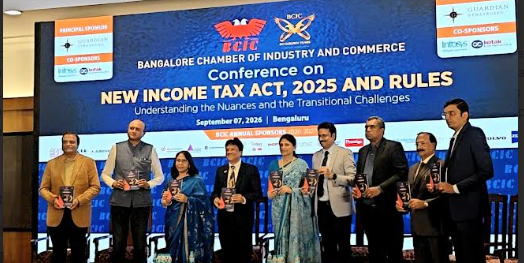
Ms. Agarwal was addressing the BCIC Conference on New Income Tax Act, 2025 and Rules- Understanding the Nuances and the Transitional Challenges, organised by the Bangalore Chamber of Industry and Commerce as part of its Golden Jubilee celebrations in Bengaluru.
“Tax law becomes genuinely simple when the taxpayer can understand what the law requires, the professional can advise with confidence and the administration can apply it consistently. The Income Tax Act, 2025 seeks to deliver this through a streamlined and modern tax framework that reduces the compliance burden, brings greater clarity and certainty and makes tax administration more citizen-centric and technology-driven,” said Ms. Pallavi Agarwal.
Delivering the keynote address, Ms. Vidisha Kalra, IRS, Principal Chief Commissioner of Income Tax, Karnataka and Goa Region, said the new tax framework was aimed at combining continuity and certainty in policy with greater simplicity and clarity.
“A fair, predictable and transparent tax system is the foundation of a confident business community. A tax law that is simple, transparent and understandable is itself an instrument of empowerment. When taxpayers understand what is expected of them, compliance becomes an act of participation rather than a burden,” she said.
Speaking at the Conference, CA K. Ravi, President, BCIC, said,
“BCIC’s 50th year reaffirms our commitment to strengthening industry and building meaningful industry-government partnerships. The new Income Tax Act is an important reform that can simplify compliance, reduce litigation and improve ease of doing business. Through this conference, we aim to help industry understand the new framework while creating a constructive platform for engagement with tax authorities.”
1.32 Crore Updated Returns Bring In ₹16,083 Crore Additional Tax
Highlighting the impact of recent reforms, Ms. Agarwal said more than 1.32 crore updated returns had been filed over the last four years, resulting in ₹16,083 crore in additional tax payments under the Department’s NUDGE campaign.
The new tax regime has also witnessed significant adoption. For Assessment Year 2026-27, more than 97% of ITR-1 and over 95% of ITR-2 returns were filed under the new regime. The Department also added 49 lakh first-time filers by July 31, 2026.
Technology-led tax administration has substantially improved processing efficiency. Of the returns furnished up to August 31, 2026, 2.54 crore, or 32.48%, were processed within one day of filing, while refunds were issued in respect of around 65 lakh returns. The Department currently interfaces with approximately 8 crore taxpayers and collects nearly 600 crore transaction details through mechanisms including TDS, Statement of Financial Transactions and the Annual Information Statement.
Taxpayer outreach is being supported by online utilities, multilingual publications, QR-enabled brochures and Samvaad video sessions. The Department’s AI-enabled virtual assistant Kar Sathi has recorded 54.83 lakh sessions on queries relating to the new Act, Rules and forms. Tax forms have also been re-engineered to become more user-friendly, standardised, interactive and pre-filled, with prefilled information now covering 12 data categories across ITR forms.
Karnataka Emerges as Second-Largest Direct Tax Contributor
Ms. Kalra said technology-driven, faceless and seamless systems had significantly enhanced transparency and reduced subjective discretion, while the emphasis on non-intrusive tax administration was helping foster voluntary compliance.
She also highlighted Karnataka’s growing contribution to direct tax collections, noting that the State had emerged as the second-largest direct tax contributor after Mumbai, with net tax collections already close to ₹1.25 lakh crore. She attributed the performance to strong economic activity, greater self-compliance, sectoral outreach, digital initiatives and improved guidance from tax professionals and industry bodies.
The conference began with a welcome address by CA K. Ravi, followed by opening remarks from Mr. Sunil Kumar Dhareshwar, Chairman, Direct Taxes Expert Committee, BCIC and a context-setting address by Dr. Sibichen K. Mathew, IRS (Retd.), Mentor, Direct Taxes Expert Committee, BCIC. The vote of thanks was proposed by Dr. Prashanth Reddy, Senior Vice President, BCIC.
The day-long programme covered the new Income Tax Act and Rules, undisclosed foreign asset holdings and the Black Money Act, organisational compliance requirements, transfer pricing, thin capitalisation, international taxation and Double Taxation Avoidance Agreements. It concluded with a panel discussion on direct taxation trends and suggestions for future changes. The dignitaries launched, Changover 2026, handbook which highlights FAQs on the interplay and transition between the Income-tax 1961 and Income-tax Act, 2025.
The conference highlighted the importance of sustained engagement between the tax administration, industry and professionals as businesses transition to the new framework, with the broader objective of improving predictability, reducing compliance friction and strengthening voluntary compliance.