


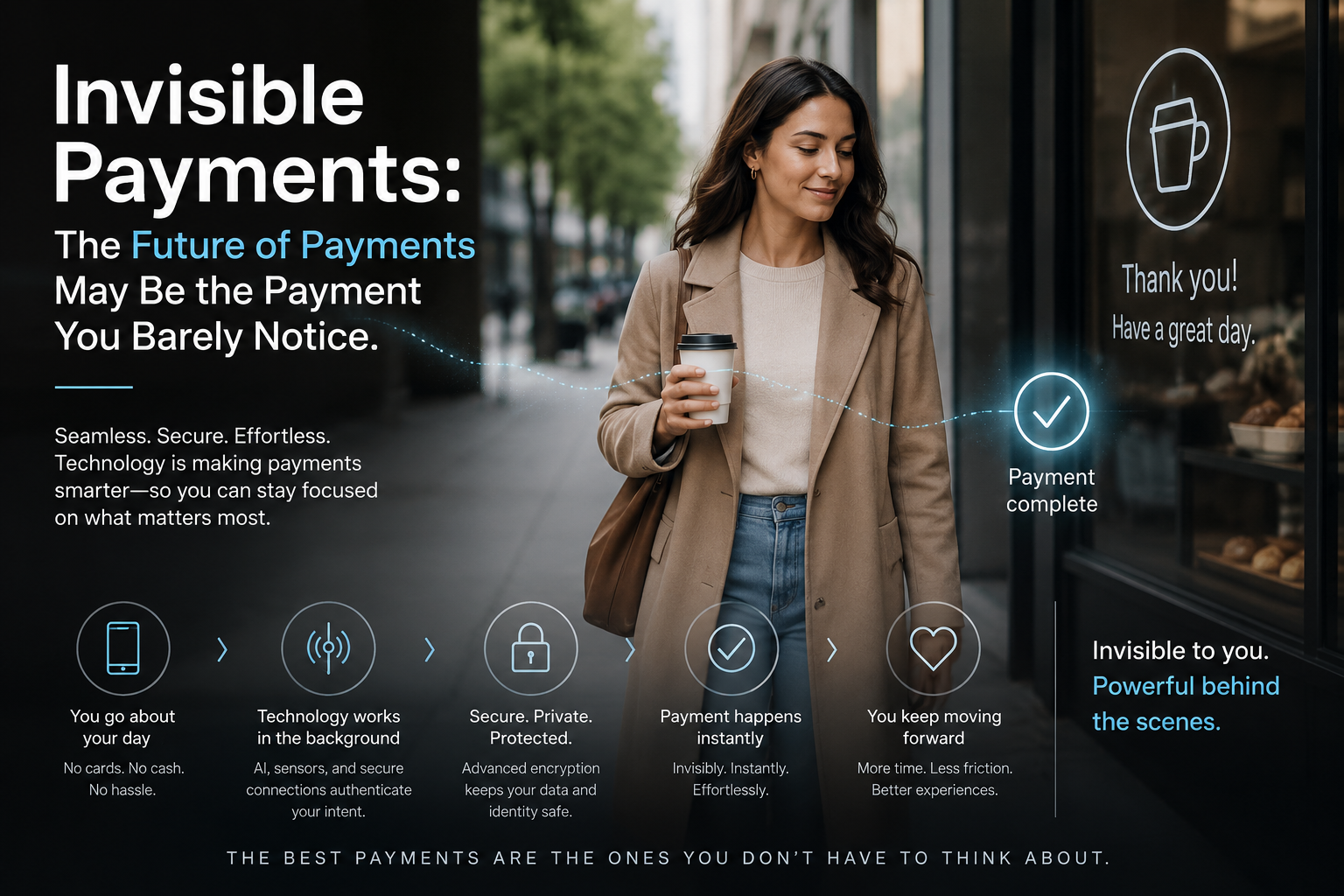
Sept 03: The next big change in payments may not be a new wallet, card or payment app. It may be the gradual disappearance of the payment itself.
The scale of digital connectivity makes that possible. The World Bank’s Global Findex Database 2025, based on surveys of about 148,000 adults across 141 economies, found that 86% of adults worldwide own a mobile phone. The report also tracks internet use, digital payments and digital safety, showing how closely financial behaviour is becoming linked to connected technology.
For consumers, the change is already visible. A tap can replace a card swipe. A stored payment method can eliminate checkout forms. A subscription can renew automatically. A ride can end with the fare being charged without the passenger doing anything at all.
The next stage is to take that convenience much further.
What Are Invisible Payments?
Invisible payments are transactions designed to happen with minimal interruption to the customer.
Instead of treating payment as a separate step, businesses build it into the overall experience. Customers authorize a payment method, set certain permissions or spending limits, and technology handles subsequent transactions according to those conditions.
Digital wallets, tokenization, recurring payments, biometric authentication and embedded finance are all contributing to this shift.
The objective is simple: make paying easier without making financial control harder.
From Traditional to Invisible Payments
The evolution can be understood in four stages:
| Payment model | Customer experience | Typical example |
|---|---|---|
| Traditional payment | Customer actively completes every transaction | Cash or card at checkout |
| Digital payment | Customer uses a phone, card or wallet | QR or contactless payment |
| Embedded payment | Payment is built into another service | Ride-hailing or food delivery |
| Invisible payment | Payment happens automatically within agreed rules | Automatic parking or AI-assisted purchases |
The technology becomes more sophisticated at every stage, but the customer interaction becomes smaller.
That reversal is what makes invisible payments particularly interesting.
India Is Already Showing What Comes Next
India offers one of the clearest examples of how quickly payment behaviour can change when the infrastructure is simple enough.
UPI has made instant digital payments part of everyday commerce, from large online purchases to small transactions at local businesses.
The numbers underline the scale. UPI processed 24.51 billion transactions worth ₹29.82 trillion in August 2026, according to Reuters.
But the more interesting development may be what comes next.
India is preparing a framework that could allow AI agents to make certain small, routine payments without requiring approval for every individual transaction. The proposed system is expected to incorporate features such as spending limits, identity checks, audit trails and rule-based instructions.
That could move payments from something people initiate to something digital systems execute on their behalf.
The Rise of Pay-Without-Thinking
Contactless payments were an early step in this direction.
A customer taps a card or phone, waits a second or two and walks away. The payment is still visible, but it barely interrupts the purchase.
Invisible payments push the idea further.
Imagine entering a parking facility, having your vehicle recognized and being charged automatically when you leave. Or checking into a hotel with a pre-authorized payment method that covers approved purchases during the stay.
The customer experience becomes almost continuous.
Embedded Payments Are Changing FinTech
The payment industry is increasingly moving away from standalone transactions and toward embedded experiences.
A mobility application does not simply connect passengers with drivers. It can handle booking, authentication, payment and receipts within the same journey.
The same model works in food delivery, travel, e-commerce, insurance and digital subscriptions.
This means FinTech is increasingly becoming infrastructure rather than the product customers consciously interact with.
For businesses, that distinction matters. Payment can become part of the customer experience instead of an obstacle between the customer and the product.
Tokenization Is Quietly Building the Infrastructure
Much of this experience depends on technology consumers rarely see.
Tokenization is one important piece of that infrastructure. The Bank for International Settlements has examined how tokenisation can support new payment and financial use cases, including programmable transactions and more integrated settlement processes.
The potential is significant because tokenized systems can connect payment instructions, asset transfers and settlement more closely together.
For consumers, however, the technology may remain almost invisible.
And that is exactly what makes it useful.
AI Could Turn Payments Into Decisions
Artificial intelligence could take invisible payments beyond automation and into decision-making.
Consider an AI travel assistant that books a cab when a flight lands late, orders groceries when household supplies fall below a chosen threshold or completes a purchase when a product reaches a specified price.
The important distinction is that the AI does not necessarily receive unlimited financial freedom.
Instead, consumers could provide rules: what can be purchased, how much can be spent, when transactions can happen and which merchants or categories are allowed.
India’s emerging agentic-payment framework illustrates this direction, with proposed controls around spending limits, identity and auditability.
The payment then becomes an outcome of a decision rather than the decision itself.
Convenience Cannot Replace Control
There is a serious challenge hidden inside all this convenience.
The easier it becomes to make payments, the easier it can become to lose sight of them.
A physical card transaction has a clear moment of action. An automatic transaction can happen while the customer is doing something else.
That makes transparency essential.
Consumers will need clear notifications, transaction histories, spending controls and straightforward ways to stop or challenge payments. Businesses, banks and payment networks will also have to maintain strong authentication and fraud controls.
The future of payments cannot simply be frictionless. It needs to be controllable.
Trust Will Decide How Far Invisible Payments Go
Technology can make an automatic payment possible. Trust will determine whether people are comfortable using it.
This becomes even more important when payment systems interact with AI agents, connected cars, wearable devices and smart-home systems.
The Bank for International Settlements has repeatedly highlighted the importance of balancing innovation with safety, sound governance and trust in the financial system as digitalisation and tokenisation develop.
In other words, invisible payments can only become mainstream if the invisible infrastructure is highly trustworthy.
Retail Could Lose the Traditional Checkout
Retail may be one of the biggest beneficiaries.
The traditional shopping journey has a clearly defined payment stage: customers select products, reach the checkout, scan or present their items and pay.
Technology is steadily breaking that sequence apart.
Smart carts, mobile applications, RFID, computer vision and automated billing can reduce the number of steps required to complete a purchase.
The long-term possibility is a retail experience where customers simply select what they want and leave, with payment handled automatically.
The checkout would not disappear because payment stopped mattering. It would disappear because payment became integrated into the shopping experience.
Travel Is Another Natural Testing Ground
Travel involves multiple payments during a single journey.
A traveller may pay for transportation, parking, accommodation, meals, attractions and other services, often across different platforms.
Invisible payments could connect some of those transactions through a common digital identity or wallet.
A hotel could handle approved incidental charges automatically. A parking system could identify a vehicle and charge the linked account. A travel platform could process several services without repeatedly asking the traveller to enter payment details.
The result is not simply faster payment. It is a smoother journey.
Small Businesses Can Benefit Too
Invisible payments are not necessarily limited to large technology companies.
Small businesses are already adopting QR payments, digital invoices, payment links, recurring billing and mobile-based payment tools.
As these technologies become easier to integrate, smaller merchants could offer customers more seamless payment experiences without building sophisticated financial infrastructure themselves.
That could make payment experience another area in which smaller businesses compete on convenience rather than simply price.
Payments Are Becoming Part of the Product
Perhaps the most important change is that payment is increasingly being treated as part of product design.
A ride-hailing service, for example, is not only about finding a driver. Booking, authentication, payment and receipts are all part of the experience.
The same applies to food delivery, online shopping, travel and subscription services.
When payment is difficult, it creates friction. When it works naturally, customers barely notice it.
That makes payment technology a customer-experience issue as much as a financial-services issue.
The Business Opportunity Is Bigger Than Faster Checkout
For businesses, invisible payments could influence more than transaction speed.
A smoother payment experience can reduce abandoned purchases, simplify repeat transactions and make recurring services easier to use.
It can also create opportunities for businesses to build more personalized services around customer preferences and pre-approved payment rules.
But the winning companies will not necessarily be those that automate everything.
They will be the ones that automate the right things while giving customers enough visibility and control to remain comfortable.
The Future May Be Designed Around Less Friction
Payment innovation has traditionally focused on making transactions faster.
The next phase is likely to focus on making them less noticeable.
The World Bank’s latest Global Findex data shows how deeply mobile connectivity is now connected with financial behaviour. India’s enormous UPI volumes show how quickly consumers can adapt to instant digital payments. And the emergence of agentic payments points toward a future in which software may increasingly act on behalf of the customer.
The payment of the future may happen when a customer parks a car, books a room, buys groceries or asks an AI assistant to handle an everyday task.
There may be no separate checkout moment.
No card to pull out.
No payment screen to interrupt the experience.
Just a transaction happening quietly in the background.
That may be the real evolution of FinTech: not simply making payments faster, but making them so seamlessly integrated that the payment itself becomes almost invisible.