


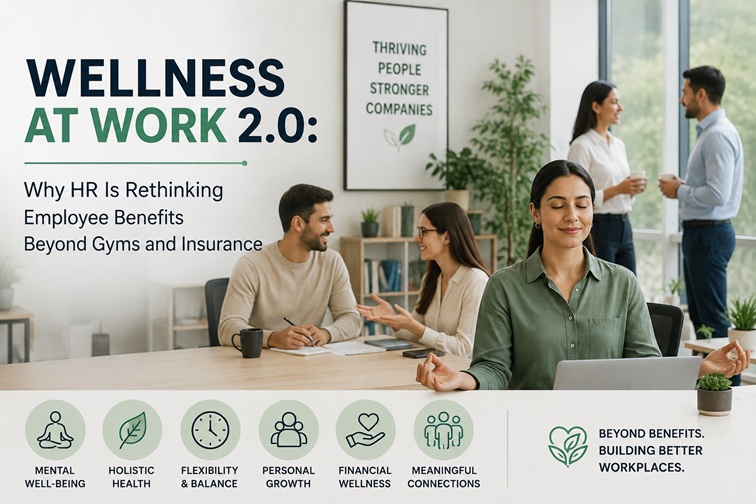
Aug 27: For years, employee wellness programmes were largely associated with health insurance, gym memberships, annual health check-ups and fitness activities. Those benefits still matter, but the definition of workplace wellbeing is changing.
For HR leaders, employee wellbeing is increasingly connected to mental health, financial security, flexibility, workload, caregiving, career development and workplace culture. This is creating a new model of Wellness at Work 2.0, where benefits are designed around the broader employee experience rather than physical health alone.
The shift comes at a time when employee engagement remains a major challenge. Gallup’s State of the Global Workplace 2026 found that only 20% of employees globally were engaged at work in 2025, while 34% were classified as thriving in their lives. The findings highlight the challenge facing employers: offering benefits is not enough if employees do not feel supported in their everyday working lives.
For HR departments, the question is increasingly moving from “What benefits should we offer?” to “What do our employees actually need to thrive?”
Mental Health Is Becoming a Core HR Priority
Mental health has moved from being a specialist employee benefit to becoming an important part of workforce strategy.
Employee assistance programmes and counselling services are increasingly being complemented by mental-health awareness, manager training, psychological safety and workload management.
The World Health Organization estimates that depression and anxiety result in around 12 billion lost working days every year, costing the global economy approximately US$1 trillion annually in lost productivity.
For HR teams, the message is significant. Mental wellbeing cannot be separated from workforce performance. Burnout, absenteeism, disengagement and employee turnover can all create costs for organisations.
This means HR leaders need to look beyond offering access to counselling and examine the workplace conditions that can contribute to stress in the first place.
Financial Wellness Is Moving Up the Benefits Agenda
Financial stress can affect employees even when they receive competitive salaries and conventional healthcare benefits.
Rising living costs, debt, emergency expenses, housing costs and retirement concerns can all affect an employee’s sense of security.
The Bank of America 2026 Workplace Benefits Report found that employee financial wellbeing had reached a four-year high, although cost-of-living pressures, inflation and economic uncertainty continued to create challenges for workers.
For HR departments, financial wellness can therefore become an important part of the broader benefits strategy.
Companies can provide employees with access to financial education, retirement planning, debt-management resources, emergency savings support and financial guidance.
The objective is not for employers to manage employees’ finances. Rather, it is to give employees practical resources that can help them make informed decisions and reduce financial stress.
Flexible Working Is Also a Wellness Benefit
Flexible working was once primarily viewed as a recruitment and retention tool. Today, it is increasingly connected to wellbeing.
Hybrid work, flexible schedules and greater autonomy can help employees manage commuting, family responsibilities and personal commitments.
However, flexibility can also create new challenges when employees feel they must remain connected outside normal working hours.
HR therefore has an important role in establishing healthy boundaries around flexible work. Clear communication expectations, manageable workloads, reasonable meeting schedules and protected time off can help prevent flexibility from turning into constant availability.
The focus is shifting from simply asking where employees work to asking how work can be structured sustainably.
Caregiving Support Can Help Retain Talent
Employees bring responsibilities from their personal lives into the workplace.
Parents and employees caring for ageing family members can face considerable pressure when organisations provide little flexibility.
HR teams are consequently paying greater attention to benefits such as parental leave, childcare assistance, eldercare support, caregiver leave and flexible schedules.
These policies can also have a direct connection to retention.
An experienced employee who cannot balance work with caregiving responsibilities may eventually reduce their working hours or leave the organisation. Providing practical support can help employers retain valuable talent while creating a more inclusive employee experience.
Personalised Benefits Are Replacing the One-Size-Fits-All Approach
Another defining feature of Wellness 2.0 is personalisation.
Employees at different stages of life do not necessarily value the same benefits. A younger employee may prioritise professional development, mental-health support and flexible working. A parent may place greater value on childcare and family support, while another employee may prioritise healthcare or retirement planning.
A standard benefits package may therefore fail to deliver equal value across the workforce.
Flexible benefits allow employees to choose options that are more relevant to their circumstances. For HR teams, this can make benefits spending more effective while potentially improving employee satisfaction and utilisation.
The goal is not necessarily to offer more benefits. It is to offer more relevant benefits.
Managers Are Part of the Wellness Strategy
HR cannot create a healthy workplace through benefits alone.
Managers have a major influence on employees’ daily experiences. Their approach to workloads, communication, recognition, flexibility and feedback can directly affect wellbeing.
This makes manager capability a crucial part of Wellness 2.0.
HR teams can train managers to recognise signs of excessive stress, have supportive conversations, manage workloads and encourage employees to use available resources.
This is particularly important because employees may interact with their managers every day, while they may access formal wellness benefits only occasionally.
A supportive manager can therefore be one of the most important components of an effective workplace wellbeing strategy.
Wellness Must Be Built Into Workplace Culture
One of the biggest mistakes organisations can make is treating wellness as a collection of perks.
A company can provide gym memberships, meditation apps and health insurance while employees continue to face excessive workloads, poor communication or limited career opportunities.
Wellness needs to be supported by the way an organisation operates.
That means HR leaders need to examine workload, leadership behaviour, career development, recognition, autonomy, psychological safety and work-life boundaries.
The World Health Organization’s guidance on mental health at work similarly highlights the importance of addressing organisational conditions and psychosocial risks alongside individual support.
The lesson for HR is straightforward: a wellness programme cannot compensate indefinitely for an unhealthy workplace culture.
What Wellness 2.0 Means for HR Leaders
Moving towards a more holistic benefits strategy does not necessarily require organisations to introduce dozens of new programmes.
HR leaders can start with a few practical steps:
- Listen to employees: Use surveys, focus groups and feedback channels to identify the issues employees actually face.
- Review benefits utilisation: Identify which benefits are being used and which are failing to reach employees.
- Segment employee needs: Consider different requirements across age groups, career stages and personal circumstances.
- Train managers: Make wellbeing part of leadership and people-management training.
- Review workplace practices: Examine workload, flexibility, communication and time-off policies.
- Measure outcomes: Connect wellness initiatives with engagement, retention, absenteeism and employee satisfaction.
- Communicate benefits clearly: A valuable benefit has little impact if employees do not understand that it exists or how to access it.
This approach allows HR teams to move from simply managing benefits to strategically managing employee wellbeing.
HR Needs to Measure Outcomes, Not Just Participation
Wellness programmes also need better measurement.
Counting registrations for a wellness app or the number of employees attending a fitness programme provides useful information, but it does not necessarily show whether wellbeing has improved.
HR departments can monitor broader indicators such as:
- Employee engagement
- Retention and turnover
- Absenteeism
- Employee wellbeing scores
- Benefits utilisation
- Employee satisfaction
- Productivity
- Internal mobility
- Manager effectiveness
- Feedback on individual benefits
The objective is to understand whether wellness investments are producing meaningful improvements in the employee experience.
This can also help HR teams make better decisions about where to increase, reduce or redirect benefits spending.
The Future of Employee Benefits Is About Relevance
Wellness at Work 2.0 does not mean abandoning traditional benefits such as health insurance or fitness programmes. Instead, it recognises that physical health is only one part of employee wellbeing.
Mental health, financial security, flexibility, caregiving, career development and workplace culture are increasingly interconnected.
For HR leaders, the challenge is not simply to offer more benefits. It is to understand which benefits solve genuine employee problems and ensure that those benefits are supported by healthy workplace practices.
Gallup’s engagement findings, WHO’s research on workplace mental health and Bank of America’s research into financial wellbeing all point towards a broader understanding of what employees need from their employers.
The next generation of employee benefits will therefore be judged less by the number of perks on offer and more by their relevance, accessibility and impact.
Ultimately, Wellness at Work 2.0 is not simply a wellness programme. It is becoming a strategic part of employee experience, talent retention, organisational culture and the future of HR.