


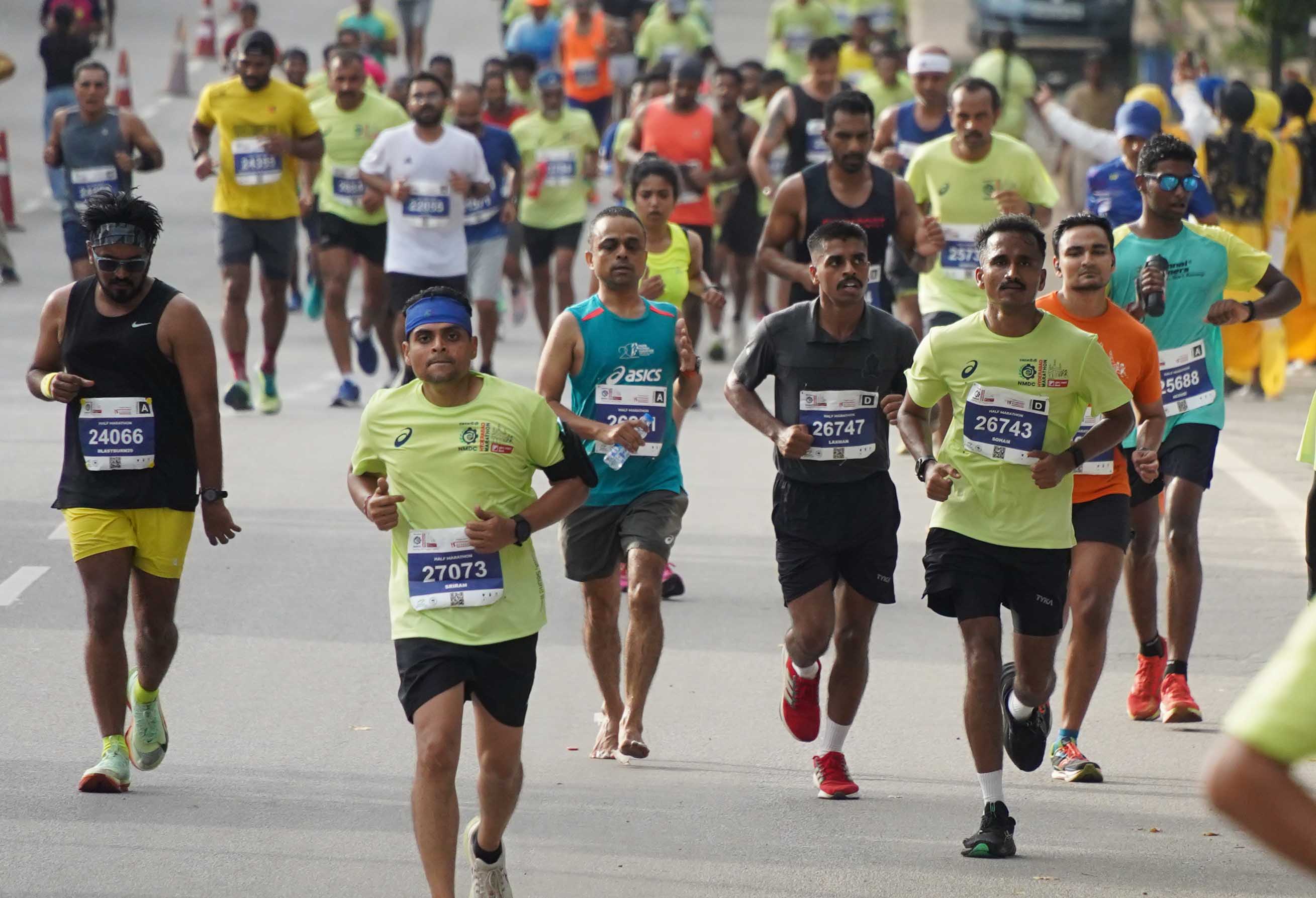
Hyderabad, Aug 26…..There was a time when walking was simply something people did. Today, in many parts of the world, walking has become a public-health strategy.
Governments are encouraging people to walk, cycle, use active transport and move more—not merely to become fitter, but to prevent disease, reduce healthcare burdens, improve mental well-being and make cities more liveable.
The question now is: What comes after walking? What else, may be, running.
It is a well-known fact that every runner starts as a walker. As the world confronts an epidemic of physical inactivity, could Telangana become a state that takes the next step and makes running a mass public-health movement?
The World Health Organization estimates that nearly 1.8 billion adults—31% of the world’s adult population—were insufficiently physically active in 2022. If current trends continue, that figure could rise to 35% by 2030. Physical inactivity is associated with increased risks of cardiovascular disease, type 2 diabetes, some cancers, depression and anxiety.
The WHO recommends that adults undertake at least 150–300 minutes of moderate-intensity physical activity a week, or 75–150 minutes of vigorous activity, or an equivalent combination. Running falls squarely within that vigorous-intensity category.
The message, therefore, is not that everybody needs to become a marathon runner. It is much simpler: People need to move. And running can be one of the most accessible next steps after walking.
Countries have demonstrated that governments can influence people’s physical-activity habits through public campaigns, technology, incentives, infrastructure and community participation.
Singapore’s National Steps Challenge, for example, used technology, behavioural nudges, rewards and community participation to encourage people to walk more. Its first season attracted 156,000 participants, while the second crossed 350,000 adult participants.
Public health does not always have to begin in a hospital. It can begin in a park, on a pavement or on a running track. Walking may be the entry point. Running can become the progression.
Hyderabad has already shown that it can work. Hyderabad provides an interesting case study.
Hyderabad Runners, founded in 2007, describes itself as India’s first group to institutionalise running. Its stated mission is to make running a preferred form of exercise and create a “fit, athletic and active Hyderabad.” The organisation combines advocacy, training and events, and has built a network of more than 30 running groups across Hyderabad and Secunderabad.
This is significant because running has moved beyond being an individual pursuit. It has become a community activity.
People meet before sunrise. They train together. Beginners are mentored by experienced runners. Families participate. Colleagues become running partners. And a person who once struggled to walk a few kilometres can eventually find themselves standing at the start line of a 5K, 10K, half marathon or even a full marathon.
Hyderabad Runners’ own FAQ makes the philosophy particularly accessible: people who only walk are welcome, and beginners can start through its Couch to 5K programme.
The most compelling argument for running as public health may not come from statistics, but from people who have actually made the transition.
Take Chandrashekhar Pannala of LB Nagar Runners. After becoming inactive for several years, his weight had reached 123.5 kg. In June 2024, he restarted with walking. He progressed to brisk walking and eventually joined Hyderabad Runners’ Couch to 5K programme in December 2024.
By April 2025, he had become an active runner. He subsequently completed the half marathon at the NMDC Hyderabad Marathon 2025 in 2:25:00 and lost 25.2 kg during the journey. It is quite natural, the Walker, tuns slowly into brisk walker, then beginner runner and the distance runner.
Then there is Venkat Madapala, who began his running journey through Hyderabad Runners’ Couch to 5K programme in 2017. His first steps were modest: a 5K graduation run. Then came the 10K, half marathon and eventually the marathon. In his own account, he describes how running transformed his life and brought him “so many friends and well wishers.” He has since mentored other runners as well.
Payal Chitranshi, a practicing ENT surgeon, offers another example. She began with Couch to 5K, completed her graduation 5K in February 2025, progressed to a 10K at the NMDC Hyderabad Marathon and then completed her first half marathon at Club Run 2026. She credits the support of coaches and the camaraderie of fellow runners for helping her progress.
These stories reveal something important: The biggest barrier to running is often not physical ability. It is the belief that “I am not a runner.” Running need not begin with running. This is where public policy can make a difference.
A government campaign promoting running need not tell an overweight 50-year-old, a sedentary office worker or a person who has never exercised to suddenly run 5 kilometres.
It could begin with something as simple as: Walk for 10 minutes. Walk faster. Alternate walking with jogging. Jog for a minute. Run for two minutes. Gradually increase the running and reduce the walking. That is how a walker becomes a runner—one small step at a time.
The WHO itself emphasises that some physical activity is better than none and recommends that people who are inactive begin with small amounts and progressively increase frequency, intensity and duration.
Could Telangana create a “Run Telangana” movement? Telangana has an opportunity to think beyond organising occasional sporting events. What if running were treated as part of the state’s preventive-health strategy?
Hyderabad alone has developed a remarkably vibrant running calendar. In 2026, running-event platforms list more than 20 organised public races and runs in the city, ranging from 2K and 3K community runs to 5K, 10K, 16K, half marathons and full marathons.
There are many other than those listed and that number could be another 50. Events such as the SBI Green Marathon, Freshathon, Yuva Bharat Run, Thalassemia Run, Whitathon, Telangana Run, FinRun, Hyderabad City Slam, Mana Run, NMDC Hyderabad Marathon, Global Grace Cancer Run, Times Internet Hyderabad Half Marathon and Hyderabad Hitec Marathon, among several corporate and community runs, demonstrate the sheer variety of running initiatives taking place through the year. The exact number varies across event platforms because they include different categories of runs and sometimes duplicate listings, but the larger message is clear: Hyderabad has a running event almost every few weeks.
And this movement is no longer confined to Hyderabad. The Society for Telangana Runners has launched the Telangana Run Tour to take organised running into the districts, with events across places such as Jangaon, Gajwel, Godavarikhani, Kamareddy, Nalgonda, Jadcherla, Siddipet, Karimnagar and Nizamabad. The scale of the NMDC Hyderabad Marathon further demonstrates the appetite for running: its 15th edition on August 29–30, 2026, is expected to bring together more than 32,000 participants across the 5K, 10K, half marathon and full marathon categories. Hyderabad Runners, meanwhile, has built a year-round ecosystem of running groups, training programmes, Sunday Long Runs and community activities. We therefore do not need to create a running movement from scratch. Telangana already has one.
The opportunity now is to connect the dots. Running clubs, schools, workplaces, hospitals, municipalities, parks, sporting organisations and government departments can come together to transform this growing running culture into a structured public-health movement. Instead of viewing running events merely as sporting or recreational activities, Telangana could use them as platforms for preventive healthcare—encouraging people to move from walking to jogging, from jogging to running and, most importantly, from inactivity to an active lifestyle. The question is no longer whether Telangana has a running movement; it is whether the state can turn that movement into a Running State.
A “Run Telangana” initiative could bring together the Health, Sports, Municipal Administration, Education, Transport and IT departments, along with running clubs, corporates, schools, hospitals and civil-society organisations.
The objective would not be to create thousands of marathoners. It would be to create millions of people who move regularly. The programme could have several simple pillars:
Run Schools – introduce age-appropriate running and movement programmes in schools. Run at Work – encourage workplaces to create walking/running clubs and active breaks. Run Your Neighbourhood – develop community running groups in colonies, gated communities and municipalities. Couch to 5K Telangana – create a free, standardised beginner programme for people who currently do little or no exercise. Safe Running Routes – identify and develop safe early-morning and evening routes in cities and towns. Run with Your Doctor – hospitals and healthcare professionals could encourage appropriate physical activity as part of preventive health conversations. Run for Every Age – programmes for children, young adults, women, senior citizens and beginners, with different levels of intensity. District Running Days – a monthly or quarterly community run across Telangana’s districts.
From an event to an ecosystem
Telangana already has an important asset in Hyderabad Runners Society and the culture that has grown around the NMDC Hyderabad Marathon.
Hyderabad Runners says its flagship marathon has been running since 2011, while its broader objective is to reach every corner of Hyderabad and create a fit, athletic and active city.
Its experience suggests that the real power of running lies not in the race itself, but in what happens between races. The training. The friendships. The accountability. The early-morning routine. And the transformation.
That is why a marathon should not be viewed merely as a one-day sporting event. It can become the celebration of a year-long public-health movement.
Running can build healthier cities too There is another dimension. A running-friendly city is likely to be a people-friendly city. Better footpaths. Safer crossings. Better lighting. Open spaces. Parks. Traffic-calmed neighbourhoods. Accessible public spaces.
The same infrastructure that enables someone to run can enable an elderly person to walk, a child to cycle and a family to spend time outdoors.
WHO has emphasised that increasing physical activity requires more than individual motivation. It requires environments that make it easier and safer for people to be active. So the running agenda can become an urban-planning agenda too.
Can Running be India’s next public-health movement? India has successfully built mass movements around many public causes.
Why not movement itself? We already have millions of people who walk. We have thousands who run. We have hundreds of running clubs and increasingly popular city races. The missing link may simply be a public-health framework that connects them. Walking can be the beginning.
Running can be the next step. And the marathon can be the destination—not the requirement.
The objective should be much bigger: Not everyone needs to run a marathon. But everyone should have an opportunity to become more active. Perhaps Telangana can take the lead by making that opportunity universal. And perhaps the slogan for such a movement could be as simple as: EVERY RUNNER STARTS AS A WALKER. The question is no longer whether running can be promoted as a sport.
The more important question is whether running can be promoted as preventive healthcare.
If countries can create national movements around walking, cycling and active mobility, perhaps India can take the next step. Can Running be India’s next Public Health Movement? And can Telangana be the state that starts it? And why not?