


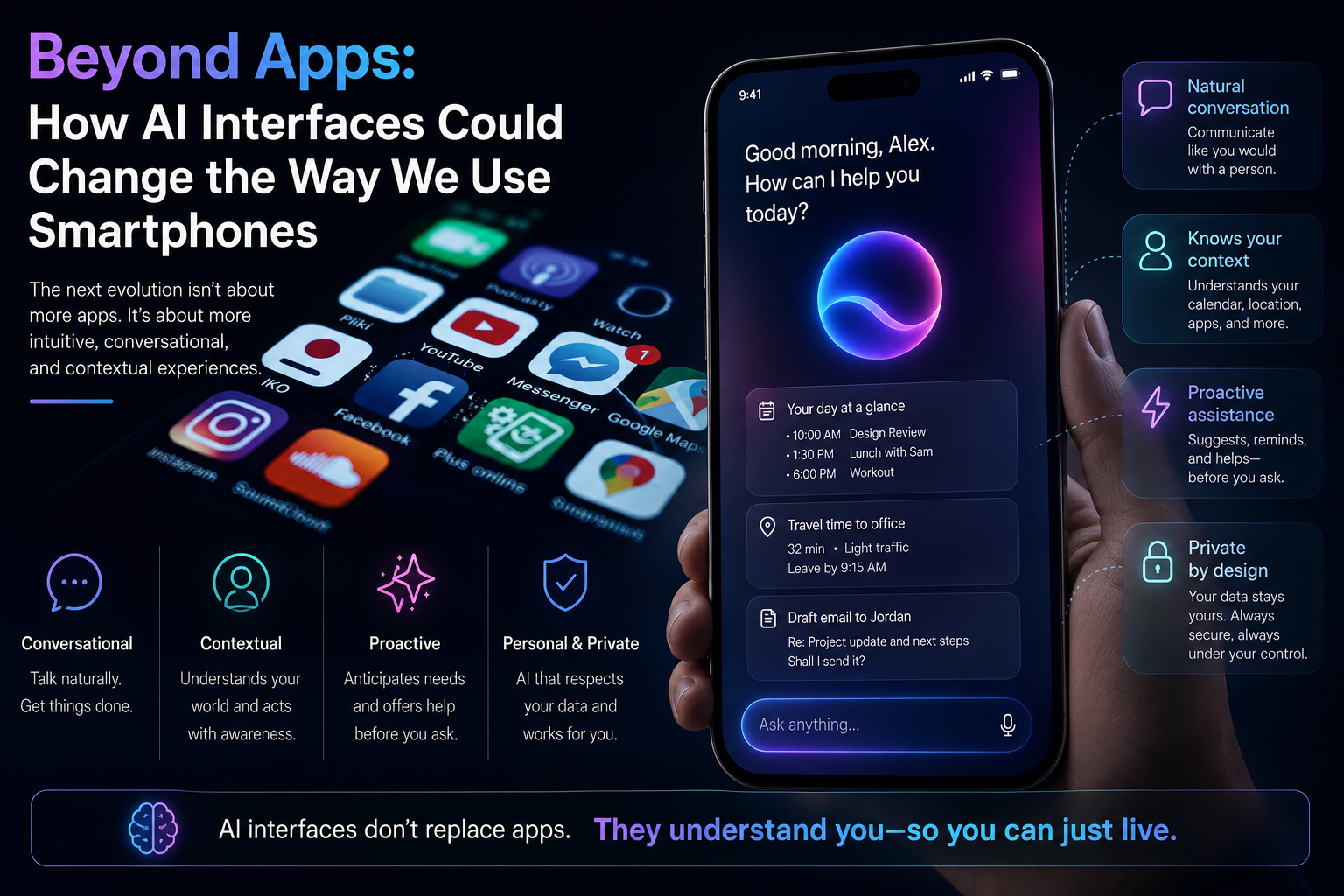
Aug 25: For more than a decade, smartphones have been built around a simple routine: find the app, open it and complete the task. Whether it is ordering food, booking a cab, transferring money or shopping online, users have become accustomed to moving between multiple applications.
Artificial intelligence could now change that behaviour.
Instead of asking users to find the right app, AI-powered interfaces are beginning to let people describe what they want and have technology work out how to complete the task. The shift could gradually transform the smartphone from a collection of applications into a more intelligent interface connecting users with digital services.
From Apps to Intent
The biggest change could be the move from app-based interaction to intent-based interaction.
Today, someone looking for a restaurant might open a maps app, compare ratings, check menus and then move to another platform to make a reservation.
An AI interface could eventually allow the user to simply say, “Find a highly rated restaurant nearby and book a table for two tonight.”
The user communicates the outcome rather than figuring out which application to use.
Deloitte has described this as a potential new interaction paradigm, noting that generative AI could make smartphones more personalised and aware of user interactions and intentions. Its research suggests that AI could allow smartphones to move from simply running apps to understanding context and acting on a user’s behalf.
The Smartphone Is Becoming an AI Platform
The shift is already becoming visible in the smartphone market.
Deloitte has predicted that generative AI could make smartphones more personalised through conversational interfaces and agentic capabilities. The report also highlights how on-device AI could allow smartphones to understand context without every interaction necessarily depending on cloud-based systems.
Meanwhile, Google’s 2026 Android announcements show how quickly this idea is moving from concept to product development. Google has described Android’s transition toward an “intelligence system” designed to take a user’s intention and turn it into action.
From Opening Apps to Giving Instructions
Traditional smartphone interfaces require users to understand how a service works.
AI could reverse that relationship.
Instead of knowing which application provides a particular service, users could simply describe their objective.
Imagine saying:
“I need to reach the airport by 6 p.m. tomorrow. Tell me when I should leave and arrange a cab.”
An intelligent assistant could potentially combine information about the user’s calendar, location, traffic and transportation services to help complete the task.
Deloitte has already used a similar scenario to illustrate how an on-device AI system could understand an appointment, the user’s location and the best route to determine when someone should leave.
This is where AI agents could become particularly important. They are designed not merely to answer questions but to carry out multiple steps on a user’s behalf.
Google Is Already Testing the App-Less Experience
The shift is no longer entirely theoretical.
Google has introduced agentic capabilities that allow Gemini on Android to handle multi-step tasks. In an early 2026 preview, Gemini was shown handling tasks such as booking a ride or reordering food, while running the relevant app in a controlled virtual window.
Google has also expanded Gemini’s capabilities in Chrome on Android. Its agentic browsing features can handle tasks such as booking parking, updating recurring orders and organising travel, with confirmation required for some sensitive actions.
That is an important change in smartphone behaviour: the user does not necessarily need to manually navigate every step of the process.
AI Could Become the New Front Door to Apps
If AI becomes the primary interface, apps may not disappear. Their role could simply change.
A travel application, for example, could continue providing flights and hotel inventory in the background, while an AI assistant becomes the layer through which the customer discovers and books the service.
This could create a new form of competition for businesses.
Deloitte’s 2026 research on agentic commerce found that 55% of consumers were starting their shopping journeys through large language models, suggesting that AI is already becoming an important discovery layer for products and services.
That could eventually make AI recommendation visibility as important as traditional search visibility.
The “Algorithmic Shelf” Could Replace Part of the Digital Shelf
For years, businesses have competed to appear prominently in search results, app stores and online marketplaces.
AI agents could create another layer: the algorithmic shelf.
When a consumer asks an AI to find a product, restaurant, hotel or service, the system may evaluate multiple options before presenting a recommendation.
Deloitte argues that businesses will increasingly need to provide machine-readable, verifiable information that AI agents can understand and trust.
That could change digital marketing significantly.
The question for a brand may no longer be only:
“How do we get the customer to visit our app?”
It could become:
“How do we make sure an AI recommends our service?”
Apps Are Not Going Away—But Their Role Could Change
Despite the excitement around AI interfaces, it would be premature to declare the end of apps.
Dedicated applications remain valuable for activities requiring detailed controls and immersive experiences. Gaming, video editing, photography, banking and social networking may continue to benefit from specialised interfaces.
A more realistic scenario is coexistence.
Users could rely on AI for routine or multi-step requests while continuing to open apps when they want greater control.
The change may therefore be less about having fewer apps and more about switching between them less frequently.
Smartphones Could Become More Proactive
AI could also make smartphones more proactive.
Instead of waiting for users to open an app or issue a command, AI systems could increasingly understand context and surface relevant information.
Google’s Android Halo concept points in this direction. It is designed to show users what an AI agent is doing directly from the top of the phone screen, allowing them to monitor an agent’s progress without leaving what they are currently doing.
This represents a subtle but important shift.
The smartphone could become less of a device users constantly operate and more of a system that works in the background when authorised to do so.
Privacy Could Decide How Far AI Goes
There is, however, a major obstacle: trust.
An AI assistant capable of organising schedules, making purchases, booking travel and managing communications could potentially have access to enormous amounts of personal information.
That raises questions about data protection, security and user control.
There is also an important difference between an AI that provides information and one that takes action. If an AI can actually make a purchase or book a service, mistakes could have real consequences.
Deloitte has highlighted the importance of governance and trust as digital channels become more agentic, with organisations needing systems that allow AI agents to operate while maintaining appropriate control and compliance.
Apple Is Taking a Different Route
The transformation is not limited to Android.
Apple announced in June 2026 that its next generation of Apple Intelligence would integrate AI more deeply across its platforms, including the iPhone. The company said its architecture is designed to make everyday apps and experiences more personalised while maintaining a strong focus on privacy.
This suggests that the future may not necessarily eliminate apps. Instead, AI could become a layer running across them, making existing applications smarter and reducing the amount of manual navigation required.
What It Means for Businesses
The AI-first smartphone could fundamentally change digital strategy.
For years, companies have invested in apps, search optimisation, advertising and customer engagement. As AI agents become more capable, businesses may also need to make their services easier for AI systems to discover, understand and access.
This means APIs, structured information, accurate product data and clear permissions could become increasingly important.
Deloitte’s 2026 research on retail and consumer products found that 50%–60% of surveyed companies were already piloting agentic-commerce capabilities, while many were prioritising API readiness.
The message for businesses is clear: preparing for an AI-first customer journey may require more than simply adding a chatbot to an existing website or app.
The Smartphone May Become an Intelligent Gateway
The smartphone is unlikely to become less important because of AI. It could become more useful while requiring less manual interaction.
For years, smartphones have functioned as containers for hundreds of applications. AI could turn them into intelligent gateways connecting users with those applications, services and information.
The transition will probably happen gradually. Apps will remain, but AI could increasingly handle the routine work between them.
The real change, then, may not be the end of the app era.
It could be the end of the assumption that users have to navigate everything themselves.
The smartphone of the future may be less about asking “Which app should I open?” and more about asking:
“What do I want to get done?”