


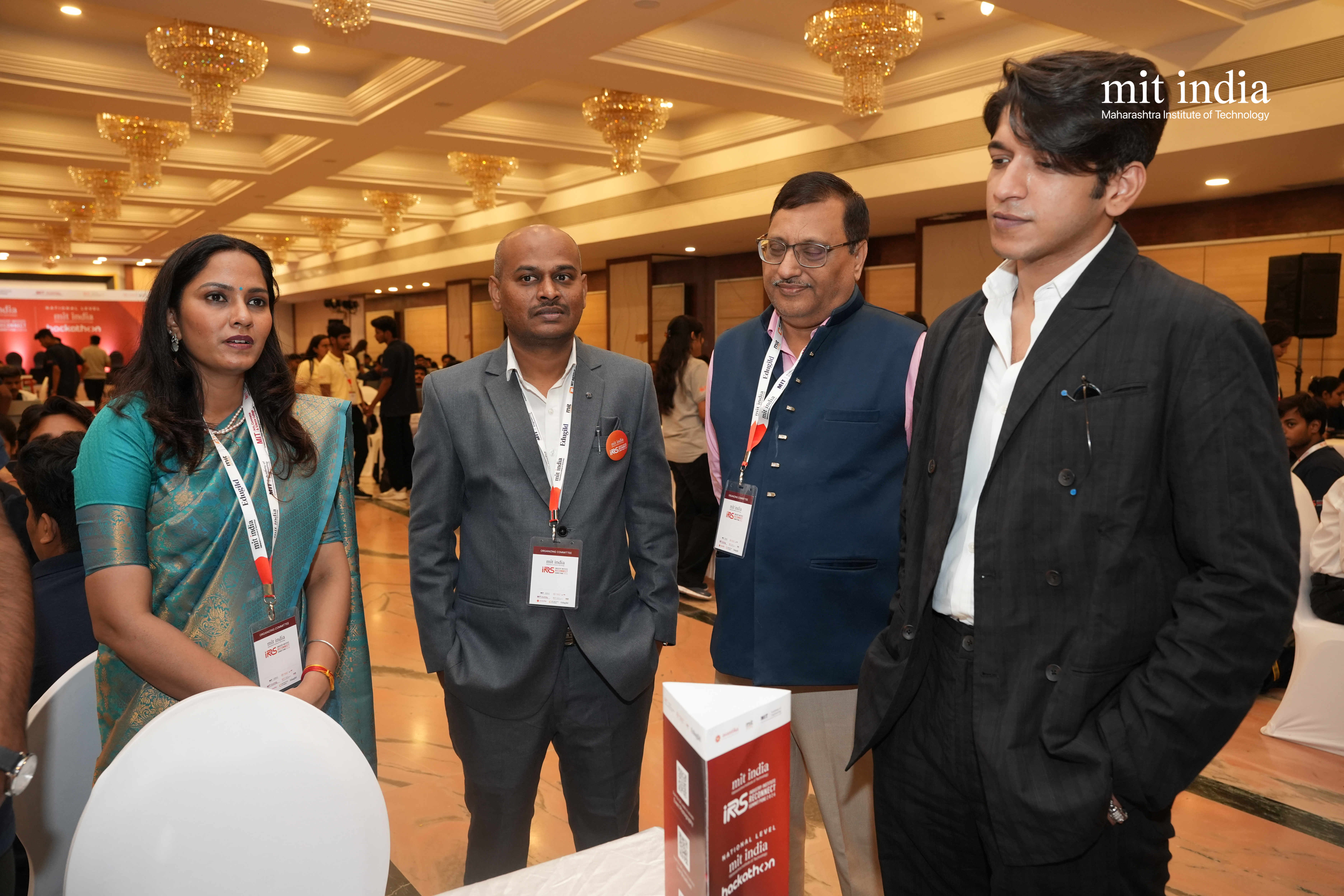
Pune, Aug 25: MIT INDIA’s Industry Institute Reconnect Summit (IRS 2026) concluded in Pune with a focus on turning industry–academia engagement into tangible opportunities for startups, student innovators and future talent. The two-day summit brought together industry leaders, investors, academic institutions, entrepreneurs and students, with Capital Nexus and the MIT India National Hackathon emerging as key platforms for taking promising ventures and ideas to the next stage.
Through Capital Nexus, 25–30 startups advanced to the Grand Finale of the Industry Institute Engagement Summit (IES) 2026 in New Delhi, following participation by 100+ startups across sectors including SaaS, FinTech, HealthTech, EdTech, D2C, AgriTech, DeepTech, AI/ML, CleanTech, Manufacturing and EV & Mobility. The platform created structured opportunities for investor matchmaking, pitch refinement, business validation and long-term mentorship, with the top three startups eligible for funding opportunities ranging from ₹5 lakh to ₹50 lakh through Edugild.
The MIT India National Hackathon advanced 30 teams to the Grand Finale in New Delhi, following participation by 100+ student teams from Engineering, Science, Management and Design institutions across India. With a ₹25 lakh prize pool, the Hackathon enabled students to work on industry-relevant challenges across Government, Social Impact, Defence, Healthcare, Technical and Industry sectors, applying their academic learning to real-world problems. Teams were evaluated by industry professionals across the qualifier and finale stages.
The Hackathon also created additional opportunities for participating finalists, with AWS certification vouchers worth ₹10,000 each and cloud credits worth ₹20,000 each for teams participating in the Grand Finale.
IRS 2026 also provided a platform for conversations around employability, future skills, innovation, entrepreneurship, industry–academia collaboration and the changing requirements of the workplace. Through panel discussions, networking engagements, sponsor and alumni interactions and leadership conversations, the summit brought together perspectives from across the education, business, investment and innovation ecosystems.
Mr. Digvijay S. Karad, Group Director, MIT India, said, “The whole point of bringing these communities together is that a good idea shouldn’t necessarily end when the competition does. If something genuinely interesting comes out of this room, we want to help create a path for it to go further. That, for me, would be far more exciting than simply handing out a trophy at the end of the two days. I hope you take a few risks, try new ideas that sound slightly ridiculous, question the problem statement, build something you’re not entirely sure you know how to build yet, and most importantly, talk to the people around you.”
Mr. Sudish Panicker, Managing Director, BNY India, said, “Academia for a long time has been viewed as the home of ideas, the home of research, the home of deep inquiry. Industry, on the other hand, is seen as the engine of execution, scale, and real-world application. But today, and for times in the future, that separation will not serve any of us well. This conversation really needs to be about how do you bring the two together, and how do you bring the two together in a way that can drive the future of our organisations, it can drive the future of our country, and it can drive the future of the world. The partnership between industry and academia is not just about transformation. It is about preparing the people for the future.”
Dr. Suresh Gosavi, Vice Chancellor, Savitribai Phule Pune University, said, “I think the education system in the entire country is changing. From that perspective, an institute like MIT is really leading. Other institutes in Pune are also leading, but I think MIT India has set up a certain benchmark in the education system. I congratulate the MIT India for initiating this activity, where young brains come here, they sit here, they look at the idea, they develop the idea, and they come up with the final product which is needed by society, which is needed by industry, which is needed for the development of the country.”
Prof. (Dr.) Sanjay Govind Dhande, Chancellor, Avantika University, Ujjain, Indore, MIT University of Shillong, Meghalaya, said, “Platforms such as these Industry Institute Reconnect Summit are essential in bringing together education, industry, technology and entrepreneurship on a common stage. Universities must not remain confined to classrooms and laboratories alone. They must become places where knowledge meets real-world challenges and where ideas are tested against the demands of practice. My hope is simple. This brings together a dialogue which converts collaboration into innovation, and innovation into national impact. So I would say collaboration, innovation and national impact are the three steps that we should follow.”
The outcomes of IRS 2026 now extend towards the Grand Finale of the MIT India National Hackathon and Capital Nexus at the Industry Institute Engagement Summit (IES) 2026 in New Delhi in October 2026. The selected startups and student teams from the Pune edition will progress to the next stage, gaining a larger national platform to engage with investors, industry leaders, experts and potential partners.
The Pune edition reinforced MIT INDIA’s larger ‘Reconnect’ vision of creating stronger pathways between education, industry, entrepreneurship, investment and emerging talent. By combining industry dialogue with platforms for innovation, investor engagement and talent development, IRS 2026 seeks to move industry–academia collaboration from conversation towards sustained opportunities and measurable outcomes.