


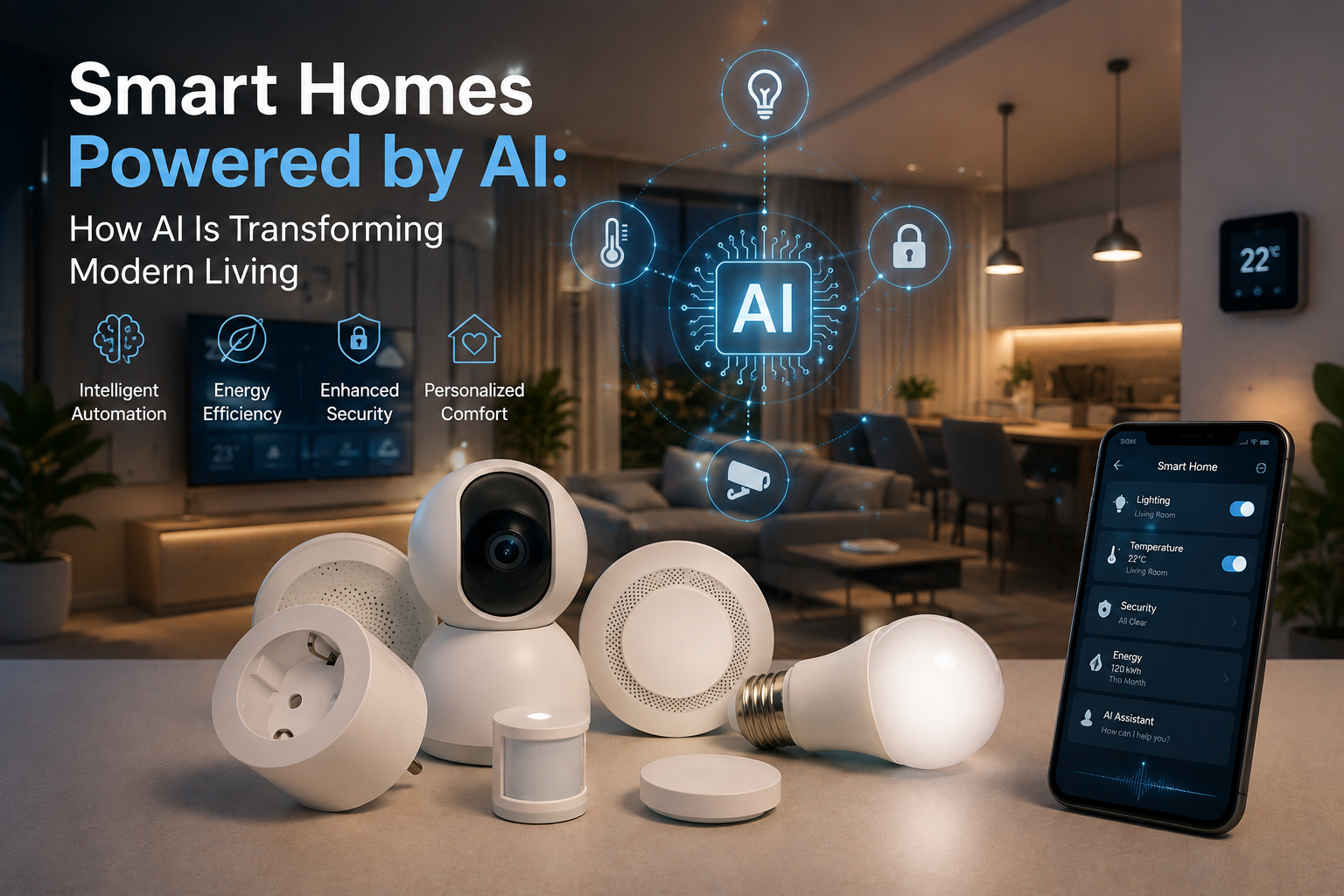
Aug 21: Artificial intelligence is moving into one of the most personal spaces in our lives — our homes. Smart lights, connected appliances, AI-enabled security cameras, smart air conditioners and robotic vacuum cleaners are changing how households manage everyday activities.
Smart homes powered by AI go beyond controlling devices through a smartphone or voice command. AI can analyse usage patterns, learn household routines and help connected devices respond more intelligently to changing circumstances.
The growth of connected technology is also creating a larger market for smart-home products. Deloitte’s 2025 Connected Consumer Survey found that average household spending on connected devices among surveyed US consumers increased from $764 in 2024 to $896 in 2025. The survey also found that 29% of respondents planned to increase their connected-device spending over the following year.
What Is a Smart Home Powered by AI?
A smart home powered by AI is a connected residential environment where artificial intelligence, sensors, machine learning and data analytics are used to automate or optimise household functions.
AI-enabled smart homes can include:
- Smart lighting and switches
- AI-powered security cameras
- Smart locks and door sensors
- Smart thermostats and air conditioners
- Connected kitchen appliances
- Smart speakers and displays
- Robotic vacuum cleaners
- Energy monitoring systems
The key difference between conventional automation and AI is adaptability.
A traditional smart device might turn lights on at a predetermined time. An AI-enabled system can potentially consider occupancy, routines, preferences and other available information before determining what action is appropriate.
How AI-Powered Smart Homes Work
AI-powered smart homes typically combine several technologies that work together.
1. Sensors collect information: Sensors can detect movement, temperature, occupancy, light levels and other environmental conditions.
2. Connected devices share data: Smart devices communicate with a central hub, home network or cloud-based platform.
3. AI analyses patterns: Machine-learning systems can analyse information to identify routines and usage patterns.
4. The system makes decisions: Depending on the configuration, AI can recommend or automatically initiate an action.
5. Devices respond: Lights, thermostats, appliances, security systems or other connected devices respond accordingly.
6. Systems can learn: Over time, the technology can use subsequent interactions and patterns to make automation more personalised.
The level of automation depends on the device and platform. Not every smart-home product independently makes decisions, and some systems still require user-defined rules.
AI Is Making Home Automation More Personal
Home automation has traditionally depended on fixed schedules and commands. AI is changing this model by making automation more responsive to context.
An intelligent system can potentially learn when residents generally arrive home, when they go to sleep or which rooms are frequently occupied.
For example, a home could adjust lighting and temperature when residents arrive and reduce the use of selected devices when everyone leaves.
This moves smart-home technology away from rigid schedules towards more adaptive automation.
AI-Powered Home Security
Security is one of the most visible applications of AI in smart homes.
Modern security cameras can use computer vision to analyse movement and distinguish between people, vehicles, animals and other activity. This can make alerts more useful than basic motion detection.
Smart locks, door sensors and cameras can also work together to create a connected security environment.
However, greater connectivity also creates new risks.
A 2025 study by the US National Institute of Standards and Technology (NIST) surveyed 401 smart-home users and examined their security and privacy perceptions across devices including security systems, thermostats, sensors, lighting and voice assistants. The research highlights the importance of protecting connected devices and the data they generate.
AI Can Help Manage Energy Consumption
Energy management is another important application of AI-powered smart-home technology.
Smart thermostats, air conditioners, lighting systems and connected appliances can collect information about household usage. AI can analyse these patterns and potentially optimise device operation.
For example, an intelligent cooling system could reduce air conditioning when a home is empty and adjust the temperature before residents return.
The International Energy Agency (IEA) has highlighted the potential of digital technologies, including sensors and learning algorithms, to make buildings more responsive to energy demand.
Its 2026 report Scaling Up Demand Flexibility also identifies smart technologies as an important tool for improving electricity-system flexibility.
The implications extend beyond individual homes. If large numbers of households use connected technologies to adjust electricity consumption, smart homes could eventually contribute to wider demand-management efforts.
Examples of AI-Powered Smart Homes
AI can be applied across several areas of the home.
AI thermostats: These can learn temperature preferences and respond to occupancy patterns.
Smart security cameras: AI can analyse activity and provide more relevant alerts.
Intelligent lighting: Connected lights can adjust according to occupancy, routines or environmental conditions.
Smart appliances: Connected refrigerators, washing machines and ovens can monitor usage and provide information or recommendations.
Robot vacuum cleaners: Advanced robotic cleaners can map rooms, recognise obstacles and plan cleaning routes.
Smart energy systems: Energy-management platforms can monitor electricity consumption and coordinate connected devices.
Smart Appliances Are Becoming More Intelligent
AI is also changing everyday household appliances.
Modern refrigerators, washing machines, ovens, air conditioners and robotic cleaners increasingly use sensors and software to improve their operation.
Robotic vacuum cleaners provide a straightforward example. Advanced models can map rooms, identify obstacles and plan cleaning routes rather than simply moving randomly around a house.
Connected appliances can also monitor their operation and provide information about energy consumption, maintenance requirements and usage.
Predictive Maintenance Could Change Home Management
Another emerging application of AI is predictive maintenance.
Connected appliances can monitor their performance and identify unusual patterns. AI can analyse these changes and potentially warn users when a problem appears to be developing.
For example, an unexpected change in an appliance’s energy consumption could indicate that it requires attention.
Instead of waiting for an appliance to stop working, homeowners could receive an early warning and arrange maintenance.
While predictive maintenance is promising, its effectiveness depends on the quality of sensors, data and algorithms used by individual products.
Voice Assistants and AI Agents
Voice control is already familiar in many smart homes, but generative AI could make interactions more natural.
Instead of remembering specific commands, homeowners could communicate using everyday language.
For example, a user could ask an AI system to prepare the house for bedtime. Depending on the system’s capabilities and permissions, this could involve turning off selected lights, adjusting the temperature, locking doors and activating security features.
This represents a shift from device-by-device control to goal-based home automation.
Benefits of AI-Powered Smart Homes
AI-enabled homes offer several potential advantages.
Greater convenience: Routine household tasks can be automated.
Better energy management: Connected devices can potentially adjust their operation according to occupancy and usage.
Improved security: AI can analyse activity and provide more sophisticated alerts.
Personalised experiences: Lighting, temperature and other settings can be adapted to household preferences.
Predictive maintenance: Connected appliances can potentially identify unusual behaviour before a major failure.
Accessibility: Voice controls and automation can make household technology easier to operate.
Privacy and Cybersecurity Challenges
The growth of AI-powered homes also raises important questions about privacy.
Smart cameras, microphones, sensors and connected appliances can collect information about household activities and routines. If this information is not properly secured, it can create privacy and cybersecurity risks.
NIST’s 2025 research on smart-home users reinforces the importance of security and privacy considerations across different categories of connected devices.
Consumers should therefore:
- Use strong and unique passwords.
- Keep device software updated.
- Enable multi-factor authentication where available.
- Review privacy and data-sharing settings.
- Understand what information devices collect.
- Choose products from manufacturers that provide security updates.
- Disconnect or replace devices that are no longer supported.
What Is the Future of AI-Powered Smart Homes?
The future of smart homes could be considerably more autonomous.
Today’s systems often wait for users to issue commands. Future AI-powered systems may increasingly anticipate requirements based on household routines, occupancy and environmental conditions.
AI agents could eventually act as a central intelligence layer connecting lighting, security, climate control, appliances and entertainment systems.
The IEA’s 2026 research on demand flexibility also suggests that smart technologies can have a wider role in helping electricity systems respond to changing demand.
As a result, the future smart home may not simply be a collection of connected gadgets. It could become an integrated environment that continuously responds to the needs of its occupants.
What Consumers Should Consider Before Building an AI Smart Home
Consumers do not need to connect every appliance immediately. A gradual approach can make it easier to understand how different devices work together.
Before purchasing smart-home technology, consider:
- Identify the objective: Decide whether the priority is security, convenience, energy management or accessibility.
- Check compatibility: Make sure devices can work together within the preferred ecosystem.
- Prioritise cybersecurity: Change default passwords and keep software updated.
- Review privacy policies: Understand what information devices collect and where it is processed.
- Consider long-term support: Check whether manufacturers provide regular security updates.
- Start with essential devices: Build the system gradually instead of purchasing unnecessary connected products.
Conclusion
Smart homes powered by AI are changing the way people interact with their living spaces. From personalised automation and intelligent security to energy management and predictive maintenance, AI is making connected homes more responsive.
Research from organisations such as the International Energy Agency, Deloitte and NIST provides evidence of the growing importance of connected technologies while also highlighting energy management, consumer adoption, privacy and security considerations.
The biggest change may be yet to come. As AI agents become more capable, smart homes could move from simply responding to commands to anticipating household needs and coordinating multiple systems automatically.
The home of the future may therefore be less about having more smart devices and more about having technology that knows when, why and how to use them intelligently.