


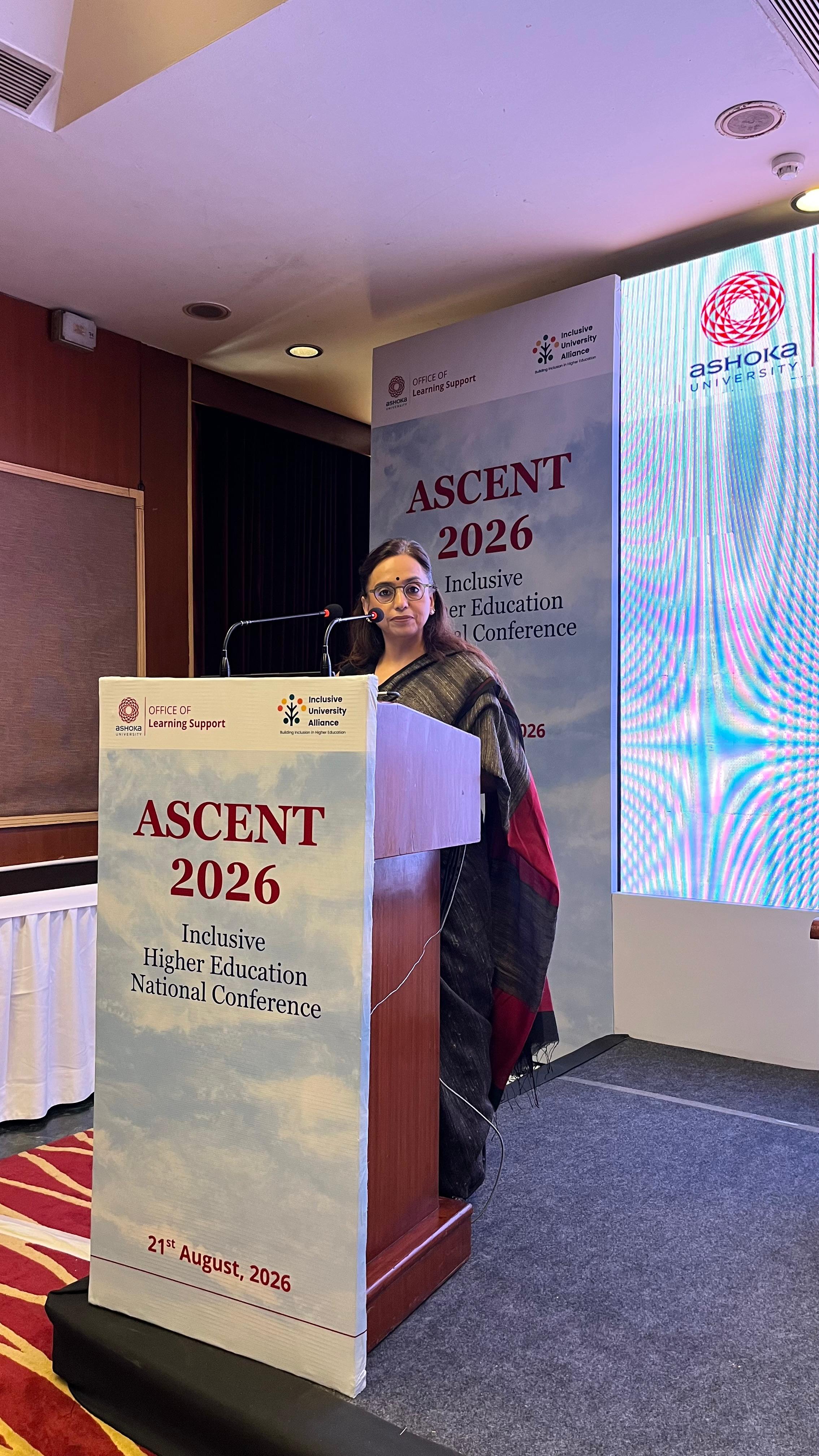
New Delhi, August 21, 2026: Ashoka University’s Office of Learning Support (OLS), in partnership with the Inclusive University Alliance (IUA), today convened ASCENT 2026 – Inclusive Higher Education National Conference at the India Habitat Centre, New Delhi. The event brought together policymakers, higher education leaders, and inclusion practitioners from across the country to advance the conversation on cultivating the ecosystem necessary to make higher education more inclusive, accessible and equitable for students with disabilities.
The occasion saw the unveiling of a special coffee table book, ‘Because of You’, marking 10 years of the Office of Learning Support, a transformative decade of building, learning and reimagining what access to higher education can look like for students with disabilities. The book encapsulates the voices of those whose trajectories changed once they were seen, heard and supported, offering a glimpse into the possibilities that open up when access is paired with the right support.
During her keynote address, Ms. Manmeet Kaur Nanda, Additional Secretary, Department of Empowerment of Persons with Disabilities (DEPwD), Ministry of Social Justice & Empowerment, called for moving beyond policy on paper to inclusion in practice, outlining a six-point roadmap for higher education institutions: audited access, implementation of the 5% reservation, reasonable accommodation by default, stronger assistive technology and support, greater faculty and administrative sensitivity, and robust accountability through periodic accessibility and social audits. She emphasised, “The 5% reservation must be implemented in reality, not just on paper,” and stressed that accessibility must extend beyond physical infrastructure to websites, learning systems, examination portals and course materials.
Professor Vinay Kumar Pathak, President, Association of Indian Universities (AIU), acknowledged Ashoka University’s decade-long work in the area and called for greater focus on grassroots realities beyond metropolitan centres. He said, “We should develop a status paper covering Tier 2, Tier 3 and Tier 4 cities, villages and communities often left out of the conversation. When we are in Delhi, we may understand India, but not always Bharat and its ground realities. Policies shaped in air-conditioned rooms must work on the ground – for a farmer’s son with a disability, for instance. We also need to harness AI and other technologies to develop assistive solutions. India is diverse, and there is much more work to be done. AIU is committed to working with Ashoka University to take this agenda forward.”
The conference subsequently featured a session on “The Inclusive Classroom”, bringing together Professor Bhuvaneswari B. of Azim Premji University, Professor Somak Raychaudhury, Former Vice-Chancellor and Professor of Physics at Ashoka University, Professor Karuna Rajeev of Lady Shri Ram College, and Professor Vandana Saxena from Delhi University. The discussion explored practical approaches to inclusive teaching, faculty mindsets, the importance of differentiating classroom environments and the role of technologies in facilitating student engagement. The panelists also examined the potential of emerging technologies, particularly artificial intelligence (AI), to make classrooms more accessible, personalised and engaging for students with diverse needs.
The conference also explored ‘Social Inclusion as the Foundation of Academic Inclusion’, led by Professor Someshwar Sati, Faculty at Kirori Mal College, Delhi University, with a focus on how belonging, campus environments and social inclusion shape meaningful academic participation. The final thematic session, ‘The Institutional Blueprint for Inclusion: System & Policy Frameworks’, featured Neha Trivedi, Founder, Spandan: Inclusion and Accessibility Consultancy Services. The session deliberated on institutional policies, reasonable accommodation frameworks, challenges institutions face while implementing various policies and the need to have pragmatic mechanisms to operationalise the inclusion agenda.
Reena Gupta, Senior Director, Office of Learning Support (OLS), Ashoka University, said “Inclusion must move beyond intent and become embedded in the everyday systems and practices of our institutions. ASCENT 2026 provides a valuable platform for HEIs to learn from one another, share best practices implemented in their own institutions and develop new practical solutions and strengthen institutional frameworks so that students with disabilities can participate meaningfully and equitably in every aspect of university life.”
Commenting on the conference, Rishikesha T. Krishnan, Vice-Chancellor, Ashoka University said, “For higher education to truly serve the aspirations of a changing India, inclusion must be viewed as an integral part of academic excellence and institutional responsibility. The work of building inclusive universities requires consistent effort, sustained leadership, collaboration and a willingness to rethink how our institutions are designed and experienced. ASCENT 2026 is an important step towards creating that shared commitment across India’s higher education ecosystem.”
Through ASCENT 2026, participating institutions were encouraged to take away an actionable blueprint for inclusion, opportunities for knowledge sharing, a stronger national network, and approaches to drive systemic excellence. The conference is designed specifically for institutional stakeholders, including senior leadership and administrators, faculty and academic leaders, and inclusion practitioners—who can influence institutional change.