


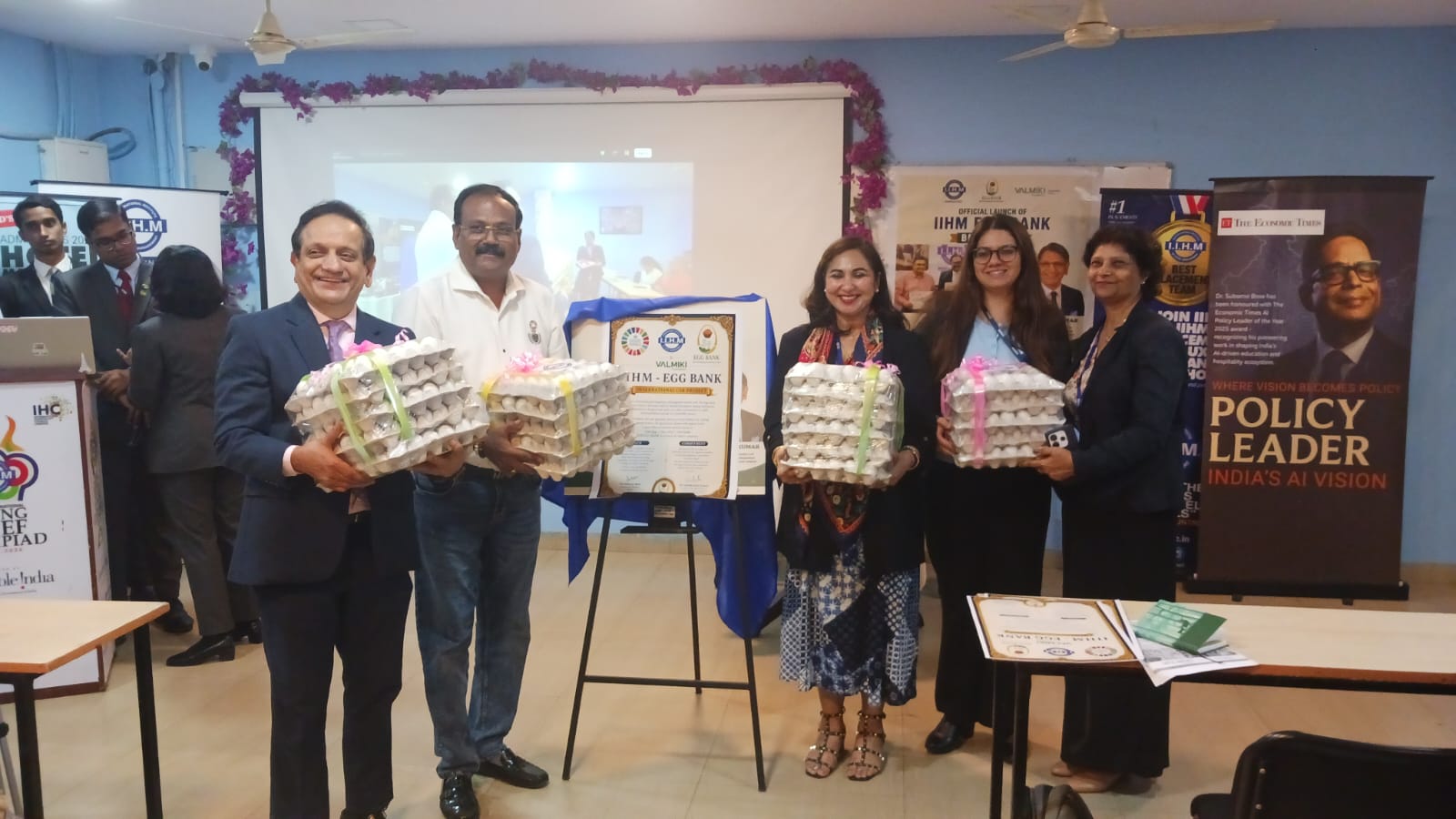
Bengaluru, Aug 21: The International Institute of Hotel Management (IIHM) launched its first Egg Bank in India in Bengaluru to provide sustained nutritional support to underprivileged and needy people in the city. As part of the launch, IIHM first identified Sri Rakum School for the Blind, where the students identified as food soldiers distributed over 700 eggs to visually impaired children.
The student-led CSR initiative, undertaken in association with the Valmiki Foundation, will involve IIHM students, known as Food Soldiers, in supporting identified beneficiary institutions. Following its association with Sri Rakum School for the Blind, IIHM will progressively extend the programme to old-age homes, orphanages and other institutions serving underprivileged communities in Bengaluru. The initiative will subsequently be taken forward across IIHM campuses in India, with each campus identifying beneficiary institutions in its vicinity.
Speaking on the initiative, Dr. Suborno Bose, Founder & Chairman, IIHM, said, “As a leading hospitality education institution, our responsibility goes beyond creating successful professionals. Hospitality is fundamentally about caring for people. Through the IIHM Egg Bank, our Food Soldiers will help address nutritional deficiencies through meaningful action. We want our students to see CSR not as a one-time activity, but as a sustained responsibility towards the underprivileged.”
Addressing the gathering, Ms. Sanchari Chowdhury, Director, IIHM Bengaluru & Head-South Operations, said, “Our Food Soldiers have always been encouraged to look beyond the classroom and contribute meaningfully to society. The IIHM Egg Bank strengthens this spirit by making students active participants in community service. ‘One Child, One Egg, One Smile’ reflects our belief that even a simple act, when carried forward with empathy and commitment, can make a meaningful difference.”
Dr. Valmiki Hari Kishan, popularly known as the ‘Egg Man of India’, Founder of the Egg Bank Project and Co-Founder & Project Director, Valmiki Foundation, said, “The idea of the Egg Bank came to me during the second wave of COVID-19, when I was in the ICU thinking about how better nutrition could protect children from vulnerable communities. What began with that thought has grown into a larger movement. The Bengaluru initiative marks our 177th Egg Bank overall and the first under IIHM. By taking this initiative across its campuses, IIHM can help extend nutritional support to many more vulnerable communities.”
Food Soldiers Drive an Ongoing Nutrition Programme
Unlike a one-time donation drive, the IIHM Egg Bank has been structured as an ongoing programme. Since eggs are perishable, IIHM’s Food Soldiers will undertake distributions twice every month, providing the required quantity for each fortnight. Their participation will help maintain continuity while allowing students to connect personally with the communities they serve.
The initiative also strengthens IIHM’s commitment to the 17 United Nations Sustainable Development Goals, particularly SDG 2-Zero Hunger. IIHM’s Food Soldiers have been involved in programmes focused on providing food and other essential support to people in need. The Egg Bank introduces a focused nutritional dimension to these community efforts.
The launch was graced by Mr. P. K. Mohan Kumar, Independent Director, Prestige Hospitality Ventures Limited, as Chief Guest.
Speaking on the occasion, Mr. P. K. Mohan Kumar said, “Hospitality is fundamentally about caring for people and initiatives such as the IIHM Egg Bank take that spirit beyond the industry and into the community. The involvement of students in such service can help nurture professionals who understand empathy and social responsibility.”
Malnutrition remains a serious challenge in India, particularly among underprivileged children and other vulnerable sections with limited access to nutritious food. Through the Egg Bank, IIHM and the Valmiki Foundation are combining the Foundation’s experience with IIHM’s institutional network and student participation to help bridge this nutritional gap. Beginning with visually impaired children from Sri Rakum School for the Blind and subsequently reaching old-age homes, orphanages and other beneficiary institutions, the collaboration seeks to make a meaningful difference to Bengaluru’s underserved communities.