


Aug 19: Paneer has become a staple on Indian dining tables and restaurant menus. But a recent food-safety crackdown has prompted consumers to look more closely at what is actually being sold and served as paneer.
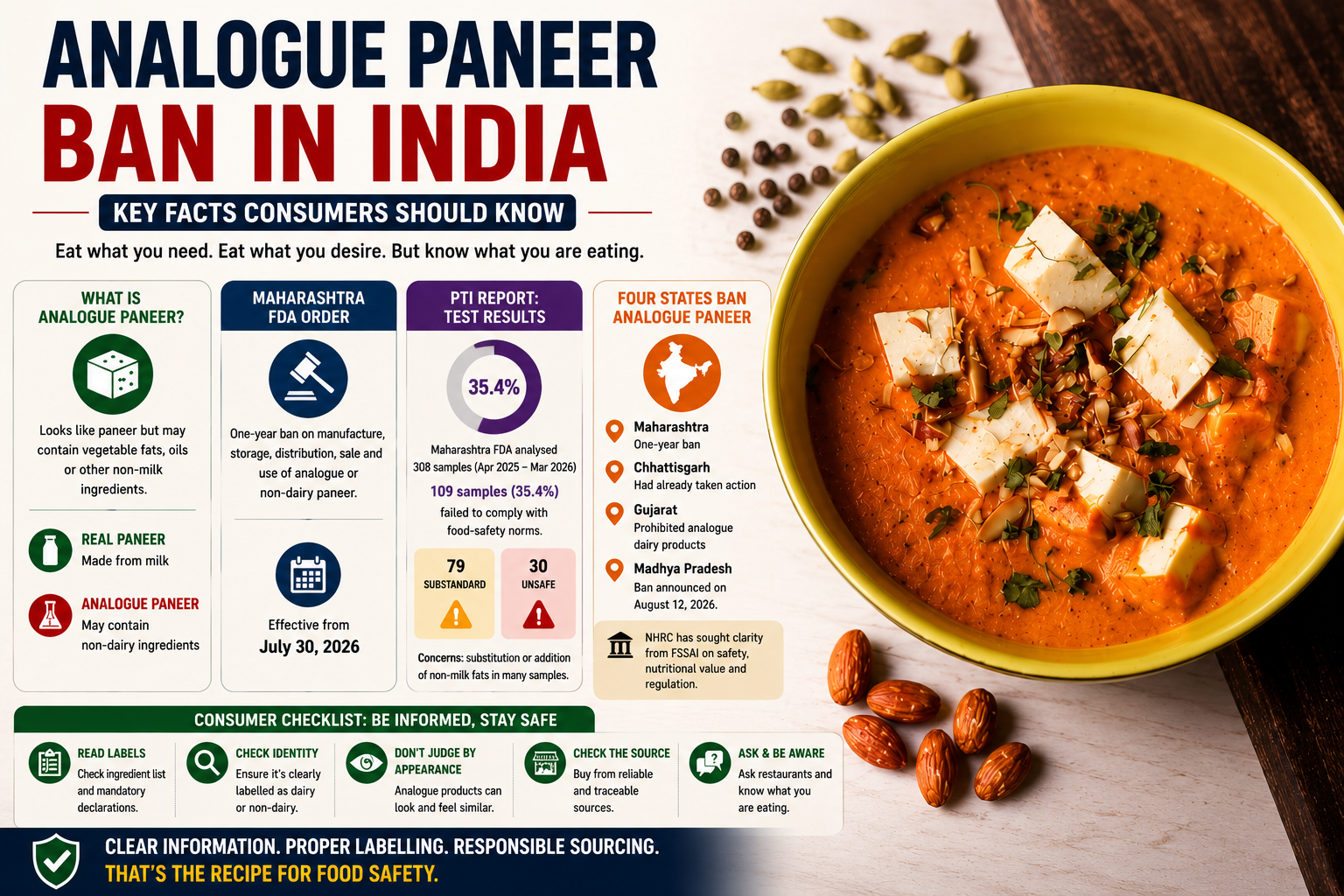
The debate over analogue paneer gained momentum after Maharashtra Food and Drug Administration Commissioner Tukaram Mundhe ordered a one-year ban on the manufacture, processing, storage, distribution and sale of analogue or non-dairy paneer across the state.
The move has since been followed by similar action in other states, turning analogue paneer into a broader national conversation around food safety, labelling, consumer awareness and the right to make an informed food choice.
What Is Analogue Paneer?
Analogue paneer is designed to resemble traditional paneer in appearance and texture but is not made entirely from milk. It can contain vegetable fats, vegetable oils or other non-milk ingredients in place of some milk components.
The important distinction for consumers is that a dairy alternative and an adulterated product are not necessarily the same thing. The key issue is how the product is made, regulated, labelled and presented to consumers.
A consumer who knowingly chooses a non-dairy alternative is making a different choice from someone who orders paneer and unknowingly receives a product made partly from non-dairy ingredients.
That is why transparency has become central to the current food-safety debate.
Why Tukaram Mundhe’s Food Safety Drive Matters
The Maharashtra FDA’s action has placed greater attention on the way food businesses source, prepare and sell dairy products.
The order issued by FDA Commissioner Tukaram Mundhe took effect on July 30, 2026, and prohibits the manufacture, processing, preparation, packing, storage, distribution, transport and sale of analogue or non-dairy paneer in Maharashtra for one year. Hotels, restaurants, caterers, eateries and cloud kitchens have also been prohibited from using or serving the product.
The action is particularly relevant for restaurants because customers generally cannot see what happens inside a commercial kitchen.
When a customer orders paneer tikka, paneer butter masala or another paneer dish, there is an expectation that the ingredient being served is genuine paneer.
That makes procurement, traceability and accurate menu information important parts of food safety.
109 of 308 Samples Failed Food-Safety Norms
The data behind Maharashtra’s action provides an important part of the story.
A PTI report said the Maharashtra FDA analysed 308 samples of paneer and dairy analogues collected between April 2025 and March 2026. Of these, 109 samples, or 35.4%, failed to comply with prescribed food-safety norms.
Among the failed samples, 79 were classified as substandard and 30 were declared unsafe.
The findings do not mean that every failed sample was analogue paneer or that every product tested was unsafe. However, they highlight why regulators have increased scrutiny of the composition and quality of paneer and dairy-analogue products.
The Maharashtra FDA’s surveillance also found concerns involving the substitution or addition of non-milk fats in a significant number of samples.
For consumers, the takeaway is straightforward: appearance and taste alone cannot establish what a food product contains.
FSSAI Rules Put the Focus on Transparency
The analogue-paneer controversy is also connected to India’s wider food-labelling framework.
FSSAI has previously focused on the need for food businesses to distinguish dairy products from analogues and prevent consumers from being misled about the identity of a product.
This distinction becomes particularly important in restaurants, hotels and catering businesses, where consumers may not have access to an ingredient label.
The underlying principle is simple: if a food is an alternative to the product a consumer expects, that difference should be clear.
Four States Now in the Spotlight
The analogue-paneer debate has expanded beyond Maharashtra.
Maharashtra
Maharashtra has imposed a one-year ban on analogue or non-dairy paneer, citing food-safety concerns, consumer deception and difficulties in enforcing standards. The order also covers restaurants, hotels, caterers and cloud kitchens.
Chhattisgarh
Chhattisgarh had already taken action against analogue paneer, making it one of the states to move against the product before Maharashtra’s latest order.
Gujarat
Gujarat has also prohibited analogue dairy products, adding to the growing regulatory focus on non-dairy substitutes.
Madhya Pradesh
On August 12, 2026, Madhya Pradesh Chief Minister Mohan Yadav announced a ban on analogue paneer, saying the state would promote natural, milk-based dairy products and increase dairy production.
With four states now reported to have banned analogue paneer, the issue has moved firmly into the national food-safety conversation. The National Human Rights Commission has also sought clarity from FSSAI on the safety, nutritional value and regulation of analogue paneer.
Why Consumers Need to Be Vigilant
The current debate does not mean consumers need to stop eating paneer.
Instead, it highlights the importance of becoming more informed about what is being purchased or served.
Read the Ingredient List
For packaged products, don’t rely only on the large product name on the front of the packet. Check the ingredient list and other mandatory declarations.
Look for Clear Product Identification
Consumers should be able to distinguish between genuine dairy paneer and a non-dairy or analogue product.
Don’t Judge Paneer Only by Appearance
Analogue products can be designed to look and feel similar to conventional products. Appearance alone is therefore not a reliable way to determine composition.
Check the Source
Buying packaged products from reliable and traceable sources can help consumers make more informed decisions.
Ask Restaurants
When eating out, consumers can ask whether a restaurant uses genuine dairy paneer in a particular dish.
Restaurants and caterers, meanwhile, have a responsibility to know what they purchase and serve.
Don’t Assume a Low Price Means Adulteration
A cheaper product is not automatically fake or unsafe. However, a significant price difference can be a reason to examine the product’s ingredients and source more carefully.
What About Loose Paneer?
Loose paneer presents an additional challenge because consumers may not have access to the same information available on packaged products.
The Maharashtra FDA has raised concerns about loose analogue paneer being transported, stored and sold without original packaging, mandatory label declarations, invoices or adequate traceability documents. Such practices can make it more difficult for authorities to identify the source of a product when a food-safety problem is discovered.
For consumers, this is one reason why source and traceability matter, particularly when purchasing dairy products in bulk or from unfamiliar sellers.
Eat What You Need or What You Desire
The analogue-paneer debate should not turn into a debate about what everyone should eat.
Consumers have different preferences and requirements.
Some people want traditional milk-based paneer. Others may prefer plant-based or non-dairy alternatives. Some may simply choose products based on taste, price or availability.
There is nothing inherently wrong with having those choices.
The important thing is informed choice.
If you want genuine paneer, you should be able to buy genuine paneer.
If you want a non-dairy alternative, you should be able to choose it knowingly.
If you are looking for a particular nutritional profile, you should be able to understand what the product contains before making that decision.
In other words: eat what you need, eat what you desire—but know what you are eating.
Food Safety Is a Shared Responsibility
Government agencies can conduct inspections, collect samples and take enforcement action. But food safety cannot depend on regulators alone.
Manufacturers must comply with food-safety standards.
Restaurants and caterers must know what they procure and serve.
Retailers must maintain appropriate sourcing and storage practices.
Consumers need to read labels, ask questions and make informed choices.
The recent crackdown shows how important each part of this chain can be.
The Bigger Lesson Behind the Analogue Paneer Debate
The controversy surrounding analogue paneer is ultimately about more than one food product.
It is about trust and transparency in India’s food market.
Consumers should be able to trust that a product described as paneer meets the applicable requirements for paneer. At the same time, consumers who prefer alternatives should be able to choose them without confusion.
The growing regulatory action in Maharashtra, Chhattisgarh, Gujarat and Madhya Pradesh, along with FSSAI scrutiny, shows that the distinction between genuine dairy products and substitutes is receiving increasing attention.
The answer is not to fear every alternative food product. It is to demand clear information, proper labelling, responsible sourcing and effective enforcement.
Conclusion: Know What Is on Your Plate
The analogue paneer ban in India has brought food safety into the spotlight and made Tukaram Mundhe a prominent figure in the latest debate.
The Maharashtra FDA’s testing data, the PTI report and the subsequent actions by other states highlight a larger consumer issue: people need to know what they are buying and eating.
For consumers, the message is simple:
Eat what you need. Eat what you desire. But know what you are eating.
Whether it is traditional paneer, a dairy alternative or any other food product, the final choice should belong to an informed consumer.