


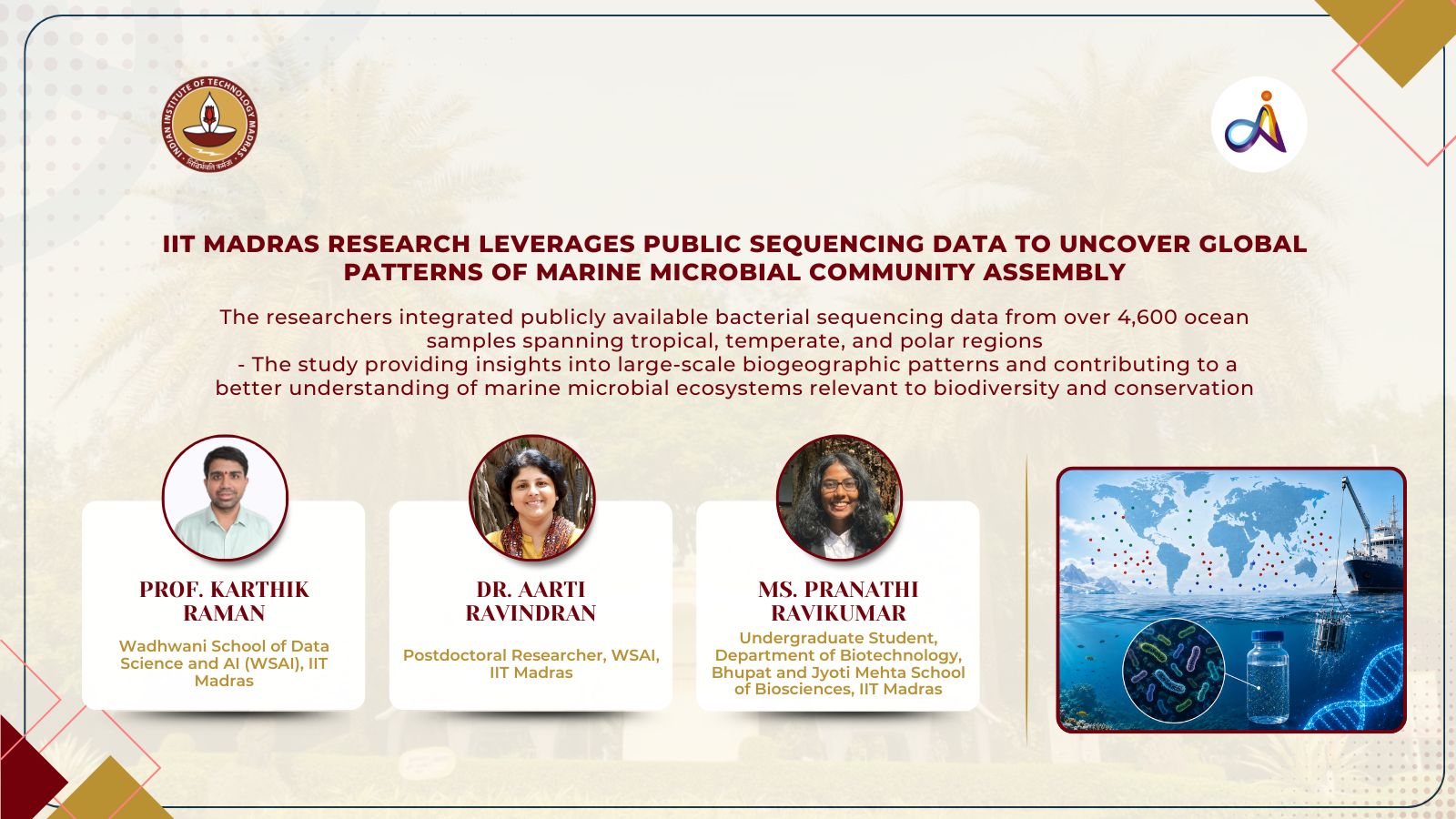
Chennai, Aug 17: Indian Institute of Technology Madras (IIT Madras) Wadhwani School of Data Science and AI (WSAI) researchers have uncovered the crucial role played by rare marine microorganisms in maintaining the stability of ocean ecosystems.
The study provides comprehensive global analyses of marine bacterial communities. By integrating microbial sequencing data from more than 4,600 publicly available ocean samples collected across tropical, temperate and polar regions by various groups, the research offers new insights into how bacterial communities assemble, interact and remain stable in diverse marine environments.
The study adds to India’s contribution to global marine microbiome research and enhances understanding of the microbial processes that support marine ecosystems and environmental health.
The findings were published in mSystems (https://doi.org/10.1128/msystems.00470-26), a peer-reviewed, open-access journal published by American Society for Microbiology. It features interdisciplinary research on microbial systems biology, microbiomes, microbial ecology, and computational microbiology. The paper was co-authored by Ms. Pranathi Ravikumar, Dr. Aarti Ravindran and Prof. Karthik Raman from IIT Madras.
‘GLOBAL PERSPECTIVE’
Elaborating on the importance of this study, Prof. Karthik Raman, Wadhwani School of Data Science and AI (WSAI), IIT Madras, said, “Marine microorganisms form the invisible foundation of ocean ecosystems. They regulate nutrient cycling, sustain marine food webs and play a vital role in controlling the Earth’s climate. However, despite their ecological importance, the scientific community has had only a limited understanding of the processes that govern the formation and resilience of these microbial communities on a global scale. Understanding these dynamics can help inform efforts to conserve ocean health, supporting the UN’s goals for Life Below Water.”
Prof. Karthik Raman added, “The most significant finding was that rare ‘specialist’ bacteria contribute far more to ecosystem stability than previously recognised. Although these microbes occur in much lower abundance than widespread ‘generalist’ species, they serve as vital connectors within microbial interaction networks. Computational analyses showed that removing these specialist bacteria substantially weakened network stability, demonstrating their outsized role in preserving resilient marine ecosystems.”
Dr. Aarti Ravindran, Postdoctoral Researcher, WSAI, IIT Madras, added, “While marine microbial communities are largely shaped by random ecological processes, the balance between randomness and environmental selection varies across different latitude zones. Polar microbial communities exhibited more modular interaction networks, whereas tropical and temperate communities were influenced by both environmental selection and stochastic ecological processes”
Ms. Pranathi Ravikumar, Undergraduate Student, Department of Biotechnology, Bhupat and Jyoti Mehta School of Biosciences, IIT Madras, added, “Our research combined multiple advanced ecological approaches, including neutral community modeling, phylogenetic community assembly analysis (iCAMP), and microbial co-occurrence network analysis. This allowed us not only to identify which microorganisms are present in the oceans but also to understand how they interact to sustain ecosystem resilience.”
‘HEALTHY OCEANS’
Healthy oceans are fundamental to climate regulation, fisheries, biodiversity conservation and global biogeochemical cycles. As climate change continues to alter ocean temperatures and marine ecosystems, understanding the behavior of microbial communities has become increasingly important for predicting ecosystem responses to environmental disturbances.
Identifying specialist microbial genera as key contributors to ecosystem stability highlights the potential importance of ecologically significant rare taxa alongside more abundant organisms in marine conservation. Although this study focused on identifying broad groups of microbes rather than individual species, the approach developed by the researchers can be applied to many different environments. This could help scientists monitor biodiversity, track changes in ecosystems, and support conservation and environmental management in a wide range of natural settings.
Future studies can expand the geographic and temporal scope of sampling and aim to achieve species- and strain-level resolution, enabling a more detailed understanding of microbial community structure, ecological interactions, and ecosystem function