


Aug 14: Artificial intelligence and automation are changing the way companies think about their workforce, operations and, increasingly, their office space. As businesses adopt technologies that can automate routine tasks and support faster decision-making, their requirements for physical workplaces are also changing.
For corporate leaders, the traditional approach of signing long-term leases based on fixed employee numbers is becoming less attractive. Businesses want the ability to increase or reduce their workspace as teams, projects and operational priorities change. This is giving flexible offices a much larger role in India’s corporate workplace strategy.
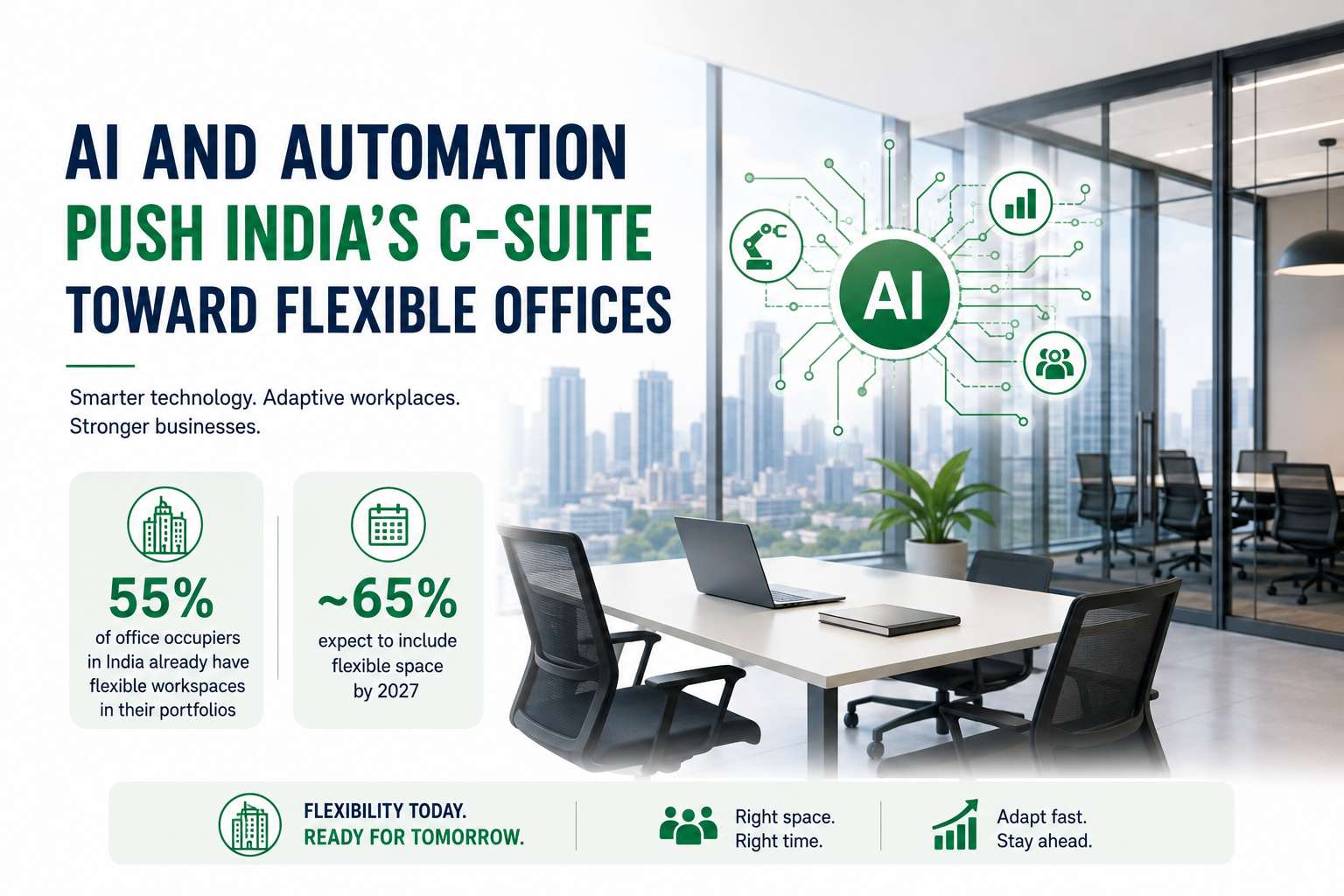
A CBRE India Research and FICCI report found that 55% of office occupiers in India already have flexible workspaces in their portfolios, while nearly 65% expect to include flexible space by 2027. The findings indicate that flexible offices are increasingly becoming part of long-term corporate planning rather than being viewed simply as temporary workspace solutions.
Automation Is Changing Workforce Requirements
Automation has traditionally been associated with manufacturing and repetitive business processes. Its role has now expanded into areas such as customer service, finance, technology, data management and other knowledge-based functions.
As more routine activities become automated, companies are changing the way teams are structured. Some functions may require fewer employees, while emerging areas such as artificial intelligence, data science and technology may require new talent.
This creates an important challenge for companies: predicting exactly how many employees will need office space several years from now is becoming increasingly difficult.
Flexible offices offer one possible answer. Companies can retain a permanent workplace for their core teams while accessing additional space when business requirements increase.
Flexible Workspace Market Expands
The growth of India’s flexible office sector reflects this changing approach.
The CBRE-FICCI report estimates that flexible workspace stock increased approximately threefold between 2020 and 2025, reaching around 110–114 million square feet in 2025. Flexible offices now account for approximately 10–12% of India’s overall office stock.
This represents a significant change from the earlier perception of flexible workspace as primarily a solution for startups, freelancers and small businesses.
Large companies are now becoming important occupiers, looking for managed workspaces that can provide offices, meeting rooms, technology infrastructure and other facilities without requiring them to build and manage every aspect of a workplace themselves.
Bengaluru Remains a Major Hub
India’s leading technology and business centres are at the forefront of flexible workspace adoption.
According to the report, Tier-1 cities account for more than 90% of India’s flexible workspace stock. Bengaluru has approximately 30–32 million square feet, followed by Delhi-NCR with around 21–23 million square feet.
Pune has also developed a strong flexible office market, with penetration estimated at 14–16%.
The concentration of flexible workspace in these cities is closely linked to their technology ecosystems, multinational companies, startups and Global Capability Centres.
GCC Growth Adds to Demand
The expansion of Global Capability Centres (GCCs) is another factor supporting demand for flexible offices.
Indian GCCs are increasingly involved in technology development, engineering, analytics, research and artificial intelligence rather than being limited to traditional support operations.
For multinational companies, setting up or expanding a GCC can involve significant changes in workforce requirements over relatively short periods. Flexible workspaces can provide the additional capacity required while allowing companies to avoid making large permanent commitments immediately.
This makes flexibility particularly valuable for companies entering new markets or scaling technology-led operations.
Companies Are Combining Permanent and Flexible Space
Flexible offices are not necessarily replacing conventional workplaces. Instead, many businesses are looking at ways to use both.
The core-and-flex model is one example. Under this approach, a company maintains a permanent office for its core workforce and supplements it with flexible space when required.
Additional space can be used for temporary teams, new projects, training programmes, expansion plans or employees who do not need permanent desks.
This approach gives companies greater control over their real estate footprint while allowing them to respond to changes in demand.
Technology Could Improve Office Utilisation
AI and automation could also help companies make better use of the office space they already have.
Technology can be used to analyse patterns such as meeting-room usage, desk occupancy and employee movement. Companies can then use this information to redesign workplaces around actual usage rather than assumptions.
For instance, an organisation may discover that employees use collaboration areas far more frequently than individual workstations. Instead of maintaining a large number of permanent desks, it could increase meeting and collaborative spaces.
Such data-driven planning could make offices more efficient while reducing unused capacity.
Why Flexibility Matters to the C-Suite
For senior executives, workplace decisions increasingly involve more than employee convenience.
Office commitments can affect operating costs, expansion plans, capital allocation and the speed at which a company can respond to market opportunities.
Automation makes these considerations more important because technology can change workforce requirements quickly. A business investing heavily in automation today may have a very different organisational structure a few years from now.
Flexible workspace provides companies with an additional layer of adaptability without requiring them to completely redesign their real estate strategy.
A New Direction for Commercial Real Estate
The rise of flexible offices could also influence India’s broader commercial real estate market.
Businesses may increasingly seek shorter commitments, adaptable leasing arrangements and managed workplace services. Landlords and developers could respond by offering buildings with better technology infrastructure, collaborative facilities and greater flexibility.
For flexible workspace providers, the opportunity is moving beyond simply offering desks. Enterprise customers increasingly require secure, professionally managed and technology-enabled environments that can support larger teams and complex operations.
Conclusion
AI and automation are not making physical offices irrelevant. Instead, they are changing what companies expect from them.
The latest CBRE-FICCI report shows the direction of this change clearly: 55% of Indian office occupiers already have flexible workspaces, while nearly 65% expect to incorporate them by 2027. Flexible workspace stock has also grown approximately threefold since 2020, reaching around 110–114 million square feet in 2025.
For India’s C-suite, flexibility is increasingly becoming a way to manage uncertainty. Companies can maintain a stable core workplace while gaining the ability to expand, contract or reorganise their office footprint as business needs evolve.
As AI and automation continue to reshape jobs and organisational structures, India’s corporate workplace is likely to become more adaptable. The future office may not be about having the most space, but about having the right space at the right time.