


Aug 14: India’s smartphone market is showing resilience despite a decline in shipment volumes, with rising average selling prices and stronger demand for mid-range and premium devices helping the industry maintain growth in value. The latest market trends suggest that India’s smartphone industry is moving away from its traditional volume-led model toward a value-driven growth phase.
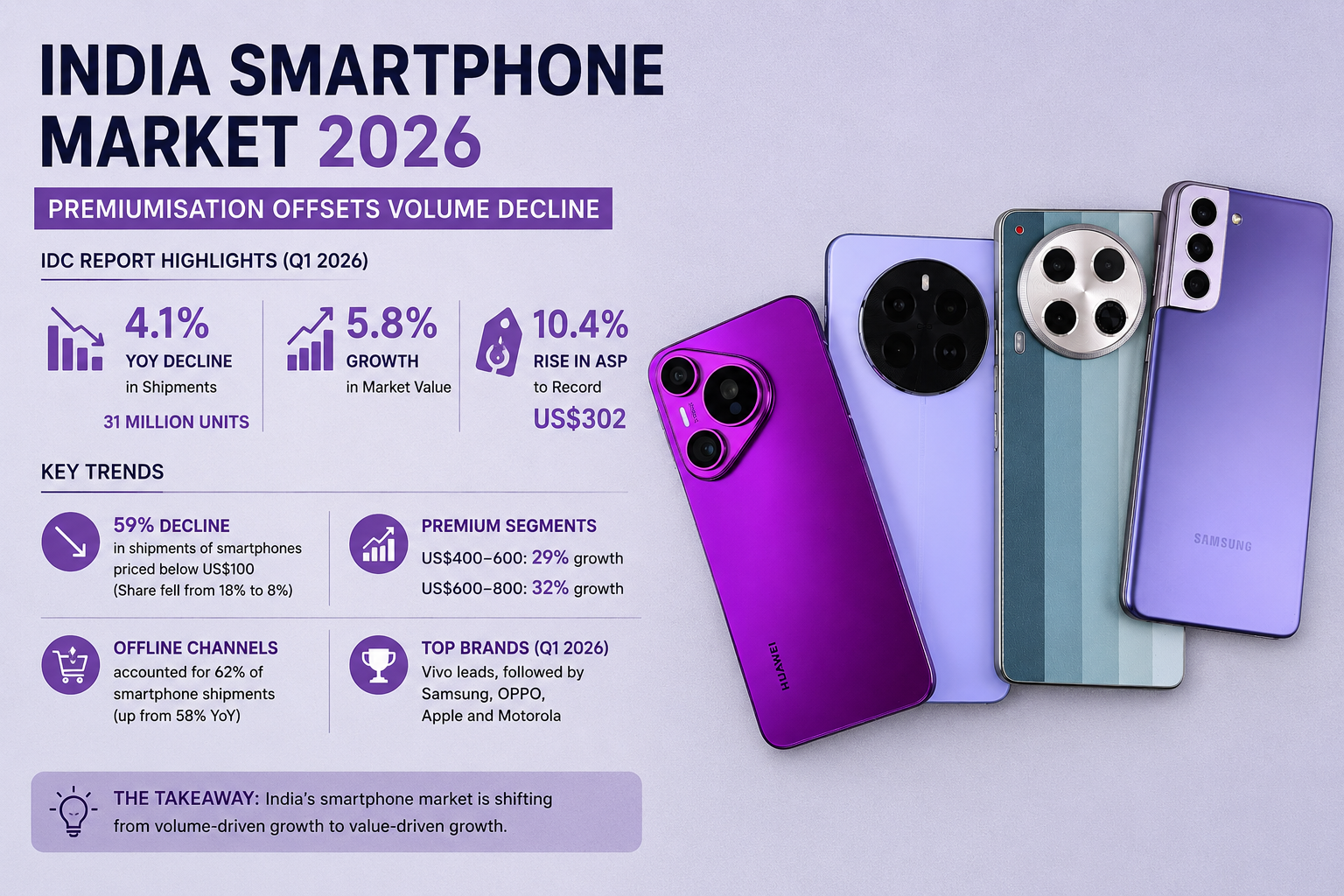
According to an IDC report, India’s smartphone shipments declined 4.1% year-on-year to 31 million units in Q1 2026. Despite the decline in volumes, the overall market value increased 5.8%, while the average selling price (ASP) rose 10.4% to a record US$302.
The numbers highlight an important shift in the India smartphone market: fewer devices are being shipped, but consumers and manufacturers are generating greater value from each smartphone sold.
India Smartphone Market: Key Takeaways
- Smartphone shipments declined 4.1% year-on-year to 31 million units in Q1 2026.
- Market value increased 5.8% during the quarter.
- Average selling price rose 10.4% to US$302.
- Smartphones priced below US$100 recorded a 59% shipment decline.
- The US$400–600 segment grew 29%, while the US$600–800 segment increased 32%.
- Offline channels accounted for 62% of smartphone shipments.
These figures indicate that the smartphone market in India is undergoing a structural change rather than simply experiencing a broad-based slowdown.
Smartphone Volumes Face Pressure
India has traditionally relied heavily on affordable smartphones to drive shipment growth. However, the entry-level segment is now facing significant pressure.
The IDC report found that shipments of smartphones priced below US$100 declined 59% year-on-year in Q1 2026, reducing the segment’s share from 18% to 8%.
Higher component costs and rising device prices are making it increasingly difficult for manufacturers to maintain ultra-affordable smartphones. Consumers are also becoming more cautious about upgrades as the cost of purchasing a new device rises.
For a market where affordability has historically been a major driver of adoption, this represents a significant change.
Premiumisation Reshapes the Indian Smartphone Market
While entry-level smartphones are losing momentum, higher price segments are performing strongly.
According to IDC, the US$400–600 segment grew 29% year-on-year, while the US$600–800 segment expanded 32% in Q1 2026. The US$100–200 segment also grew 10%, increasing its share from 39% to 45%.
This reflects the growing importance of smartphone premiumisation in India.
Consumers are increasingly looking for better cameras, faster processors, improved displays, longer battery life, artificial intelligence features and more sophisticated designs. These features are encouraging demand for devices positioned above the traditional entry-level price range.
Premiumisation is also helping manufacturers protect revenues. Even with fewer smartphones being shipped, higher selling prices are allowing companies to generate greater value from the market.
Rising Component Costs Put Pressure on Prices
Rising memory costs are another important factor influencing the India smartphone market in 2026.
Smartphones depend on memory components such as DRAM and NAND, and increasing component costs can raise the overall cost of manufacturing devices. The pressure is particularly challenging for manufacturers operating in India’s price-sensitive budget segment.
Brands have two choices: absorb higher costs and accept pressure on margins or pass some of the additional costs on to consumers. Both approaches present challenges.
This environment could encourage manufacturers to place greater emphasis on mid-range and premium smartphones, where higher selling prices provide more flexibility to manage rising production costs.
Offline Smartphone Sales Gain Ground
The latest market data also points to a growing role for offline retail.
IDC reported that offline channels accounted for 62% of India’s smartphone shipments in Q1 2026, compared with 58% a year earlier. Offline shipments increased 3% year-on-year, while online shipments declined 14%.
The shift highlights the continued importance of physical retail in the Indian smartphone industry.
As smartphone prices rise, consumers may increasingly want to see and compare devices before making a purchase. Physical stores also provide opportunities for customers to explore financing, exchange offers and other purchase options.
For smartphone manufacturers, maintaining strong relationships with offline retailers could therefore become increasingly important.
Competition Moves Beyond Price
The changing market is also forcing smartphone brands to rethink their competitive strategies.
IDC reported that Vivo retained the leading position in India’s smartphone market in Q1 2026, followed by Samsung and OPPO. Apple and Motorola completed the top five.
Motorola and OPPO were among the brands recording growth during the quarter, with Motorola entering the top five.
The competitive landscape suggests that price alone may no longer be enough to secure growth. Brands will increasingly need to differentiate themselves through technology, design, cameras, artificial intelligence capabilities, performance and ecosystem integration.
The ability to justify higher prices through meaningful product improvements could become particularly important as consumers become more selective about upgrades.
Why the India Smartphone Market Remains Resilient
The most important aspect of the latest data is the contrast between shipment volumes and market value.
A 4.1% decline in shipments alongside 5.8% growth in market value shows that India’s smartphone industry is adapting to changing market conditions.
The record US$302 ASP demonstrates how higher-value devices are changing the economics of the market. Premiumisation is allowing manufacturers to generate greater revenue even when unit shipments are under pressure.
The trend also suggests that consumers are not necessarily abandoning smartphones. Instead, purchasing patterns are changing, with some buyers moving toward higher-priced models and others delaying upgrades because of rising costs.
What’s Next for India’s Smartphone Industry?
The outlook for the smartphone market in India will depend on several factors, including memory costs, consumer purchasing power, currency movements, financing availability and promotional activity.
The festive season could be particularly important for the industry. Consumers who have delayed upgrades may return to the market if manufacturers and retailers introduce attractive financing, exchange programmes and promotional offers.
At the same time, continued increases in component costs could keep pressure on entry-level smartphones and encourage further movement toward higher price categories.
For manufacturers, the challenge will be to balance affordability, profitability and innovation.
Conclusion
The India smartphone market is entering a new phase in which value growth is becoming increasingly important alongside shipment volumes. The latest IDC report shows a 4.1% decline in shipments, but market value increased 5.8%, while the average selling price reached a record US$302.
The sharp decline in entry-level smartphones, strong growth in premium price segments and rising importance of offline retail all point toward changing consumer behaviour.
For smartphone brands, the next phase of growth will depend on their ability to offer meaningful innovation while managing rising costs. For consumers, the market is likely to deliver increasingly capable devices, although at higher prices.
India’s smartphone industry is therefore not simply slowing down. It is evolving from a volume-driven market into a more value-focused ecosystem, where premiumisation, product differentiation and consumer value are likely to define the next stage of growth.