


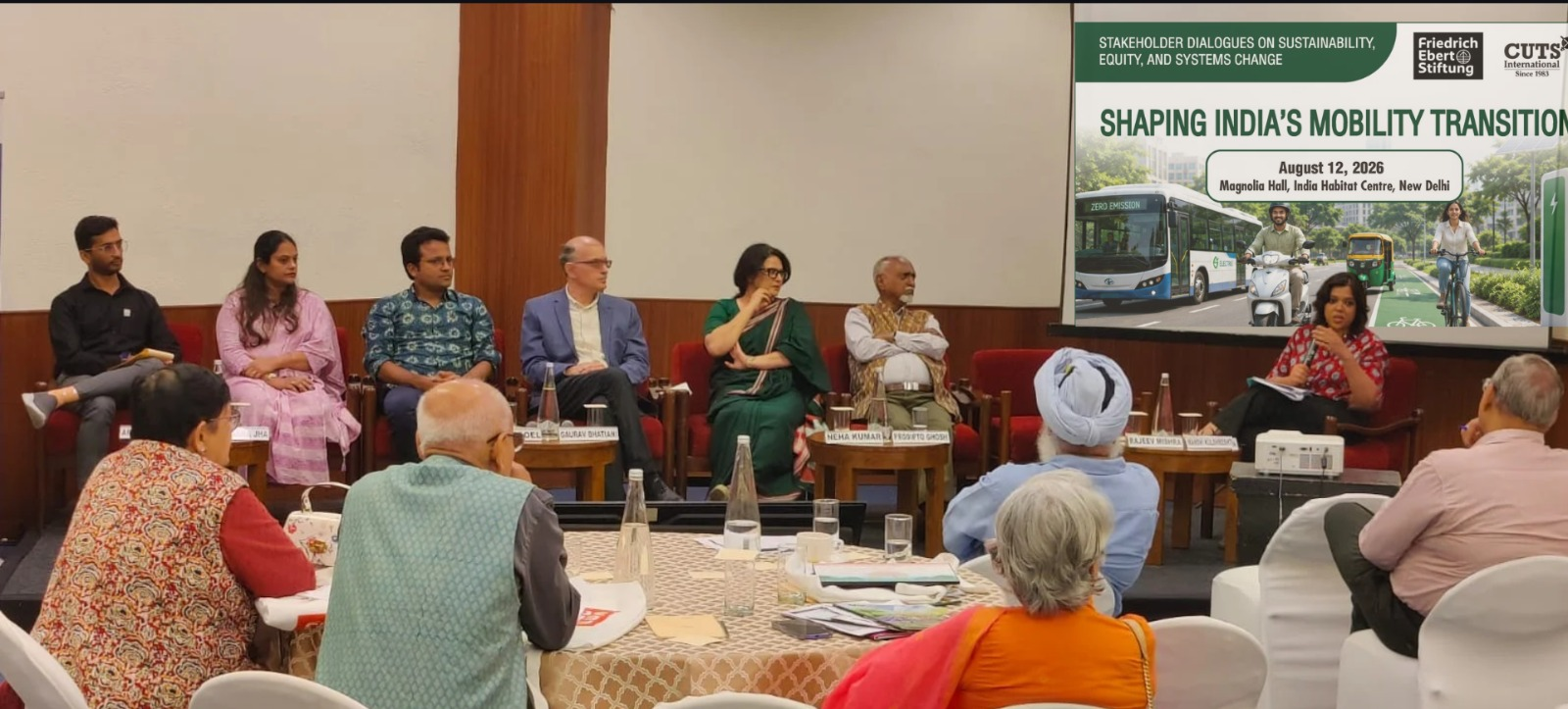
New Delhi, August 13, 2026: “We have a limited amount of public space and a restricted time frame, within which we must expand and utilise this public space judiciously,” said Sudhendu J Sinha, Former Adviser (Infrastructure Connectivity & Electric Mobility), NITI Aayog, highlighting the particular mobility challenges of Tier-2 cities and the need for pragmatic, locally tailored solutions.
His observation set the tone for Shaping India’s Mobility Transition: Stakeholder Dialogues on Sustainability, Equity, and Systems Change, organised by CUTS International and Friedrich-Ebert-Stiftung (FES) India in New Delhi.
Prodipto Ghosh, Distinguished Fellow, CUTS International, stressed that the transition is ultimately about changing how people travel. “Shifting people from private to public transport is ultimately a question of behaviour, shaped by policy,” he said, calling for transport systems to reflect both patterned and non-patterned travel. He also underlined the need to balance net-zero and air-pollution goals with automotive competitiveness, technological independence and economic stability, while strengthening institutions and regulatory coordination.
Mandvi Kulshreshtha, Senior Programme Adviser, FES India, emphasised the value of bringing different perspectives together: “Sustainable mobility cannot be addressed in isolation. Dialogues like this are essential to bring different perspectives together and build solutions that are both practical and sustainable.”
A recurring message was that EVs are important, but cannot constitute the entire mobility transition. Abhilasha Jha, Chief Executive Officer, Bharat Bio Energy Association, called for EVs, biofuels, green fuels and other resources to complement one another according to their suitability. Gaurav Bhatiani, Senior Fellow, Ashoka Centre for a People-centric Energy Transition (ACPET), Ashoka University, stressed that incentives must align with policy goals and that India’s diversity requires locally customised mobility solutions.
The discussion also brought infrastructure and road safety to the centre of mobility justice. Rahul Goel, Associate Professor, Transportation Research and Injury Prevention Centre, Indian Institute of Technology Delhi, called for a shift from car-centric to people-centric infrastructure. “Adopting a 30 km/h speed limit is an important prerequisite for safer, more inclusive roads,” he said, advocating greater community participation and stronger enforcement.
Financing was identified as equally critical. Neha Kumar, Head, South Asia Programme, Climate Bonds Initiative, noted that traffic congestion costs India an estimated US$22 billion annually in lost productivity, arguing that better mobility is also about giving people back time for family, rest and life. She called for greater priority for transport in state budgets, dedicated financing and transparent climate finance, while highlighting mobility’s role in expanding women’s access to employment.
Archit Fursule, Lead, Engagements and Partnerships, Climate and Sustainability Initiative (CSI) Global, highlighted the need for state-level collaboration through data sharing and coordinated policies. Rajeev Mishra, President, Indian Federation of Electronic Vehicles Association, pointed to India’s strong three-wheeler manufacturing base and the need for enabling regulations, training and sensitisation.
Pradeep S Mehta, Secretary General, CUTS International, raised a related question on the role of existing fuels: “Why are we not doing enough to ensure an adequate and reliable supply of CNG, particularly when it remains an important part of India’s mobility transition?”
Summing up the systems-change perspective, Madhvendra S Panwar, Assistant Director, CUTS International, said: “Real systems change happens when mobility, justice and smart planning intersect.”
The central message emerging from the dialogue was clear: India’s mobility transition will be measured not only by how quickly vehicles become cleaner, but by whether mobility becomes safer, more accessible, efficient, equitable and responsive to the people and places it serves. The deliberation therefore pointed towards a transition that goes beyond cleaner vehicles, encompassing stronger public transport, people-centric infrastructure, locally responsive planning, regulatory reform, innovative financing, and better coordination across levels of government.
The engagement brought together policymakers, researchers, industry and civil society to examine how India can make its mobility transition more sustainable, equitable and responsive to diverse local needs.
CUTS International is a public policy research and advocacy organisation working across trade, competition, regulation, investment and sustainable development. FES India works on social, economic and democratic policy issues through research, dialogue and stakeholder engagement.