


Gandhinagar, Aug 12: Indian Institute of Technology Gandhinagar has launched the Policy Research and Analytics for Governance Initiative, on August 11, 2026, a new platform that will bring together technology, public policy and governance themes to look at challenges for effective governance and sustainable development.
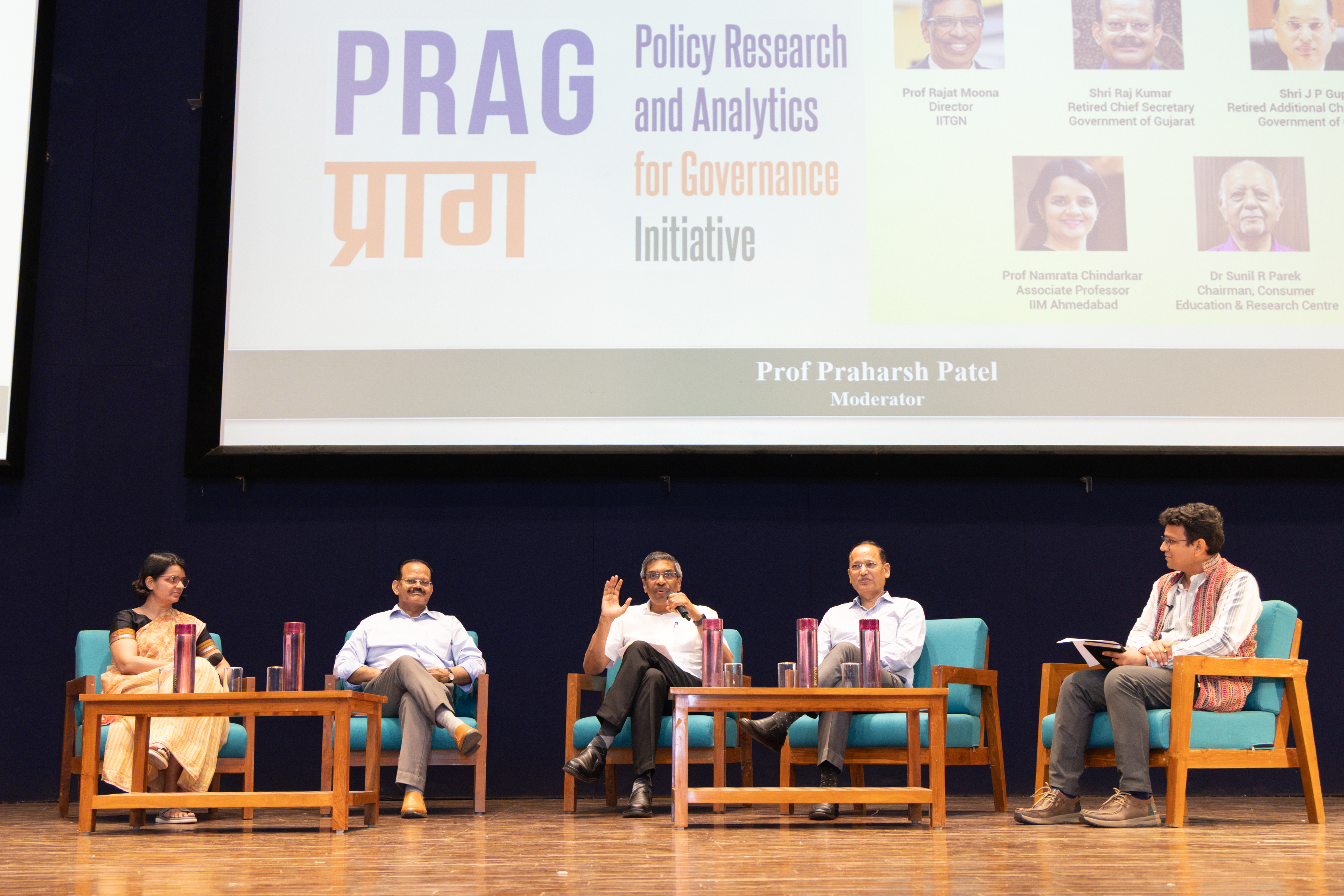
The initiative was launched as part of IITGN’s Foundation Programme and was marked by a panel discussion on “The Role of Technology Institute in Public Policy and Governance”. The discussion brought together former government officials, academics and professionals to look at how technology institutes can contribute to policy beyond their traditional academic and technical roles.
Prof Rajat Moona, Director, IITGN, spoke about the role technology institutes can play in preparing students to deal with problems that do not fit neatly into one discipline. He said students should be encouraged to take what they learn in the classroom and apply it to wider social and national challenges.
Introducing PRAG, Prof Praharsh M Patel, who is coordinating the initiative with Prof Deepak Singhania, spoke about the need for a space where technical expertise can be brought closer to the realities of policymaking and administration. The initiative will work across research, education and experiential learning, while also creating opportunities to work with government and other stakeholders.
The panel featured Shri Raj Kumar, former Chief Secretary, Government of Gujarat; Shri J P Gupta, former Additional Chief Secretary, Government of Gujarat; Prof Namrata Chindarkar, JSW School of Public Policy, IIM Ahmedabad; Prof Rajat Moona; and Dr Sunil R Parekh, Chairman, Consumer Education and Research Centre and Member, Senate, IITGN. Dr Parekh joined the discussion through a recorded video message.
Taking up the discussion on the role of technology institutes in public policy, Shri Raj Kumar highlighted evidence-based policymaking as a critical area where academic institutions can contribute. Explaining the challenge through the idea of “bounded rationality”, he noted that policymakers often have to make decisions with limited information, time and cognitive capacity. Citing the example of free or highly subsidised electricity for farmers, he pointed to groundwater depletion, distorted incentives and the financial burden on power distribution companies. “The most important problem can be faced in order to learning stages evidence-based policy,” he said, underscoring the need for stronger evidence and analysis in policy design and implementation.
He also emphasised the need to look beyond the district or state averages. “Conditions can vary dramatically within the same administrative area,” he said. Crop insurance is one example. Rainfall or crop damage in one part of a district may be very different from another, something that a single aggregate figure may not show. Better local-level data, he said, can lead to better policy decisions and more targeted use of resources.
Shri J P Gupta took the discussion towards how better use of data can improve policy decisions. He stressed that policymaking requires the right data to be identified, analysed and interpreted in line with the objective of a policy. He illustrated this through the electricity sector, explaining how granular consumption data from smart meters, combined with AI-based models, could help match electricity demand with periods of high solar generation. Such data-driven interventions, could encourage consumers to shift their electricity use, make better use of renewable energy and help address demand-supply challenges, he added.
Prof Namrata Chindarkar focused on another part of the data question: how existing data is used. She noted that India already produces large amounts of high-quality data, but its value can increase when relevant data is responsibly made available to people who can use it to answer important policy questions. She also stressed the need for policy, technology and public policy research to inform each other, particularly in areas such as energy, healthcare and infrastructure.
Prof Moona illustrated this point with examples from engineering concepts, where the same measure could mean different things in different circumstances. Giving the example of temperature, he noted that 45°C in summer in one place may not mean exactly the same thing in another place, and that 45°C for two minutes is different from 45°C sustained for an hour. Similarly, he said, policy outcomes cannot be judged only by a single number such as the amount of money spent; what matters is the impact created over time and the lives affected.
Taking the discussion from policy research to implementation, Dr Sunil R Parekh called for greater emphasis on testing policy interventions on the ground before taking them to scale. He proposed the idea of a Gujarat Policy Innovation Lab, where IIT Gandhinagar could work with the state government to design pilot interventions, establish baselines, evaluate outcomes and identify approaches that should be scaled or discontinued. “There is no shortage of good policies in Gujarat, but the bigger question remains what actually works on the ground, and how effectively,” he said.
Dr Parekh also proposed a Gujarat Data and Governance Observatory to bring together administrative data from sectors including health, education, agriculture, water and social welfare. He noted that much of this data currently remains within departmental silos and could be made more useful through integration, analysis and visualisation. Such a platform, he suggested, could help to strengthen evidence-led decision-making and shift governance from an input-focus to measurable outcomes.
Towards the end of the discussion, Shri Raj Kumar returned to the need to look at governance as a connected system. He used the shift from polluting autorickshaws to cleaner vehicles as an example. Simply removing older vehicles can have consequences for the livelihoods of drivers and may create pressure elsewhere on welfare systems. A more practical approach could combine environmental goals with financial support that helps drivers move to electric vehicles, he noted.
“There is no absolute right or wrong solution. We need to figure out what is the best solution within those constraints,” he said.
The discussion around PRAG pointed to a common theme: technology can contribute to governance, but its usefulness depends on how well it is connected to evidence, local realities and what happens on the ground. Through the new initiative, IITGN aims to create more opportunities for researchers, students, government and practitioners to work together on such questions.