


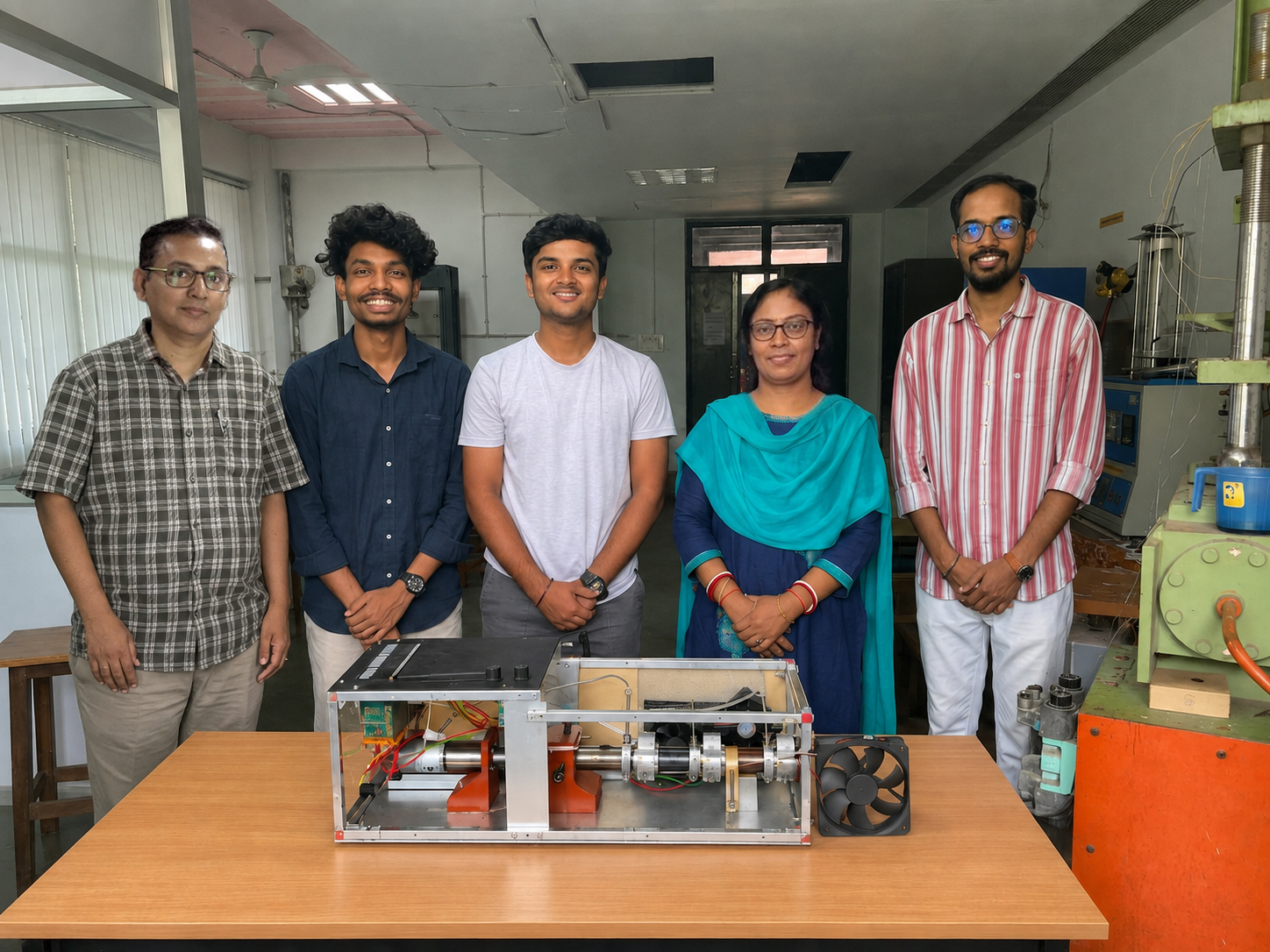
Rourkela, Aug 11: Innovators from National Institute of Technology Rourkela (NIT Rourkela) have patented a low-cost and portable extruder system to make filaments for 3D printing. The developed setup can use recycled plastics, minimizing full reliance on virgin materials and increasing the use of plastic waste.
From usage in biomedical and engineering fields to print scaffold, anatomical model, to the production of decorative items, brackets, drone parts and toys, 3D printing has become increasingly popular in India.
In this context, Fused Deposition Modeling (FDM) is the most widely used 3D printing technology. This process includes melting thermoplastic filament and precisely depositing it layer by layer to form the final object. In simple words, the thermoplastic filament can be considered as the ink in a 3D printer. In regular practice, pure (virgin) plastics are used.
The rapid growth of additive manufacturing has led to an increasing demand for high-quality thermoplastic and polymer filaments, which are often commercially expensive. Low-quality filaments may exhibit strength during the manufacturing process, resulting in poor print quality and reduced dimensional accuracy of the final products. To overcome these limitations, numerous research efforts worldwide are focused on developing cost-effective filaments from recycled plastics. However, the adoption of recycled filaments remains challenging due to the high cost of processing techniques, material wastage, inadequate mechanical strength, and limited durability, which restrict their widespread application.
Researchers at NIT Rourkela have addressed these challenges by developing a filament extrusion system that can manufacture filaments while recycling used plastic waste. Product is developed at a cost of approximately Rs. 45,000, this cost-effective system has several interconnected components such as an extruder, controlled cooling system, and PID temperature controllers, among others, that ensure precise control over the manufacturing process.
Explaining the developed extruder setup, Prof. Sandhyarani Biswas, Associate Professor, Department of Mechanical Engineering, NIT Rourkela, said, “The developed filament extrusion system represents advancement in filament production technology, offering compelling technical and commercial benefits for the 3D printing industry. The composite filament produced through the developed extruder can be used for 3D printing of parts with the improved mechanical properties, desired for wide range of applications. Further, the use of recycled plastic in making filament will offer substantial environmental benefits.”
The research team, including Prof. Sandhyarani Biswas, Prof. Sujit Sen, Mr. Jagdish Uday Khatu, Mr. Himanshu Singh and Mr. Kiran Suna, has secured a patent for the developed extrusion system (Application No. 202431068691 dated 30th July 2026).
The developed extrusion system is capable of producing different kinds of filaments by combining plastics particles with other reinforcement material, providing them additional strength and durability. In lab-scale tests, the research team has found the developed filaments with satisfactory mechanical properties and desired dimensional accuracy.
Explaining the potential of the developed setup, Prof. Sujit Sen, Professor, Department of Chemical Engineering, NIT Rourkela, said, “The developed extruder system is highly useful for converting various types of plastics into useful 3D printer filament, thereby forming sustainable closed-loop system. It has the potential to recycle, reuse and remanufacture various waste plastic materials to value-added products.”
Given its increased durability and strength, the filaments produced using the developed extruder setup patented by NIT Rourkela can be used in various settings. These include:
· Development of customized products in the automotive, aerospace, consumer goods, and electronics industries.
· Use in educational and research institutions for conducting experiments and studying material properties.
· Helps in production of medical devices component such as dental model, scaffolds and patient specific prosthetics and orthotics.
By promoting circular economy principles across industrial and research applications, the developed setup marks a major milestone towards more sustainable additive manufacturing practices.