


Artificial Intelligence has introduced a defining paradox for modern enterprises. The technology that is responsible for creating new opportunities, is now also bringing about new vulnerabilities.
AI is transforming business at an unprecedented pace. It is automating workflows, accelerating innovation, and enabling organisations to unlock new efficiencies. But the same technologies that are driving growth are also arming cybercriminals with sophisticated new capabilities.
Generative AI is enabling highly convincing phishing campaigns. AI-powered malware is adapting faster than traditional security systems can respond. Retrieval-Augmented Generation (RAG) is changing how organisations access knowledge, but it is also introducing new security considerations around sensitive enterprise data. As digital ecosystems become increasingly interconnected, the nature of cyber risk is shifting from isolated technical incidents to enterprise-wide business challenges.
The question facing organisations is no longer whether they will experience cyber threats. It is whether their leaders are prepared to navigate them.
Cybersecurity Has Moved from the Server Room to the Boardroom
For years, cybersecurity was largely viewed as a technology function managed by IT teams. Today, that perspective is rapidly becoming outdated.
Cybersecurity decisions now influence business continuity, customer trust, regulatory compliance, corporate reputation, and investor confidence. A single cyber incident can disrupt operations, impact financial performance, and erode years of brand equity.
As organisations accelerate AI adoption, leaders are increasingly expected to evaluate cyber risk alongside business strategy. They must make informed decisions about AI governance, cloud security, data protection, crisis management, and regulatory compliance, while ensuring innovation does not outpace organisational resilience.
The AI Era Demands a New Kind of Cyber Leader
The challenge for modern executives is not learning how to configure firewalls or detect malware. It is developing the strategic judgement to lead organisations through increasingly complex digital risks.
This requires understanding how AI is reshaping the threat landscape, while also recognising its potential to strengthen cyber defence. AI-powered threat detection, intelligent risk monitoring, automated incident response, and predictive cyber intelligence are becoming essential capabilities for resilient enterprises.
Leaders who understand both the opportunities and the risks of AI are better positioned to build organisations that remain secure without slowing innovation.
Executive Education Must Evolve Alongside Cyber Risk
As cyber threats become more sophisticated, executive education is evolving beyond traditional information security concepts.
Business leaders increasingly require learning that combines cybersecurity strategy with Artificial Intelligence, Generative AI, governance, regulatory frameworks, and enterprise resilience. Practical exposure to real-world business cases, cybersecurity frameworks, AI-enabled tools, and crisis management simulations is becoming essential for developing leadership confidence in an AI-enabled world.
This shift reflects a broader reality: organisations do not simply need better security professionals. They need better cyber-informed leaders.
Preparing Leaders for the Next Era of Cyber Resilience
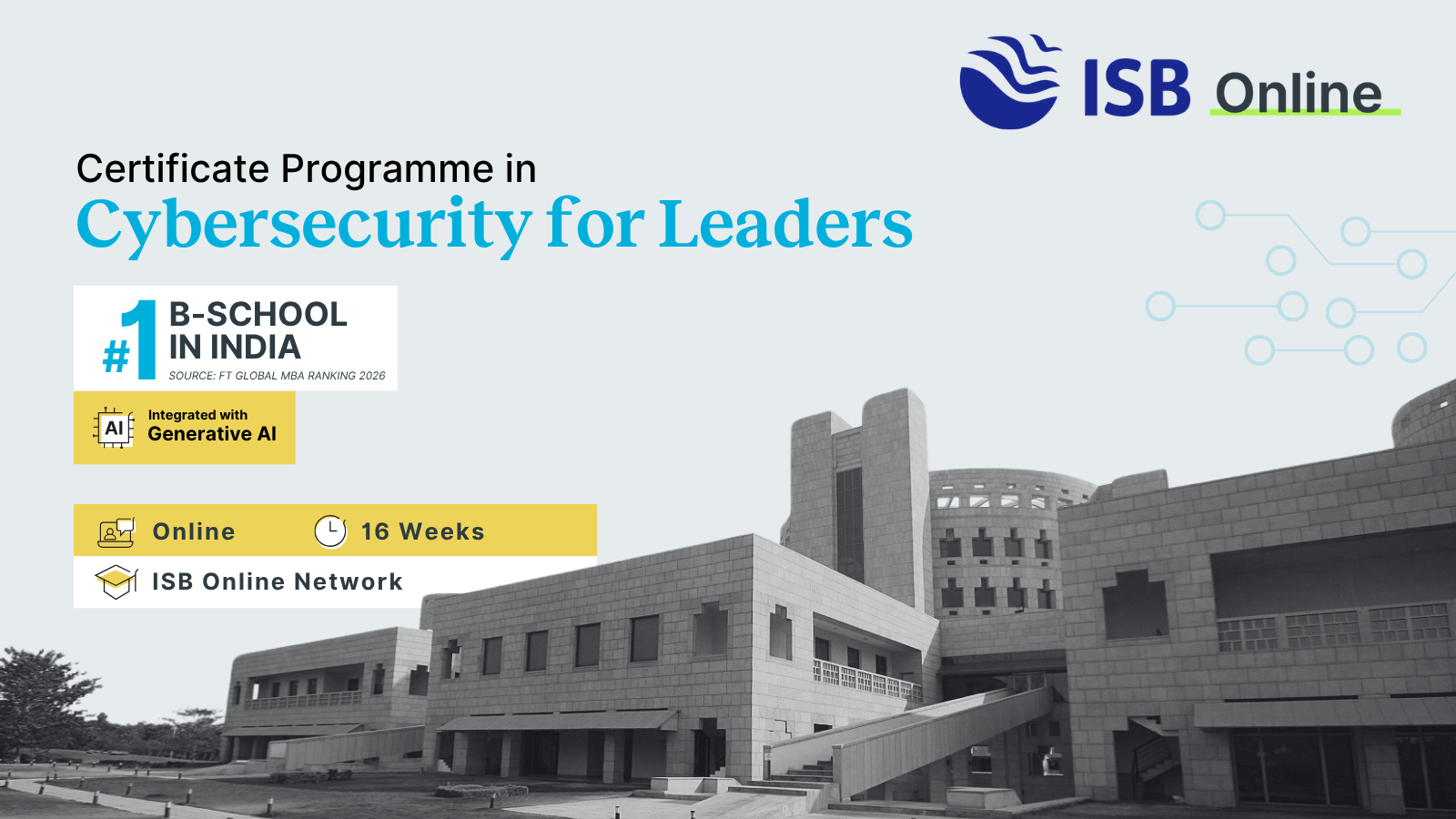
Academic-backed programmes like ISB Online‘s Cybersecurity for Leaders, is a 16-week executive journey, designed to help managers and business leaders navigate cybersecurity as a strategic business capability rather than a purely technical function.
The curriculum integrates cybersecurity with Artificial Intelligence, Generative AI, and Retrieval-Augmented Generation (RAG), enabling participants to understand emerging threats while exploring how AI can strengthen cyber defence, governance, business continuity, and organisational resilience.
Participants engage with enterprise case studies, cybersecurity frameworks, AI-enabled industry tools, leadership-focused capstone projects, and live masterclasses covering AI-powered cyber defence, Generative AI risks, RAG for cyber intelligence, and crisis management. Recorded fireside conversations featuring globally renowned ISB faculty and industry experts further enrich the learning experience with practical leadership insights.
Delivered by ISB Online, the digital learning arm of the Indian School of Business (ISB), the programme also draws on the institution’s globally recognised academic excellence. ISB is consistently ranked among the world’s leading business schools for executive education and management learning, reflecting its commitment to research-backed, industry-relevant education.
The Future of Cybersecurity Will Be Defined by Leadership
Technology alone will never eliminate cyber risk. Every major technological advancement creates new opportunities and new vulnerabilities.
The organisations that thrive in the AI era will not simply be those with the strongest security infrastructure. They will be those led by executives who understand how to align cybersecurity with business strategy, embed resilience into organisational culture, and make confident decisions during periods of uncertainty.
As AI continues to reshape the digital economy, cybersecurity is no longer just about defending systems. It is about protecting business continuity, enabling innovation, and building organisations that customers, investors, and regulators can trust.