


Students and Employees to benefit with regular monitoring of mental & physical health
CHANDIGARH, India, Aug. 8, 2026 /PRNewswire/ — A team of researchers at Chandigarh University has developed an attendance-based health monitoring system which integrates biometric attendance authentication with real-time physiological health monitoring. The system simultaneously measures multiple vital health parameters including body temperature, heart rate and blood pressure on a single device during biometric attendance.
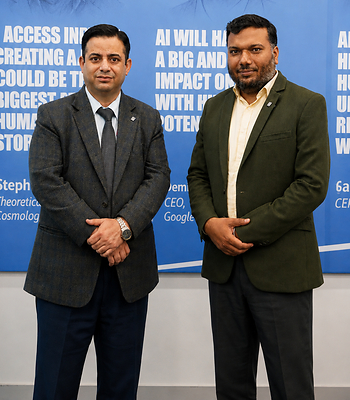
This innovative health monitoring system, developed by Chandigarh University Researchers, Dr Vikas Wasson, Professor CSE & Director (Engineering Foundations), Dr Sachin Kalsi, Associate Professor (Mechanical Engineering) and Head-Academic Operations (E-Governance) along with three CU students Rishabh Raj, Paras Gupta, Vikas Sharma has been granted a patent by the Indian Patent Office in 2026.
Prof Wasson said the invention addresses a growing societal concern where students and employees often work or study for long hours under intense academic and professional pressure, while neglecting their physical well-being. “In today’s highly competitive world, students and working professionals pursue their academic, career and organisational goals, many times at the cost of their health. But long working hours, stress, irregular routines and inadequate attention to well-being gradually affects an individual’s physical and emotional health. We live in an age surrounded by intelligent technology, yet most attendance systems do not pay attention to the well-being of the person. This invention is an attempt to bridge that gap by integrating health monitoring into an activity that people already perform every day. By monitoring vital health parameters, the system can support the early identification of unusual health trends, thereby contributing to healthier workplaces and educational institutions,” he said.
Prof Kalsi said the invention provides a practical solution for integrating daily attendance management with preventive healthcare monitoring. “Since attendance recording is a mandatory activity in most organizations and educational institutions, the system enables routine health assessment without requiring additional effort from users. It also supports digital health record management by maintaining authenticated historical health data, which can be useful for health trend analysis, occupational safety, and institutional health management,” he said.
“In addition, the system reduces the dependence on wearable monitoring devices by embedding health monitoring directly into the attendance process, making it cost-effective and scalable for large organizations. Overall, the invention contributes to the advancement of smart healthcare infrastructure by combining biometric authentication, real-time physiological monitoring, automated health assessment, and institutional alert mechanisms into a single integrated platform, thereby promoting proactive healthcare, improving safety, and supporting the development of intelligent workplaces and smart educational campuses,” he added.
Prof Wasson said, “Almost every day, millions of us walk up to a biometric machine — in schools, colleges, coaching centres, and offices. Rather than only recording who showed up, the enhanced biometric sensor also reads three vital signs — blood pressure, body temperature, and heart rate. In one effortless gesture that people already perform every single day, the machine begins to understand not just whether a person is present, but how they truly are on the inside,”.
Prof Kalsi said, “A single stressful morning — a frantic rush to reach office on time — can spike anyone’s heart rate and blood pressure. So the system never judges a person on one reading. Instead, it monitors each individual over a seven-day period to learn their personal, normal baseline. Only a genuine, sustained deviation from that baseline is treated as meaningful. Crucially, the readings are never displayed on the screen, because a person confronted with alarming numbers may panic and worsen their own condition. Instead, the weekly data will flow confidentially to the Human Resource team. If someone’s pattern shifts in a concerning way, the HR department can take timely action to provide required medical help,” he added.
Prof Wasson said sensors for blood pressure, temperature, and heart rate all exist today but as separate instruments and have not traditionally been integrated into a single attendance device that millions use at their workplace daily. “The true novelty here is integration: fusing quiet health monitoring into routine biometric attendance, so that emotional and physical distress can be detected early, within the natural rhythm of everyday life, without asking anyone to do a single extra thing. The mission is stated plainly, and it is deeply human: to save lives. By transforming a mundane daily habit into a compassionate early-warning system, this invention aims to build calmer classrooms, healthier workplaces, and — above all — a world where far fewer families are left to grieve the people they love most,” he added.
Congratulating Chandigarh University researchers for getting the patent for attendance based health monitoring system, Deepinder Singh Sandhu, Senior Managing Director, Chandigarh University said, “This achievement reflects the strong research and innovation eco-system at Chandigarh University to support research excellence and intellectual property generation for advancement of technology. Chandigarh University’s students and faculty members have filed more than 6,100 patents out of which 5800 patents have been published and 260 patents have been granted. Chandigarh University is ranked number one as a single institution in India for filing highest number of patents. CU’s 44 faculty members featured in Stanford University–Elsevier list of the world’s top 2% scientists. The range of research activities at Chandigarh University is wide-ranging and profound. University scholars conduct research in practically every domain, and pursue to develop human knowledge through investigation, invention, and understanding. Chandigarh University is recognized as Scientific and Industrial Research Organization (SIRO) by the Union Ministry of Science and Technology’s Department of Scientific and Industrial Research (DSIR) for promoting and advancing the research. To amplify research, Chandigarh University has dedicated an annual budget of Rs 15 Crore for research and has also 60 Research Centres and 15 Centres of Excellence. CU’s research initiatives are further strengthened by 67 projects funded by the corporate sector and government bodies with Rs 90 Crore,”.
About Chandigarh University
Chandigarh University is a NAAC A+ Grade University and QS World Ranked University. This autonomous educational institution is approved by UGC and is located near Chandigarh in the state of Punjab. It is the youngest university in India and the only private university in Punjab to be honoured with A+ Grade by NAAC (National Assessment and Accreditation Council). CU offers more than 109 UG and PG programs in the field of engineering, management, pharmacy, law, architecture, journalism, animation, hotel management, commerce, and others. It has been awarded as The University with Best Placements by WCRC.
Website: https://www.cuchd.in/
 View original content to download multimedia:https://www.prnewswire.com/in/news-releases/chandigarh-university-researchers-granted-patent-for-attendance-based-health-monitoring-system-to-monitor-three-vital-health-parameters-302846543.html
