


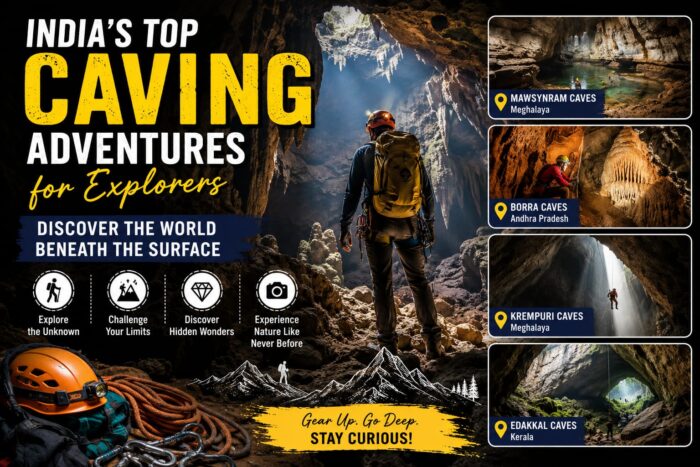
India is home to some remarkable natural landscapes, but some of its most fascinating wonders are hidden beneath the surface. Caving adventures in India offer travellers an opportunity to explore underground rivers, limestone formations, narrow passages and enormous natural chambers that have been shaped by geological processes over thousands and millions of years.
From the extensive cave systems of Meghalaya to ancient caves found in other parts of the country, cave exploration in India is attracting travellers who want something beyond conventional sightseeing. While some caves are relatively easy to visit, others require physical fitness, specialist equipment and experienced local guides.
For explorers looking to discover India’s underground world, these are some of the country’s most interesting caving destinations.
India’s Best Caving Destinations at a Glance
| Cave | Location | Experience Level | What Makes It Special |
|---|---|---|---|
| Krem Liat Prah | East Jaintia Hills, Meghalaya | Advanced | One of South Asia’s longest natural cave systems |
| Siju Cave | South Garo Hills, Meghalaya | Moderate to Advanced | Underground passages, streams and bat colonies |
| Mawsmai Cave | Sohra, Meghalaya | Beginner-Friendly | Accessible limestone cave and natural formations |
| Arwah Cave | Sohra, Meghalaya | Moderate | Fossils and natural limestone formations |
| Krem Puri | Mawsynram region, Meghalaya | Advanced | Extensive sandstone cave system |
| Krem Mawmluh | Near Sohra, Meghalaya | Advanced | Challenging passages and underground exploration |
Difficulty can vary depending on weather, route and the section of a cave being explored. Travellers should confirm current access and safety conditions locally.
Why Caving Is an Exciting Adventure in India
Caving is more than simply walking into a dark underground passage. It provides a close look at geological formations, underground waterways and ecosystems that are rarely visible during conventional travel.
India’s varied geology has resulted in caves of many different types. Meghalaya, in particular, is famous for its extensive limestone cave networks. The state’s Khasi, Jaintia and Garo Hills contain numerous caves, ranging from relatively accessible tourist attractions to complex systems explored by experienced cavers.
For travellers, this creates an unusual form of adventure where the journey itself becomes part of the attraction.
1. Krem Liat Prah, Meghalaya
For experienced explorers, Krem Liat Prah is one of India’s most impressive caving destinations. Located in the East Jaintia Hills, the cave system is more than 30 kilometres long and is recognised as the longest natural cave in South Asia.
One of its best-known sections is the Aircraft Hangar, a remarkably large natural passage. The Shnongrim Ridge area surrounding Krem Liat Prah is also known for numerous other caves, making the region particularly important to the caving community.
This is not a typical sightseeing cave. Exploring its deeper sections requires preparation, appropriate equipment and experienced guides.
Best suited for: Experienced cavers, serious explorers and geology enthusiasts.
2. Siju Cave, Meghalaya
Located in the South Garo Hills near the Simsang River, Siju Cave is one of Meghalaya’s best-known underground attractions. It is also called the Bat Cave because of the large number of bats found within its passages.
The cave features winding limestone passages, underground streams, stalactites and stalagmites. Some sections can be challenging, which makes local guidance particularly important.
The surrounding landscape also adds to the appeal, allowing visitors to combine cave exploration with Meghalaya’s rich biodiversity and scenic countryside.
Best suited for: Experienced explorers, wildlife enthusiasts and photographers.
3. Mawsmai Cave, Meghalaya
For travellers new to caving in India, Mawsmai Cave near Sohra, or Cherrapunji, is one of the more approachable choices.
Unlike long expedition-style cave systems, Mawsmai offers visitors the opportunity to experience natural underground formations through a comparatively accessible route. The cave’s limestone passages provide a glimpse into the geological character of the region without requiring the level of preparation associated with advanced caving.
Its location near several of Sohra’s major attractions also makes it convenient to include in a wider Meghalaya itinerary.
Best suited for: Beginners, families and first-time cave explorers.
4. Arwah Cave, Meghalaya
Located near Sohra, Arwah Cave offers a more natural and adventurous experience. Unlike some of the more developed tourist caves, its surroundings retain a relatively rugged character.
The cave is known for its limestone formations and fossilised material, giving visitors an opportunity to observe traces of the area’s geological past. Reaching the cave also involves walking through the surrounding landscape, making the journey part of the experience.
For travellers spending several days in Sohra, Arwah Cave is a worthwhile option for getting away from the more familiar tourist routes.
Best suited for: Nature lovers, photographers and adventure travellers.
5. Krem Puri, Meghalaya
Located in the Mawsynram region, Krem Puri is particularly interesting because of its sandstone geology and extensive underground passages.
The cave has attracted attention from caving expeditions and adventure enthusiasts because of its scale and challenging environment. Its relatively remote character also makes it different from more accessible tourist caves in Meghalaya.
Anyone planning to explore deeper sections should travel with experienced local guides and use appropriate caving equipment.
Best suited for: Experienced adventurers and serious cave explorers.
6. Krem Mawmluh, Meghalaya
Close to Sohra, Krem Mawmluh is another destination for travellers interested in a more demanding form of Meghalaya caving.
The cave contains narrow sections and uneven terrain, requiring visitors to be comfortable with physically challenging conditions. Water levels and conditions inside natural caves can also change depending on the weather.
This makes preparation particularly important. Visitors should rely on experienced guides and check local conditions before entering.
Best suited for: Experienced cavers and adventure enthusiasts.
Why Meghalaya Is India’s Caving Capital
Although caves can be found in several parts of India, Meghalaya stands apart because of the extraordinary scale and variety of its underground systems.
The state’s heavy rainfall, limestone geology and rugged terrain have contributed to the formation of extensive cave networks across the Khasi, Jaintia and Garo Hills. Meghalaya Tourism promotes several destinations for cave exploration, including Mawsmai, Arwah, Siju and Krem Liat Prah.
For adventure travellers, this means that a single trip to Meghalaya can offer several very different underground experiences—from a relatively easy cave visit to a serious expedition lasting several hours or more.
What to Carry for a Caving Adventure
The equipment required depends on the cave and the type of exploration planned. However, travellers should consider carrying:
- A properly fitted helmet
- A reliable headlamp
- Backup lighting and extra batteries
- Non-slip footwear
- Quick-drying clothes
- Gloves for rocky surfaces
- Drinking water
- Energy snacks
- Basic first-aid supplies
- Waterproof bags for phones and cameras
For more demanding cave systems, specialist equipment may be necessary. Travellers should follow the recommendations of experienced guides rather than attempting to explore challenging caves independently.
When Is the Best Time for Caving in India?
Weather plays an important role in planning a caving adventure, particularly in Meghalaya. Heavy rainfall can increase water levels inside caves and make passages slippery or difficult to access.
The drier months are generally more suitable for exploring many Meghalaya caves, although the best travel period can vary from one cave to another. For example, Meghalaya Tourism recommends October to April for Krem Liat Prah and November to March for Siju Cave.
Travellers should always check local weather and access conditions before visiting a cave because natural conditions can change quickly.
Safety Tips for Cave Exploration
Caving can be an exciting experience, but it should not be treated like an ordinary sightseeing activity.
Before entering a cave:
- Check the weather forecast, particularly during the monsoon.
- Use a local guide who knows the cave and surrounding area.
- Never explore an unfamiliar cave alone.
- Carry more than one source of light.
- Wear footwear with good grip.
- Keep electronic equipment protected from water.
- Follow marked routes and local instructions.
- Avoid entering restricted or unexplored sections.
- Inform someone about your planned route and expected return.
The difficulty of a cave can also vary considerably depending on weather conditions. A route that appears manageable in dry weather may become significantly more challenging after heavy rain.
Explore India’s Caves Responsibly
Caves are fragile natural environments. Limestone formations such as stalactites and stalagmites can take extremely long periods to develop, while bats and other organisms depend on caves for shelter.
Responsible caving means leaving the underground environment as it was found.
Visitors should avoid touching or breaking rock formations, refrain from disturbing wildlife, carry their waste back out and follow local conservation rules. Supporting local guides and communities can also help ensure that tourism contributes positively to the destinations.
The Adventure Beneath India’s Landscapes
India’s caves reveal a side of the country that is easy to overlook. While the country’s mountains, beaches and forests attract millions of travellers, the landscapes beneath the surface tell a different story—one shaped by water, rock and time.
For experienced explorers, Krem Liat Prah, Siju Cave, Krem Puri and Krem Mawmluh offer challenging underground adventures. For beginners, Mawsmai Cave provides a more accessible introduction, while Arwah Cave offers a balance between natural surroundings and exploration.
With the right preparation and a responsible approach, caving adventures in India can turn an ordinary trip into a genuine exploration experience. And for travellers willing to venture beyond the usual tourist trails, Meghalaya’s underground world offers plenty of reasons to look beneath the surface.