


India, July 30: Haier Smart Home, part of Haier Appliances India, global major appliances brand for 17 consecutive years, has once again earned its place on the prestigious 2026 Fortune Global 500 list. It has surged an impressive 12 spots to secure the No. 378 rank. This marks its ninth straight year on this esteemed index. The result reflects two forces that have been building in parallel: a global brand and operations footprint that has matured into genuine local leadership in every major market, and an AI integration effort that is restructuring how the organization itself works.
Global Brands, Local Leadership
Haier Smart Home’s brand portfolio, including Haier, Casarte, Leader, GE Appliances, Fisher & Paykel, AQUA, and Candy, operates as market leaders with their own manufacturing bases, R&D mandates, and product roadmaps tailored to local users. In North America, GE Appliances has held the No. 1 position among U.S. appliance companies for four consecutive years, with enlarging market share. In Europe, the company organizes by country rather than region, prioritizing speed of local response over scale efficiency. The X11 washing machine — engineered across Nuremberg, Milan, and China — consumes 70% less energy than Europe’s highest A-class standard and has sold over one million units across 20-plus countries. In Southeast Asia, where Haier now ranks No. 1, a new air conditioning production base also deepens local manufacturing capabilities.
The core strength lies in operating as a local incumbent in each market — with the product depth, manufacturing proximity, and brand resonance that incumbency demands.
AI Embedded, Not Bolted On
Internally, Haier Smart Home has embedded AI across every function through a self-developed domain-specific large model and a unified technology platform. The internal entry point, ZhiXiaoNeng, is an AI digital worker serving more than 60,000 users that independently executes complete processes.
In manufacturing engineering, ZhiXiaoNeng drafts process plans from historical data, compressing an hours-long task into minutes with a 20% improvement in accuracy. The engineer’s role shifts from drafter to reviewer — a redefinition of the work itself. Across the organization, new product development cycles have shortened by 30%, manufacturing efficiency is up 20%, and the SG&A expense ratio has declined for five consecutive years.
This represents organizational velocity — the speed at which a signal from a user in Lyon or Lucknow can translate into a product change, a service adjustment, or a new scenario offering.
Where It Converges
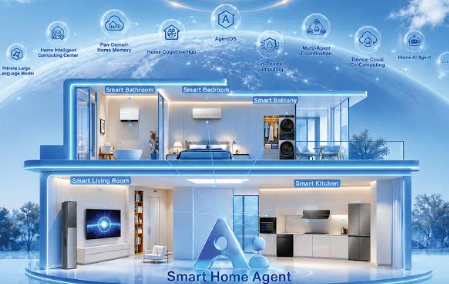
The smart home business sits where these two forces meet. Centered on an AI Agent, Haier Smart Home delivers AI products that anticipate user needs, AI scenarios that coordinate devices into coherent experiences, and AI lifestyles that extend intelligence into a unified person-vehicle-home-community continuum.
The scale is no longer experimental: 130 million global registered users, 86.1 billion annual scenario interactions, and certification from Euromonitor International as the world’s No. 1 enterprise by smart home sales — a shift from No. 1 in major appliances to No. 1 in smart homes.
Taken together, the Fortune Global 500 climb is not a single-year event. It is the measurable outcome of a company that has been building local leadership in every market it serves and embedding AI across every function it runs — and the two are now reinforcing each other in ways that are difficult for competitors to replicate.