


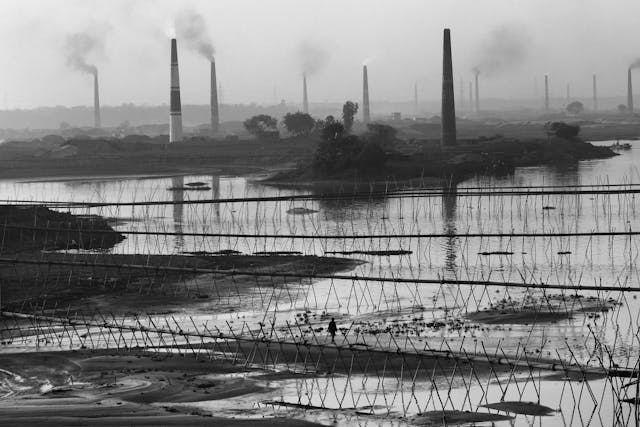
Introduction: A Dual Crisis — Economic and Environmental
India is facing a deepening crisis where environmental degradation and economic stability are inseparably linked. Air pollution—once viewed mainly as an ecological problem—has now become a major public health and economic threat. Rapid urbanisation and unchecked industrial expansion are filling the skies of Indian cities with harmful emissions from vehicles, construction, and factories, creating severe consequences for both people and the economy.
The urgency of this issue was most recently highlighted in Delhi, where pollution levels surged past safe limits, prompting health warnings, school closures, and sharp public outcry. These periodic spikes in dangerous smog remind us that air pollution isn’t seasonal or temporary—it is a chronic challenge with lasting effects.
Poor air quality is contributing to increasing rates of respiratory disorders, heart disease, and premature deaths. Vulnerable groups like children, the elderly, and those with pre-existing conditions are especially at risk, placing greater strain on India’s healthcare system and social infrastructure.
At the same time, the economic fallout—from lost workdays to spiralling medical costs and declining productivity—is increasingly evident. Addressing this crisis demands a new way of thinking—one that recognises air pollution not just as an environmental hazard but as a critical economic liability.
The Limits of India’s Traditional Growth Model
For decades, India’s economic strategy has prioritised rapid urbanisation, industrial growth, and rising consumption as markers of success. This focus has helped lift millions out of poverty and fuelled impressive GDP growth. But it has also taken a heavy toll on the environment.
Migrants flocking to cities in search of better opportunities have placed intense pressure on infrastructure. Construction activity, rising vehicle ownership, and growing energy demand all contribute to worsening air quality. Cities intended to be engines of progress increasingly struggle under layers of smog and toxic pollutants.
Industrial expansion, while creating jobs and boosting output, has in many cases ignored environmental safeguards. Factories in polluting sectors often fail to invest in clean technology, releasing harmful emissions into the air.
Meanwhile, rising consumption linked to higher incomes has intensified resource extraction and waste production, adding further strain on the environment.
While this traditional growth model has delivered economic gains, it has also overlooked its environmental costs. Recognising these flaws is essential for reshaping India’s development journey.
The Health Toll of Polluted Air
Air pollution in India has become a major public health challenge. Exposure to high levels of fine particulate matter (PM2.5 and PM10) has been linked to asthma, chronic obstructive pulmonary disease (COPD), cardiovascular problems, and reduced life expectancy. According to recent studies, cities with the worst air quality, including Delhi, have residents experiencing measurable declines in overall health outcomes.
The impact extends beyond physical health—hospital admissions for pollution-related illnesses surge during high-smog periods, increasing demand for medical care and driving up healthcare costs for families and the government.
This health burden also translates into economic losses. Workers suffering from pollution-related illness are more likely to miss work or be less productive on the job. Over time, reduced productivity hinders economic performance and affects national growth prospects.
The Economic Costs of Polluted Air
Air pollution doesn’t just damage lungs—it damages livelihoods.
Healthcare Expenditures
Millions of pollution-related medical cases lead to high personal and public health spending, diverting funds from education, infrastructure, and social services.
Lost Productivity
Workers affected by poor air quality are less productive and more likely to take sick leave. This reduces output across sectors and strains businesses.
Economic Output
Economic indicators rarely capture the full cost of environmental damage, meaning policymakers may underestimate the true price of pollution. Without factoring these costs into development planning, India risks long-term economic harm that outweighs short-term gains from growth-oriented policies.
Rethinking Environmental Solutions: The Green Paradox
In recent years, environmental campaigns like large-scale tree planting have become popular. While expanding green cover is beneficial, research shows that one-size-fits-all approaches can backfire.
Planting trees without considering local climate and water availability can strain scarce resources, especially in water-stressed regions. In some cases, well-intentioned programmes have diverted attention away from more impactful solutions, such as reducing emissions at the source.
This phenomenon—sometimes called the “green paradox”—underscores the need for context-specific strategies. Effective pollution control must combine ecological knowledge with targeted interventions that address the root causes of air pollution.
Shifting Economic Perspectives: Sustainability as a Core Principle
Tackling air pollution effectively requires a fundamental shift in how India defines economic success. Instead of focusing primarily on GDP, policymakers should integrate environmental health and sustainability into economic planning.
Redefining Progress
Traditional economic metrics should be supplemented with indicators that assess air quality, public health, and ecological resilience. This would support policies that balance growth with environmental wellbeing.
Clean Energy and Innovation
Accelerating investment in renewable energy—such as solar, wind, and bioenergy—can reduce dependence on fossil fuels. Such investments not only cut emissions but also create new industries and jobs.
Public-Private Collaboration
Partnerships between government and industry can drive innovation in clean technologies and sustainable infrastructure, enabling scalable solutions.Effective Actions to Control Air Pollution
To achieve cleaner air and stronger economic health, India must take decisive action:
1. Strengthen Emission Standards
Enforce stricter pollution norms for industries and vehicles. Promote cleaner fuels and tighter regulation of industrial emissions.
2. Expand Public Transportation
Invest in efficient and affordable public transit systems to reduce private vehicle use. Promote electric buses, metro systems, and non-motorised transport options like cycling.
3. Promote Clean Industry
Support businesses in adopting low-emission technologies through incentives, subsidies, and tax benefits.
4. Urban Design for Health
Design cities that improve air flow, increase green spaces where appropriate, and minimise exposure to pollution hotspots.
5. Public Awareness and Behaviour Change
Educate citizens about pollution risks and ways to reduce personal exposure, such as using public transport and avoiding outdoor activities during peak smog.
Drawing Lessons from Global Successes
Countries like the United States, members of the European Union, and Singapore have shown that proactive air quality policies can deliver both environmental and economic benefits.
-
U.S. Clean Air Act standards helped reduce harmful emissions while supporting innovation and economic growth.
-
EU low-emission zones reduced urban pollution and encouraged sustainable transport.
-
Singapore’s integrated planning improved air quality through efficient public transport and green technology adoption.
These examples highlight the importance of policy clarity, scientific guidance, and public engagement in driving measurable results.
Conclusion: A Sustainable Path Forward
India’s battle with air pollution is more than an environmental mission—it is an economic imperative. Poor air quality threatens public health, reduces productivity, and undermines long-term prosperity. Reimagining economic policies to prioritise sustainability is not just beneficial—it is essential.
By embracing cleaner energy, smarter cities, and evidence-based environmental strategies, India can protect its citizens and secure a resilient economic future. The path forward demands collective effort—government, industry, communities, and individuals working together to ensure that economic growth and environmental health move in harmony.