


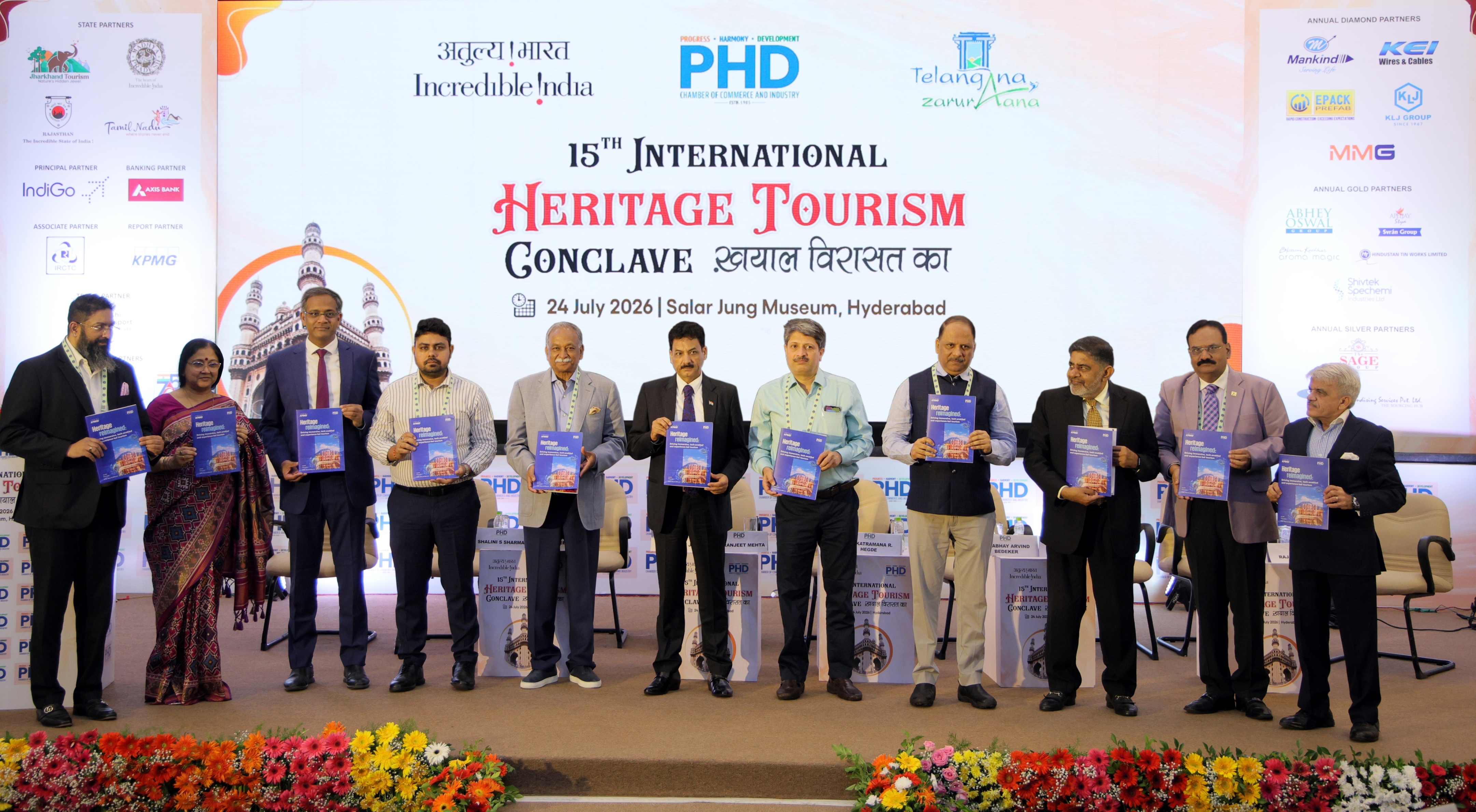
A national call to reposition heritage, specially culinary heritage, as a strategic pillar of India’s tourism economy, supported by greater private sector participation, investment-friendly policies, technology adoption and community engagement, emerged at the 15th International Heritage Tourism Conclave (IHTC) organized by the PHD Chamber of Commerce and Industry (PHDCCI) on 24 July 2026 at the Salar Jung Museum, Hyderabad.
Organised with the support of the Ministry of Tourism, Government of India, under the theme ख़याल विरासत का (Care for Heritage), the conclave brought together senior government officials, policymakers, tourism boards, museum leaders, conservation experts, hospitality professionals, academicians, technology innovators and industry stakeholders to deliberate on practical strategies for preserving India’s cultural legacy while unlocking its economic and tourism potential.
State Tourism Boards which supported the conclave included Telangana Tourism, Jharkhand Tourism, Madhya Pradesh Tourism, Rajasthan Tourism and Tamil Nadu Tourism.
Third edition of the PHDCCI-KPMG Report on Heritage Tourism was released on this occasion. The report presents strategic recommendations for strengthening India’s heritage tourism ecosystem through policy reforms, destination planning, investment facilitation, digital innovation, skill development and greater industry participation. The report highlights the growing importance of heritage tourism as a driver of employment generation, regional development and cultural preservation while outlining strategies to improve visitor experiences and unlock greater private sector investment.
Addressing the conclave, Mr. Venkatramana R. Hegde, Additional Director General, Ministry of Tourism, Government of India, reaffirmed the Ministry’s commitment to working closely with states and industry to strengthen India’s tourism ecosystem. “India has made significant progress in strengthening its global tourism competitiveness, supported by substantial investments in tourism infrastructure and heritage development. With more than 3,300 protected monuments and billions of domestic tourist visits annually, the opportunity before us is to improve destination infrastructure, visitor experiences and ease of doing business. Tourism deserves industry status and stronger partnerships between governments, industry and institutions such as PHDCCI will be essential for unlocking the sector’s full potential.”
Dr. Abhay Arvind Bedekar (IAS), Additional Managing Director, Madhya Pradesh Tourism Board, emphasized that conservation and tourism must progress together. “Heritage is both tangible and intangible and preserving it requires commitment, collaboration and pride. From UNESCO World Heritage Sites to community traditions and innovative partnerships, Madhya Pradesh is working to demonstrate how conservation can generate tourism opportunities while safeguarding cultural identity. Platforms like this conclave are invaluable in sharing ideas and strengthening collective efforts towards heritage preservation.”
Speaking on Telangana’s tourism vision, Mr. L. Ranjeet Nayak (IFS), Director – Tourism, Government of Telangana, said the state is committed to creating an enabling ecosystem for heritage-led development. “Telangana is the youngest state in India, yet it possesses one of the country’s richest cultural legacies. Our focus is on opening heritage assets for responsible private participation, strengthening destination development, leveraging Artificial Intelligence to enrich visitor experiences and creating employment by training young people as heritage interpreters and guides. What we preserve today will become the heritage of tomorrow.”
Welcoming the delegates, Dr. Ranjeet Mehta, CEO & Secretary General, PHDCCI, said heritage tourism has emerged as a powerful catalyst for economic growth, employment generation and community empowerment. “India’s cultural heritage is one of its greatest strengths and has the potential to become a significant driver of sustainable economic development. The next phase of heritage tourism must combine conservation with transformation by leveraging digital technologies, innovation and stronger partnerships between government, industry and cultural institutions.”
Delivering the theme address, Mr. Anil Parashar, Chair – Tourism & Hospitality Committee, PHDCCI, said India’s heritage tourism strategy must move beyond preserving monuments towards creating meaningful visitor experiences rooted in culture and community. “Heritage belongs to all of us and preserving it is a shared responsibility. India’s monuments, museums, crafts, cuisine, performing arts and living traditions together create experiences that few countries can offer. By embracing emerging technologies such as Artificial Intelligence, immersive storytelling and virtual reality while empowering local communities, we can preserve our legacy and simultaneously build a globally competitive heritage tourism ecosystem.”
Mr. Gautam Jain, Chair – Telangana Chapter, PHDCCI, highlighted the city’s unique position as a destination where history, hospitality and modern infrastructure come together. “Hyderabad is a living museum where every monument, market, craft and culinary tradition tells a story. Alongside its emergence as a global investment destination, Telangana has recognized tourism as an important engine of economic growth. By strengthening collaboration between government and industry and encouraging greater investment, Hyderabad has the potential to become one of Asia’s leading heritage tourism destinations.”
Mr. Sunil Kumar, Co-Chair – Telangana Chapter, PHDCCI, said the future of tourism lies in creating memorable experiences rather than simply increasing visitor numbers. “Travellers today seek authenticity, whether through heritage, cuisine, local traditions or cultural experiences. India’s diversity gives us a unique competitive advantage, but unlocking its full tourism potential will require investment in skills, digital connectivity, destination infrastructure and stronger participation from local communities. Heritage tourism can play an important role in achieving India’s long-term economic aspirations.”
The inaugural session concluded with a vote of thanks by Mr. Rajan Sehgal, Co-Chair – Tourism & Hospitality Committee, PHDCCI, who reiterated that preserving both tangible and intangible heritage is fundamental to building a sustainable and globally competitive heritage tourism sector.
During the conclave, PHDCCI and Axis Bank signed a Memorandum of Understanding to strengthen collaboration in the tourism and hospitality sector. The MoU was signed by Dr. Ranjeet Mehta, CEO & Secretary General, PHDCCI and Mr. Shrikesh P., Regional Branch Banking Head, Axis Bank, with the objective of facilitating greater engagement with industry stakeholders and supporting initiatives that contribute to the growth of tourism and hospitality.
The conclave featured four thematic sessions that examined emerging opportunities and policy priorities across the heritage tourism ecosystem.
The session ‘The New Age of Museums’ moderated by Mr. Aalap Bansal, Partner, KPMG India, explored how museums must evolve beyond being repositories of artefacts into vibrant cultural institutions that drive tourism, education and community engagement. Ms. Priyanka Francis (IAS), Director, Salar Jung Museum & National Gallery of Modern Art, Bengaluru; Mr. Ajay B. Kochle, Director, Chhatrapati Shivaji Maharaj Vastu Sangrahalaya; Prof. Aloka Parasher Sen, Author and Historian; Ms. Anuradha Reddy, Convenor, INTACH Hyderabad Chapter; and Ms. Shoba Rudra, Partner & Founder, RARE India, discussed changing visitor expectations, the role of immersive interpretation, sustainable revenue models and stronger integration between museums, historic neighbourhoods and local communities.
The session ‘Food is Memory’ moderated by Chef Thomas Zacharias, Founder, The Locavore, highlighted culinary heritage as an important tourism asset capable of strengthening destination identity and local economies. Chef Manjit Gill, President, Indian Federation of Culinary Associations; Chef Madhu W. Krishnan, President, Bocuse d’Or India; Mr. Sanjay Thakur, Principal, Institute of Hotel Management, Hyderabad; and Mr. Rubin Cherian, General Manager, Novotel Hyderabad Convention Centre & HICC, discussed preserving regional food traditions, promoting indigenous cuisines, encouraging responsible culinary tourism and building stronger linkages between local producers, hospitality businesses and travellers.
The session ‘Shared Heritage, Shared Responsibility’, moderated by Ms. Shalini S Sharma, Assistant Secretary General, PHDCCI, focused on policy interventions required to expand public-private partnerships in heritage conservation. Mr. D. Venkatesan, Regional Director (South), Ministry of Tourism; Dr. Devendra Singh, Assistant Superintending Archaeologist, Archaeological Survey of India; Mr. Deepraj Singh, EC Member, Indian Heritage Hotels Association and Owner, Laxmi Vilas Palace, Bharatpur; Mr. Raju Sharma, Director – CSR, InterGlobe Aviation Ltd (IndiGo); and Mr. Ajay Verma, Chief Experience Officer, EaseMyTrip, deliberated on adaptive reuse of heritage properties, CSR-led conservation, strengthening the Adopt a Heritage initiative and creating policy frameworks that encourage responsible private investment while preserving the integrity of heritage assets.
The concluding session, ‘Tech, AI & the Future of the Past’, moderated by Mr. Raghava Krishna, Founder & CEO, Brhat, explored how Artificial Intelligence and immersive technologies are transforming heritage conservation, documentation and visitor engagement. Dr. Shiva Ji, Associate Professor, IIT Hyderabad; Mr. Ajit Padmanabh, Founder & CEO, Who VR; Mr. Vijay P. Kamalakara, Founder & CEO, Storytrails; and Mr. Santosh Kalyan Kumar, Founder & CEO, Consistency AI and Jatayuv AI, showcased applications including digital twins, multilingual AI, immersive storytelling and virtual experiences while emphasizing that technology should complement authentic cultural narratives rather than replace them.
The conclave also facilitated more than 30 structured B2B meetings between state tourism boards, hospitality companies, tour operators, travel businesses and cultural enterprises, to foster cross-sector collaboration and business development.
Extending the discussions beyond the conference venue, PHDCCI curated immersive heritage experiences for delegates. A pre-conclave heritage walk at the Taj Falaknuma Palace on 23 July offered participants insights into Hyderabad’s royal architectural legacy and conservation practices. The conclave concluded with a heritage walk through Charminar, Laad Bazaar and the historic quarters of the Old City on 25 July, enabling delegates to experience Hyderabad’s living heritage, traditional crafts, historic markets and culinary traditions firsthand.
The conclave was supported by IndiGo; Axis Bank; IRCTC; Bakshi Transport Service; KPMG; Association of Domestic Tour Operators of India (ADTOI); Indian Association of Tour Operators (IATO); Indian Heritage Hotels Association (IHHA); and Travel Agents Association of India (TAAI).