


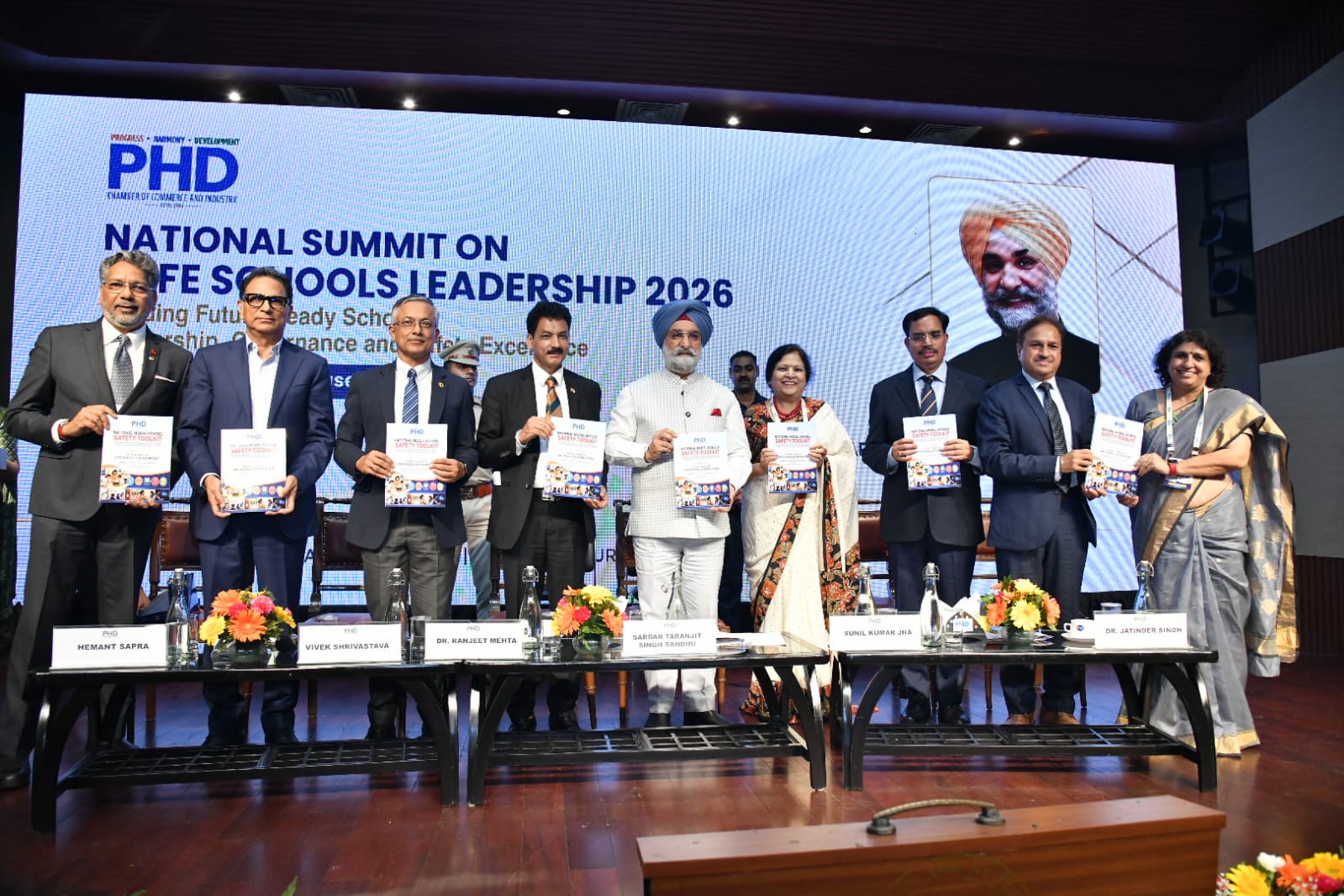
New Delhi, July 23: Reinforcing the national commitment towards creating safe, resilient and future-ready educational institutions, PHD Chamber of Commerce and Industry (PHDCCI) organised the National Summit on Safe School Leadership 2026 on the theme “Building Future-Ready Schools: Leadership, Governance and Safety Excellence” at PHD House, New Delhi.
The Summit convened senior policymakers, government officials, education leaders, school administrators, safety professionals and industry experts to deliberate on strengthening governance frameworks and institutional preparedness across India’s school ecosystem.
A landmark outcome of the Summit was the launch of the National Model School Safety Toolkit, developed under the aegis of the PHDCCI Safety & Fire Committee. Designed as a comprehensive implementation framework, the toolkit equips educational institutions with practical guidance to institutionalise safety across five critical pillars: Fire & Infrastructure Safety, Cyber Safety, Transport Safety, Mental Well-being and Emergency Preparedness thereby embedding safety into the core of school leadership and governance. This Toolkit is a voluntary model resource prepared by the PHD Chamber of Commerce and Industry for education, awareness, planning and institutional self-assessment.
Delivering the inaugural address, Chief Guest Sardar Taranjit Singh Sandhu, Lieutenant Governor of NCT of Delhi, underscored that a safe learning environment is the foundation of educational excellence and nation-building. He observed that schools are not merely centres of learning but institutions where the character and aspirations of future generations are shaped. As India advances towards the vision of Viksit Bharat @2047, he emphasised that educational institutions must evolve into centres of excellence, resilience and responsible leadership. Welcoming the launch of the PHDCCI National Model School Safety Toolkit, the Lieutenant Governor described it as a significant national initiative that encourages institutions to move beyond compliance towards a culture of preventive preparedness. He called for integrating regular safety audits, emergency response protocols, mock drills, cyber awareness, technology-enabled monitoring systems and coordinated stakeholder engagement into the governance architecture of every school. Paying tribute to Sardar Teja Singh Samundri on the centenary year of his martyrdom, he recalled his enduring contributions to education, institution-building and public service, urging all stakeholders to work collectively towards ensuring that every child learns in an environment of safety, dignity and confidence.
Addressing the gathering as Guest of honor, Shri Sunil Kumar Jha, IPS, Director General, Fire Services, Civil Defence & Home Guards, Ministry of Home Affairs, Government of India, emphasised that fire safety must be viewed as a governance imperative rather than a regulatory obligation. He highlighted six foundational elements of institutional fire safety, including scientific fire load management, electrical safety, functional fire protection systems, evacuation planning, regular mock drills and early safety education. He also informed that the Directorate General has developed “Fire Safety – A Guide for Students” to strengthen awareness and preparedness among school children across the country.
Mr. Hemant Sapra, Chair, Safety & Fire Committee, PHDCCI, observed that educational excellence can only be sustained when supported by a robust culture of safety. He noted that contemporary schools must address emerging challenges encompassing fire safety, cyber security, mental well-being, transport safety and disaster resilience through an integrated institutional framework.
Shri Vivek Shrivastava, IPS, Former Director General, Fire Services, Civil Defence & Home Guards, Ministry of Home Affairs, Government of India, and Advisor, Safety & Fire Committee, PHDCCI, highlighted that with more than 25 crore students enrolled across over 14.5 lakh schools, India requires a nationally scalable and practical safety framework. He described the National Model School Safety Toolkit as one of the country’s most comprehensive reference documents, integrating best practices across child safety, infrastructure resilience, fire safety, cyber security, transport safety and mental well-being.
Welcoming the dignitaries, Dr. Ranjeet Mehta, CEO & Secretary General, PHDCCI, reaffirmed the Chamber’s 121-year commitment to nation-building through policy advocacy, industry collaboration and institutional development. He remarked that when parents send their children to school, they entrust institutions with their greatest responsibility, making safety the foremost obligation of every educational establishment. He observed that school safety today extends beyond physical infrastructure to encompass emergency preparedness, cyber resilience, mental well-being, transport safety and child protection. Paying homage to Sardar Teja Singh Samundri, he highlighted his enduring legacy in education and institution-building while acknowledging the distinguished public service of the Chief Guest. Calling for collective responsibility, Dr. Mehta emphasised that safeguarding children is fundamental to securing India’s future.
Dr. Jatinder Singh, Deputy Secretary General, PHDCCI, stated that the Summit had been conceptualised around five interrelated pillars: Mental Health & Well-being, Transport Safety, Cyber Safety, Infrastructure Safety and Fire Safety to address the evolving dimensions of school leadership. He noted that the National Model School Safety Toolkit provides educational institutions with an actionable framework comprising implementation guidelines, assessment mechanisms and best practices to strengthen governance and institutional preparedness. He urged schools across the country to adopt the framework and contribute towards creating a culture of continuous improvement, collaboration and resilience.
The inaugural session was complemented by cultural performances by students from Greenfields Public School, Laxman Public School and Hansraj Model School, celebrating the values of safety, discipline, leadership and responsible citizenship.
The Summit further featured three high-level technical sessions on “Building Safe Minds & Secure Digital Classrooms,” “Strengthening Emergency Preparedness for Safer Schools,” and “Safe School Transport & Road Safety,” bringing together domain experts to deliberate on policy priorities, emerging risks and global best practices for strengthening institutional resilience across the education sector.
The National Summit concluded with a shared resolve to advance a culture of safety that is proactive, inclusive and sustainable. Through the launch of the National Model School Safety Toolkit, PHDCCI reaffirmed its commitment to partnering with government, educational institutions and industry in building a future-ready school ecosystem where every child can learn, grow and thrive in a safe and secure environment.