


Venue: Chandragupt Institute of Management Patna (CIMP)
Patna, July 2, 2026: The Fourth International Conference on Public Policy and Management (ICPPM–2026) commenced today at the Chandragupt Institute of Management Patna (CIMP) under the theme “Public Policy in Times of Polycrisis: Rethinking Governance, Evidence and Equity.” Organized by the Centre for Public Policy, CIMP, in collaboration with the Public Finance Research Cluster, Andrew Young School of Policy Studies, Georgia State University, USA, and supported by NITI Aayog, Government of India, the two-day conference has brought together policymakers, academicians, researchers, civil servants, and students to deliberate on contemporary governance challenges and evidence-based public policy.
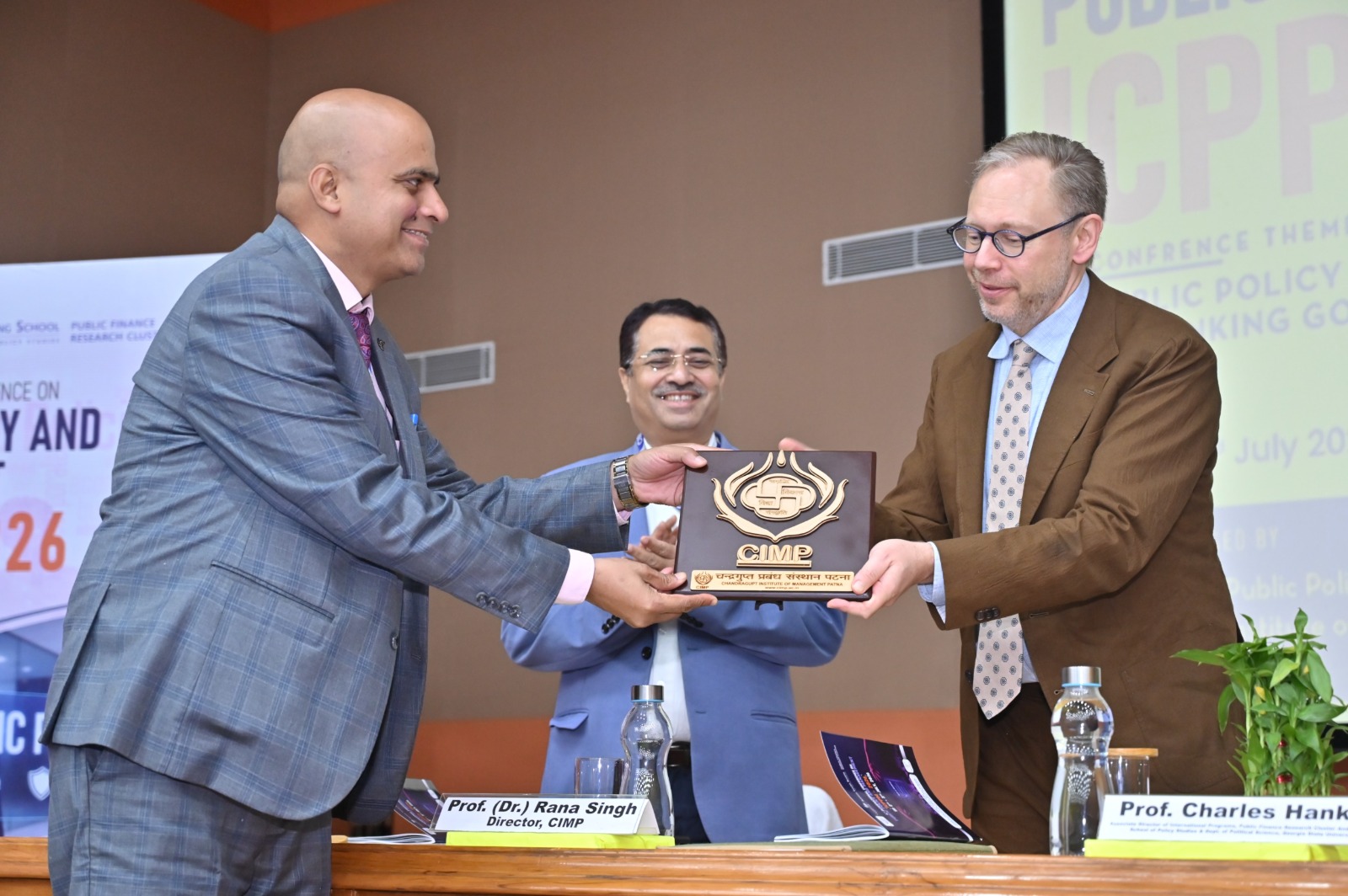
The conference was inaugurated by Dr. N. Vijayalakshmi, Additional Chief Secretary, Planning and Development Department, Government of Bihar, in the presence of keynote speaker Prof. Charles Hankla (Georgia State University, USA), Guest of Honour Prof. Praveen Gupta, Director, Lal Bahadur Shastri Institute of Management (LBSIM), New Delhi, and Prof. G. Singhaiah, Vice-Chancellor, Birangana Sati Sadhani Rajyik Vishwavidyalaya, Assam. The dignitaries were welcomed by Prof. Rana Singh, Director, CIMP, while Dr. Debabrata Samanta, Coordinator, Centre for Public Policy and Conference Convenor, presented the conference overview, highlighting the selection of 42 research papers from leading national and international institutions.
Addressing the gathering, Dr. Vijayalakshmi emphasized the importance of adaptive, evidence-based and equitable policymaking in today’s VUCA world, underscoring the role of continuous policy evaluation and responsible use of Artificial Intelligence in governance. Prof. Charles Hankla introduced the concept of “polycrisis” advocating collaborative and responsive policymaking to address interconnected global challenges. Prof. G. Singhaiah highlighted Bihar’s development journey and the importance of strengthening grassroots institutions, while Prof. Praveen Gupta encouraged students to develop leadership, communication, and analytical skills for future governance.
Following the inaugural session, three parallel technical sessions featured 25 research paper presentations on evidence-based policymaking, health, education, and human development under polycrisis. The conference will continue on July 3 with technical sessions on Decentralization, Local Governance and State Capacity, Climate Change, Sustainability and Policy Resilience, and Viksit Bihar, along with a special session organized in collaboration with the Bihar State Biodiversity Board on Environment Policy, Governance and Biodiversity Conservation: Institution, Society and Community.