


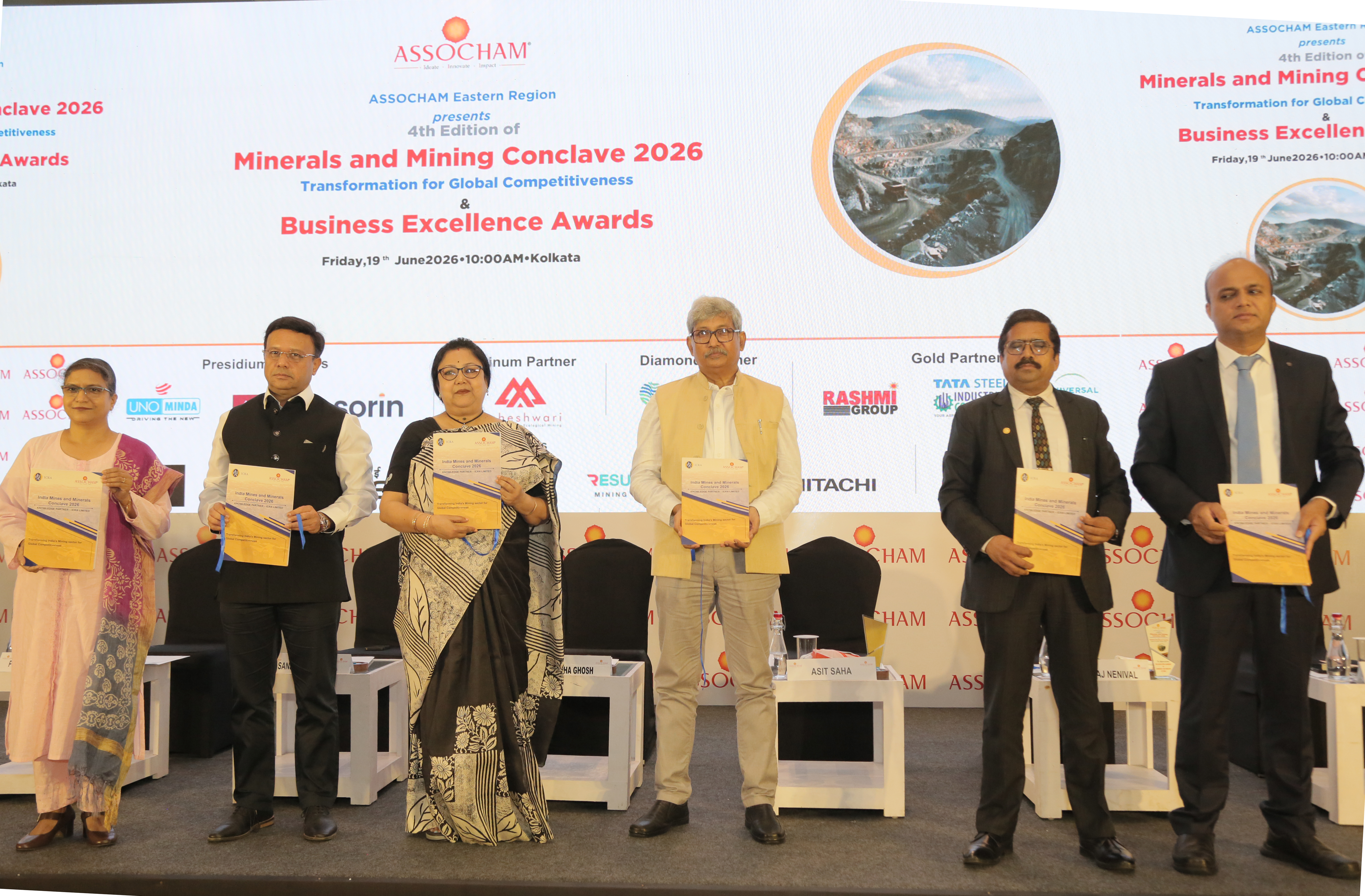
Kolkata, June 19: The lack of industry–scale knowledge of mining of critical minerals is one of the biggest stumbling blocks for India when it comes to extraction and processing of these minerals.
According to Mr Asit Saha, Director General, Geological Survey of India, Ministry of Mines, Government of India, India has been a “powerhouse” when it comes to mining of bulk minerals. However, when it comes to new age minerals, we still do not have the industry–scale knowledge on extraction and processing of these minerals and that is preventing the country from taking a lead.
“We are very comfortably placed as far as iron ore, limestone, chromite, bauxite etc are concerned. But when we talk about these new age minerals, we are absolutely low-end. It is not only because of land acquisition issues and environmental issues. There are other factors which we need to take into cognisance. We still do not have the industry–scale knowledge as to how to extract and process these minerals. That is the biggest stumbling block, which is preventing us from taking the lead,” Mr Saha said at the 4th Edition of Minerals and Mining Conclave, organised by Assocham here on Friday.
Mining of critical minerals and REE (rare earth elements), which are relatively small scale, calls for a separate strategy and thinking, as against bulk mining.
“Critical minerals have emerged as a strategic currency of geopolitical influence. Lithium, cobalt, nickel, rare earth elements, graphite, copper are no longer ordinary commodities. They have become strategic national assets. The global race is no longer for oil fields, it is now for minerals value chain,” Dr Pukhraj Nenival, Controller of Mines (East Zone), Indian Bureau of Mines, Ministry of Mines, said.
The government of India has initiated one of the most comprehensive reform trajectories in the history of Indian mining. From policy driven regulation, India is progressively moving towards technology enabled governance, investment facilitation, resource efficiency and global competitiveness. The reforms encompassing commercial mining, digitization, exploration acceleration, mineral auctions, critical mineral development and institutional strengthening have fundamentally redefined India‘s mining landscape, he added.
West Bengal has good critical deposits in the mineral bearing districts and the Directorate of Mines and Minerals has requested GSI to work on it. In some cases, it is also looking to work jointly with GSI, Ms Sarmistha Ghosh, Assistant Director, Directorate of Mines and Minerals, West Bengal said.
“India has huge reserve of rare earths, critical minerals like vanadium, titanium, graphite. But the main challenge lies in the beneficiation and process of getting, acquiring processing technology or beneficiation technology to extract these minerals from the rock and the primary mineral. Recent reforms and initiatives taken by Ministry of Mines and Ministry of Coal by Government of India have created a more transparent and investor-friendly ecosystem, opening new opportunities for exploration, beneficiation, value addition and international collaborations,” Mr Sanjiv Ganeriwala, Chairman, ASSOCHAM Mining Council – East, said.