


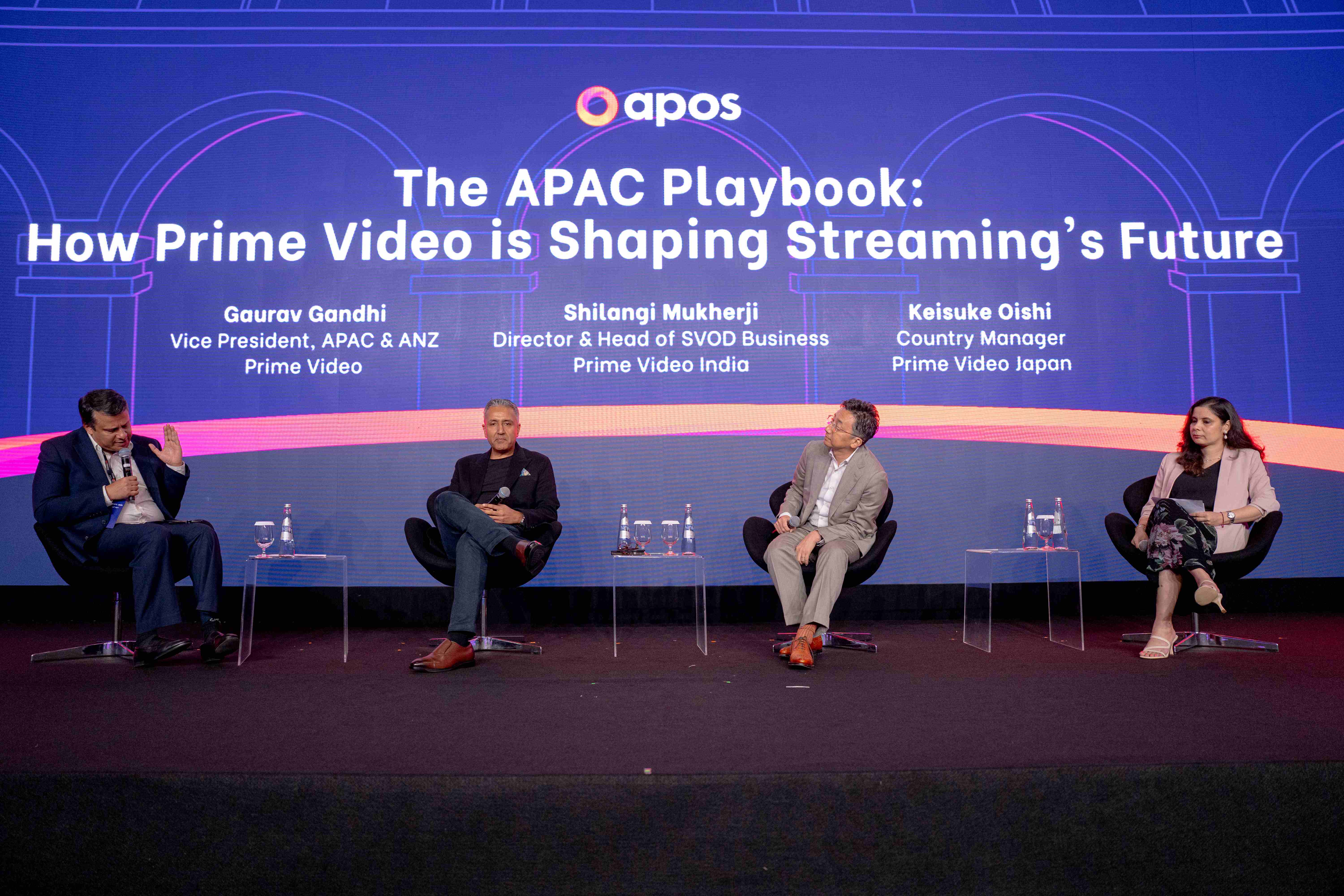
BALI, Indonesia June 18: At APOS 2026, Prime Video’s Asia Pacific leadership team outlined the company’s regional strategy in a session titled The APAC Playbook: How Prime Video is Shaping Streaming’s Future. Gaurav Gandhi, vice president, APAC & ANZ, Prime Video; Shilangi Mukherji, director and head SVOD business, Prime Video India; and Keisuke Oishi, country manager, Prime Video Japan took to the stage, in conversation with Vivek Couto, managing & executive director, Media Partners Asia (MPA) for the discussion that explored how Prime Video navigates the diversity of the Asia Pacific region through country-specific playbooks and significant local content investments while maintaining a consistent business vision and an entertainment hub model across markets.
One Business vision, Different Playbooks
Gaurav Gandhi opened by addressing the complexity of operating across Japan, India, Southeast Asia, and Australia and New Zealand – markets with vastly different audience segments, content preferences and consumption behaviours. “We operate a common business model, but we cannot have a common playbook for a diverse region like APAC.” Highlighting the dynamism and diversity in the region, he emphasized on how Prime Video’s local playbooks drive service growth in each country. “There are two important aspects of our business model that are common in our key locales – JP, IN and ANZ. First, we operate as part of the Prime Program, and second, we are an entertainment hub where we make Add-on subscriptions and TVOD available to our customers, in addition to our SVOD offering.” Underscoring the heterogeneity in Asia and how content preferences are vastly diverse, Prime Video model provides customers with a wide selection and choice on a single destination.
Japan: A Decade of Category Creation
Keisuke Oishi reflected on Prime Video Japan’s 10-year journey since its launch in 2015, highlighting two key focus areas in the initial years.
“The first, we had to establish an entirely new category of subscription video, in a locale where most of the customers were on free-to-air TV. This required building trust with the customers and establishing a new viewing behavior. The second, was that we needed to build the best diversified mix of content to offer our large Prime member base. Over the years, we have 4 key pillars of our content strategy – Anime, scripted TV & movies, Unscripted TV and Live sports. And we complement this with a strong Add-on subscription, TVOD and Pay-per-view offering to serve our large and growing base in Japan”
India: 10 Years of Multilingual, Original-First Programming
Shilangi Mukherji shared how Prime Video India’s content strategy has been guided by a consistent investment thesis over the past decade.
“This year we complete 10 years in India. From the get-go our investment thesis has been divided into two parts: Deep understanding of Indian customers and their multilingual content preferences – over 60% of IN customers stream in 4+ languages. So, it was very important for us to have a programming strategy with selection across multiple languages. While programming in overall 10 languages, we continue to invest deeply in Hindi, Tamil, and Telugu along with our strong global English and international content. The second part of our investment thesis has been creating our original content playbook in India. We have ensured that we had a single North Star, which is to create local original content that delights and resonates across diverse customer segments. Today, Prime Video India is home to the most-loved IPs, with 60% of our series having returning seasons, making India Originals program the largest outside the US. We have so far launched 100+ Originals and we have over a 100 more in different stages of development and production.”
The Entertainment Hub: Selection, Value, and Convenience
Gandhi elaborated on how Prime Video’s hub model creates value for both customers and content partners. He highlighted the importance of selection, value, and convenience as the objective of the entertainment hub. “We want to offer our customers the widest selection with an easy way to access via one application, one billing relationship, making it much easier for them to access content. It also works for our partners, giving them engaged customer base, deep distribution as well as simplified tech and billing infrastructure”
“Globally, we have over 600 partners that we work with, 70+ in Japan, 50+ in Australia, and 30+ in India; and these partners see Prime Video as a key part of their distribution strategy; and the expanded selection allows us to super-serve our customers”
“In India, we are further broadening our offering on Prime Video, including AVOD alongside our existing SVOD, TVOD & add-on subscription offerings. With the integration of Amazon MX Player, Prime Video is now India’s largest streaming service for exclusive originals, bringing together the best selection across our free and paid offerings. It unites Prime Video’s premium audience with Amazon MX Player’s reach, giving creators and advertisers the unmatched scale of Indian streaming, all in one place.”
APAC: A Growth Engine and Innovation Hub
Looking ahead, Gandhi positioned APAC as central to Prime Video’s global ambitions both as a growth driver and a source of innovation. “APAC is seen as a key driver of growth for Prime Video and a big innovation hub – be it in terms of creating unique offerings for diversified socio-economic segments, like the tiers in India and mobile first plans, as well as building playbooks to serve multi-lingual streamers in the region.”
Sharing his perspective on the next phase of growth, Gandhi said,
“Prime Video Japan business has tremendous momentum and we continue doubling down on our content investments there. In India, we are super excited about bringing our AVOD and SVOD businesses together, substantially increasing audience scale by creating a unified service.”