


Bengaluru, May 18: Calling this a defining moment in India’s economic and geopolitical journey, Dr. V. Anantha Nageswaran, Chief Economic Advisor, Government of India, said India stands ‘at a fork, not a crisis’ and urged the country to act with urgency, strategic clarity and institutional confidence to secure its place in a rapidly changing global order.
Delivering the inaugural keynote at the Pan IIT Alumni Meet 2026 in Bengaluru, he addressed an audience of policymakers, technologists, entrepreneurs, investors and industry leaders, outlining the structural shifts reshaping the global economy and India’s strategic opportunities in manufacturing, energy, AI, talent and geopolitics.
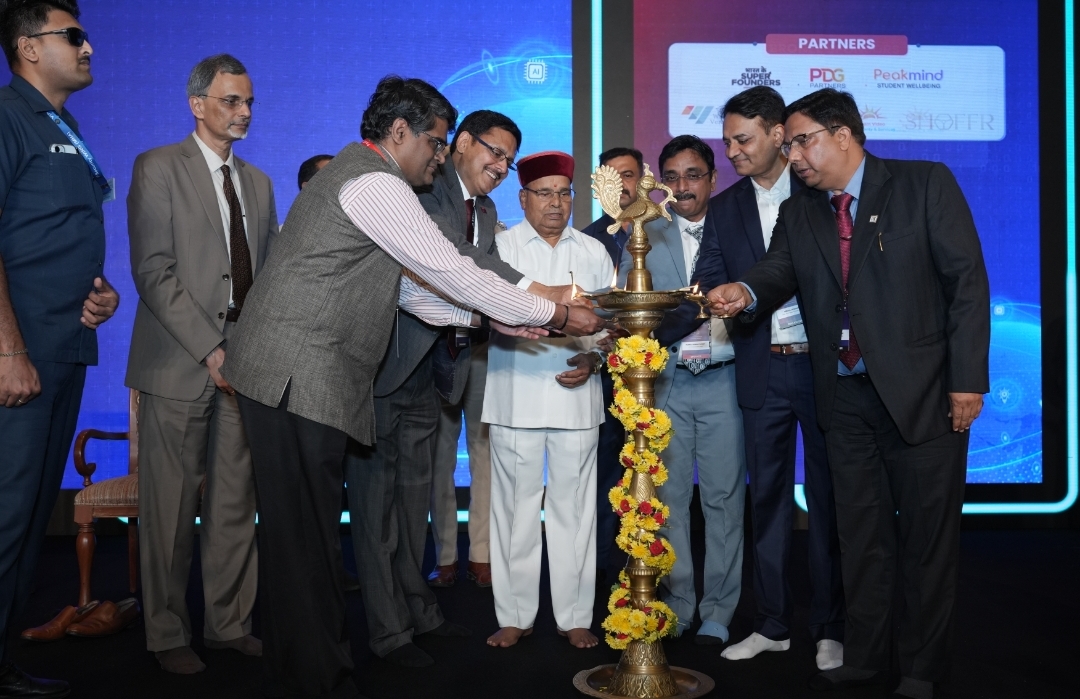
The PAN IIT Bangalore Summit 2026, held in Bengaluru, was inaugurated by Shri Thawar Chand Gehlot, Governor of Karnataka, who appreciated the role of the IIT community in driving innovation, strengthening the country’s knowledge economy and contributing meaningfully to India’s development journey. The event brought together leaders, entrepreneurs, technologists and the IIT alumni community for meaningful conversations around AI, innovation, startups and India’s future.
Mr. Prabhat Kumar, IRS, Chairman, PanIIT Alumni India, said, “The story of the IITs is the story of India from the first campus at the Indian Institute of Technology Kharagpur to a powerful network of 23 IITs and over five lakh alumni shaping the nation’s technological destiny. From Silicon Valley to India’s new ‘Indus Valley’ in Bengaluru, this journey is now about innovation, sovereignty in technology, research, entrepreneurship and building a stronger India together.”
India’s Economic and Strategic Imperatives
Speaking candidly about India’s economic realities, Dr. Nageswaran noted that India’s goods trade deficit remains structurally significant and that global capital flows are becoming more selective in a high-interest-rate environment.
“India’s potential is not a given. It must be claimed deliberately,” he said, emphasizing that the coming decades would be shaped not by any single government, but by the collective choices of citizens, institutions and industry leaders.
Highlighting the changing global landscape, he pointed to three major forces redefining the world order intensifying great-power competition, fractures within Western alliances and China’s unprecedented manufacturing dominance.
He pointed that India’s goods trade deficit stood at 8.5% of GDP in FY24, and even after excluding oil and coal imports, the deficit remained at 3.5% of GDP, indicating a structural rather than cyclical challenge. At the same time, foreign direct investment (FDI), after accounting for repatriation and outflows by Indian firms, has reduced significantly, with global investors watching India closely but not committing capital at the scale required.
The speech noted that the global financial environment has become increasingly challenging, with U.S. 30-year Treasury yields crossing 5%, the UK 10-year yield rising above 5.2%, and Japan’s 30-year yield touching 4%. It was highlighted that much of the FDI India attracted over the past two decades came during an era of near-zero interest rates and quantitative easing, when global capital actively sought higher returns in emerging markets. With that phase now over, India must compete in a world where 5% risk-free long-term interest rates have raised the benchmark for every dollar of investment entering the country.
He highlighted three major global shifts shaping India’s future intensifying great-power competition, the fragmentation of Western alliances and China’s unprecedented manufacturing dominance.
On manufacturing, he said India must simultaneously focus on labor-intensive sectors such as garments, footwear and food processing, while also building capabilities in semiconductors, batteries, advanced electronics and specialty chemicals.
Calling for greater urgency in building strategic reserves and accelerating nuclear energy adoption, he said a country aspiring to host semiconductor fabs, battery gigafactories and data centers cannot treat nuclear energy as a distant horizon.
AI, Employment and the Future Workforce
Addressing the rise of artificial intelligence and its impact on employment, Dr. Nageswaran said AI would compress routine cognitive work and narrow entry-level hiring, making deep expertise and skilled trades increasingly important.
He observed that India needs at least eight million new jobs or livelihoods every year and stressed that trade skills such as electricians, skilled construction workers and technicians would remain among the most protected and essential jobs in the emerging economy.
He urged IIT alumni to leverage their influence across government, academia, industry and startups to help shape India’s next phase of growth and strategic transformation. Stressing that India’s next 25 years would be determined by the collective choices of institutions and individuals, he said the country could no longer afford slow decision-making and delayed execution in an increasingly fragmented and conflict-prone world order.
The event also brought together distinguished leaders from government, academia, industry, defence, deep technology and startups to discuss India’s future across AI, governance, national security, manufacturing, healthcare, finance and innovation.
Spiritual Keynote Address by Gurudev Sri Sri Ravi Shankar
While addressing the IIT alumni, spiritual leader Sri Sri Ravi Shankar said the world is facing a growing ‘attention deficiency syndrome,’ along with rising stress and mental health challenges, especially among students and professionals.
He stressed that spirituality, meditation and self-awareness are essential for innovation, focus, emotional resilience and handling the pressures created by AI, startups and modern work culture.
Calling AI a tool rather than a threat, he said humanity’s future depends on mindset, intuition, teamwork and inner well-being, urging young innovators to combine technology with spirituality to build a better world.
Panel Discussions
A series of content-rich panel discussions were held on topics including Sovereignty for National Security, AI Stack for 1.4 Billion, AI for Governance: Building the Next Generation of Public Systems, GCC – Road Ahead with AI, AI, Automation and the Next Industrial Era, Future of Money in the Age of AI, The New Healthcare Stack, From Code Generation to Autonomous Delivery: The Future of the SDLC and From Startup to Public Company: The Human Journey Behind, featuring leading voices from industry and technology.
Book Launch
A book authored by Mr. Prabhat Kumar, titled IIT – The Story of India’s Most Prestigious Educational Ecosystem, was released by Sri Sri Ravi Shankar during the event.
The Pan IIT Alumni Meet 2026 served as a platform for dialogue on India’s strategic future, innovation-led growth and the role of technology and talent in nation-building.