


New Delhi, Apr 30: India Retails and Hospitality Private Limited (IRHPL) has released a new trend report highlighting that international tourists contribute an estimated 35% to 45% of total airport retail spending, making them the most influential segment in travel retail.
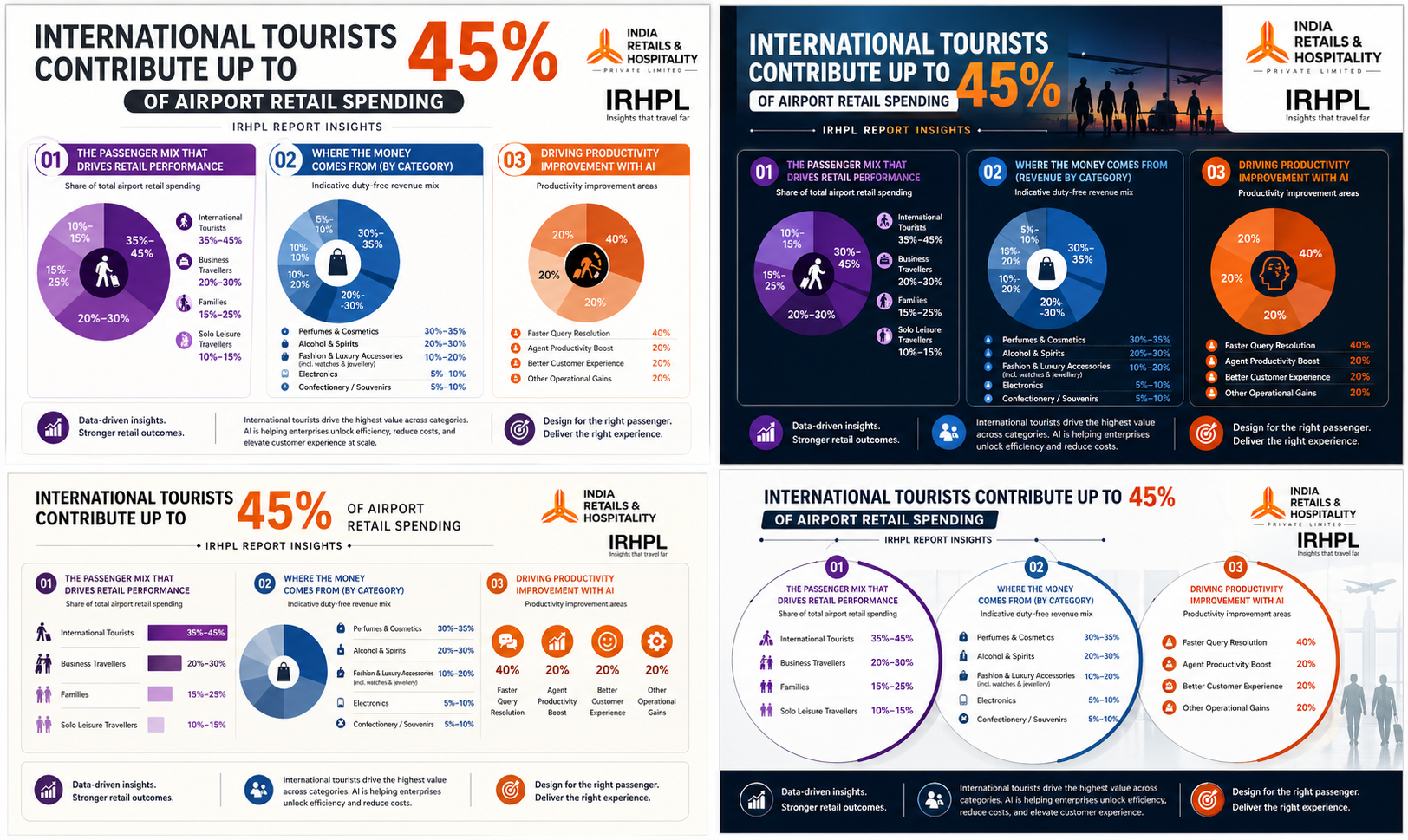
The report underscores that airport retail performance is shaped not just by passenger footfall, but by traveller mix, dwell time, and category preferences. International passengers, in particular, drive higher basket values and dominate premium categories such as duty-free, luxury goods, and gifting, thereby contributing disproportionately to overall retail value.
Passenger Segments and Spending Behavior
According to IRHPL, airport retail spending is broadly distributed across four key traveller segments:
- International tourists: 35–45%
- Business travellers: 20–30%
- Families: 15–25%
- Solo leisure travellers: 10–15%
Each segment exhibits distinct purchasing behavior. International travellers are more inclined toward duty-free and luxury purchases, while business travellers focus on convenience, quick F&B, and select premium items. Families and leisure travellers primarily contribute to everyday categories such as food, essentials, and gifting.
Key Revenue Categories
The report identifies perfumes and cosmetics as the leading category in airport retail, contributing around 30–35% of duty-free revenue, followed by alcohol and spirits (20–30%) and fashion and luxury accessories (10–20%). Other contributing segments include electronics, confectionery, souvenirs, and travel essentials.
Food and beverage (F&B) remains a consistent revenue driver, with grab-and-go formats accounting for 50–65% of spending, dine-in meals contributing 25–35%, and premium beverages making up 10–15%.
Shopping Trends and Consumer Behavior
IRHPL’s findings challenge the perception that airport shopping is largely impulse-driven. Instead, 65–75% of purchases are pre-planned, including pre-orders, while impulse buying accounts for 25–35%, mainly in categories such as confectionery, perfumes, and spirits.
A typical spend mix indicates:
- Luxury goods: 20–35%
- Essentials: 25–35%
- Gifting items: 20–30%
This balance highlights the need for a diversified retail strategy that caters to both high-value and everyday purchases.
Industry Insights and Outlook
Commenting on the findings, Naresh Sharma, CEO of IRHPL Group of Companies, said,
“Airport retail is no longer a footfall game; it is a passenger-mix game. International travellers bring higher intent, higher basket value, and stronger premium conversion. The opportunity lies in designing retail ecosystems around how these passengers actually spend.”
The report also notes that 30–60% of international passengers typically make at least one duty-free purchase, with a baseline of 40–50% considered standard for major hubs.
Looking ahead, IRHPL expects airport retail to grow steadily, with travel and retail expansion projected at 15–20% over the next two to three years. Overall airport retail spending is anticipated to grow in the range of 6–12% year-on-year, depending on market dynamics.
Conclusion
The report emphasizes that airport retail is fundamentally a passenger behavior-driven business. With international tourists contributing up to 45% of total retail value, airports and operators must align their strategies to cater to this high-value segment, ensuring a balanced mix of luxury, convenience, and experiential offerings.
