


Bengaluru, Apr 24: The Lambda Quantitative Strategies Association successfully concluded the 5th edition of the Indian Institutional Quant Conference (IIQC) on April 24 at Taj, MG Road, Bengaluru. Held in the city for the second time, IIQC Bengaluru Edition 2026 brought together global experts and Indian institutions to discuss the growing scope and maturity of quantitative strategies in India.
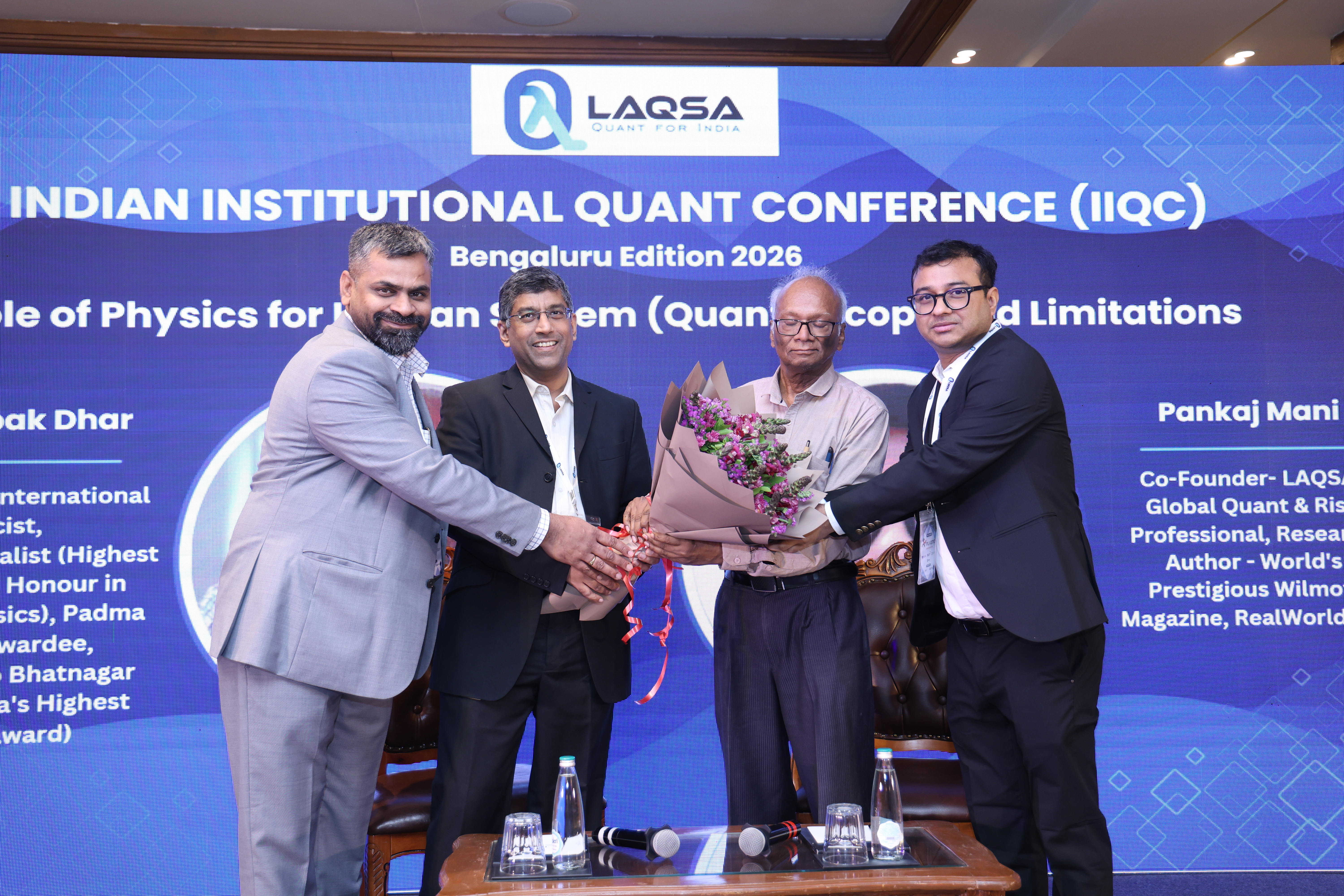
The conference was supported through sponsorships by leading institutions and market-education bodies including Nuvama Asset Services, BSE, LSEG, Khaitan & Co, Dhan and others, with Nuvama returning as the title sponsor.With a curated, day-long agenda, IIQC featured panels, fireside chats and technical presentations, bringing together participants from Asset Management Companies (AMCs), Family Offices, global research firms and academia. The event opened with a welcome address by LAQSA leaders Rishi Kohli (JioBlackRock AMC), Pankaj Mani (RealWorldRisk; Research Author at Wilmott Quant Magazine), and Pawan Mehra (Founder – Unicorn Investment Managers)
A key session focused on the Identification of HFT Regimes in India, bringing perspectives from academia, policy and practice. The session featured Dr. Ranjan Chakravarty, Senior Associate Professor of Finance & Accounting and Director, Great Lakes Institute of Management, and Vishwanathan Iyer, Professor of Practice and Head of the Quantitative Finance/Market Microstructure Research Group, Great Lakes Institute of Management.
The speaker line-up also included Prof. Deepak Dhar, Distinguished International Physicist (India’s only Boltzmann medal winner and Padma Bhushan); Sunil Ramrakhiani, Chief Business Officer at BSE; Prof. Sankarshan Basu, Professor (Finance), IIM Bangalore; Sanjiv Singhal, Founder & Chief Operating Officer, Scripbox; and noted global author and quant portfolio manager Hari P. Krishnan.
The technical depth of the conference reached its peak with sessions led by Global Author & Quant Portfolio Manager, Hari P. Krishnan, presented on “The Impact of Passive Share on Systematic Volatility.”
Pankaj Mani, Co-Founder, LAQSA, said,
“IIQC Bengaluru Edition 2026 reflected how quickly India’s institutional quant conversation is moving from strategy design to implementation, and from ‘best practices’ to world-class research rigor. The sessions on HFT Regime identification, impact of passive flows on market volatility and fat-tail risk sparked exactly the kind of candid dialogue we want to build across the ecosystem for the social and economic awareness across the country.”
Rishi Kohli, Co-Founder, LAQSA, added,
“Bringing IIQC back to Bengaluru for the second time was important for us, because the city sits at the center of India’s institutional markets. This fifth edition reinforced that India’s quant community is expanding in both depth and maturity—linking global experience with India-specific market realities, and strengthening the network of participants building systematic and data-driven capabilities.”
As India’s quant ecosystem continues to evolve, the boundaries between traditional approaches and quantitative strategies are increasingly narrowing. IIQC Bengaluru Edition 2026 highlighted how systematic and quantitative thinking is becoming central—whether through fat-tail risk modelling or allocation decisions across family offices and advisors. By convening researchers, professionals and institutions for a full day of technical and strategic exchange, LAQSA reaffirmed its role in advancing India’s transition towards a more rigorous, data-centric ecosystem.