


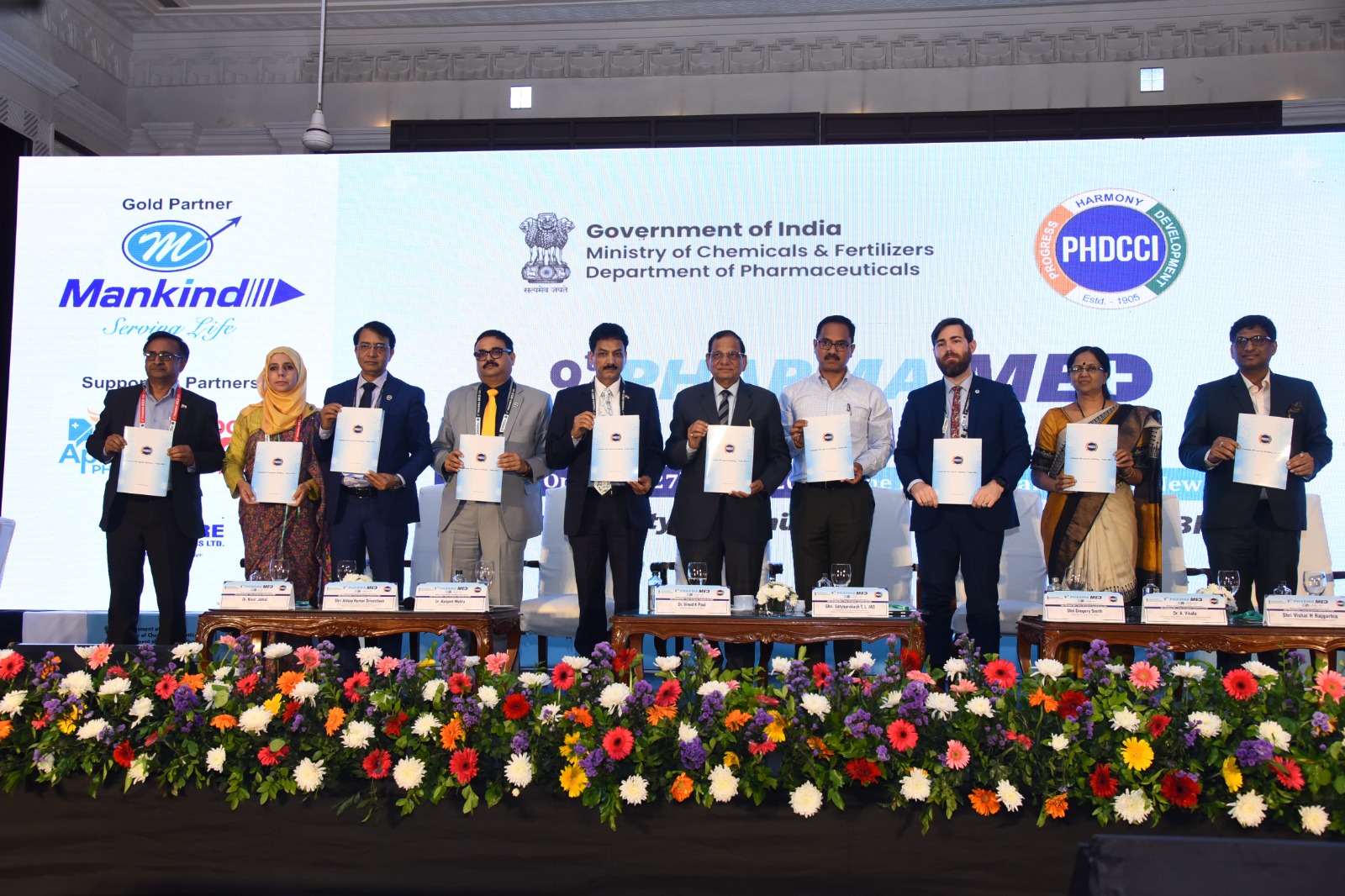
PHD Chamber of Commerce and Industry in support from Department of Pharmaceuticals Ministry of Chemicals and Fertilizers, Government of India organized the 9th PharmaMed 2026 at The Imperial, New Delhi.
The program commenced with a Welcome Address by Dr. Ranjeet Mehta, CEO & Secretary General, PHDCCI, followed by an Industry Address by Shri Abhay Kumar Srivastava, Senior President – Global Operations, Mankind Pharma, and Chair, Pharmaceutical Manufacturing Committee, PHDCCI. Dr. Nasir Jamal, Director, PHDCCI, delivered the Introductory Remarks.
Insisting on building integrated policies, cohesive strategies, and collaborative ecosystems — and to position India as the world’s biological superpower Shri Satyaprakash T.L IAS, Joint Secretary, Department of Pharmaceuticals, Ministry of Chemicals & Fertilizers, Government of India said – “Following the Union Budget 2026–27, a defining question emerges: Has biology become technology? A decade ago, the complexity of the human body made this seem impossible. Today, that perception is changing. From understanding epilepsy mechanisms to precision interventions, biology is becoming predictable and programmable.
Budget Paragraph 16 calls for building biological ecosystems — a simple statement with profound implications for industry, government, and research institutions. Two critical gaps demand urgent attention: faster research-to-market timelines, and stronger clinical trial infrastructure. India’s plan to establish 1,000 clinical trial sites will reduce drug development costs and enhance efficiency significantly.
Simultaneously, we must address our dependence on imported bulk drugs through indigenous enzymatic engineering, and leverage our 8,000+ STEM institutions and 300,000 researchers. The worst is behind us. The best has just begun.”
Applauding the industry for their valuable support, Dr. Vinod K Paul, Member, NITI Aayog, Government of India said – “Nearly 37% of total health expenditure is pharmaceutical-linked, and medicines account for 63% of out-of-pocket costs. This makes our industry not just manufacturers — but enablers of equity, affordability, and financial protection for citizens.
The Ayushman Bharat initiative is transforming 1,80,000 health centres, providing 105–172 essential medicines free at primary levels — a powerful step toward universal health coverage.
During COVID-19, India administered over 2.2 billion vaccine doses, saving an estimated 34 lakh lives in the first year alone. We also delivered the world’s first DNA vaccine and pioneered mRNA and nasal vaccine platforms.
But we must not rest on past achievements. In today’s competitive landscape, standing still is not an option.
Our foremost priority must be building a robust Research, Development, and Innovation ecosystem — because without RDI, we cannot lead, sustain competitiveness, or create long-term value.
India has the talent, scale, and scientific capability. If we align these with strong RDI, we will not just participate in global pharma — we will lead it.”
Dr. A Visala, Joint Drug Controller, CDSCO, Directorate General of Health Services, Ministry of Health and Family Welfare, Government of India shared her vision stating – “India is emerging as a hub where innovation is not just possible, but sustainable. Progressive regulations like the Medical Devices Rules, 2017 and New Drugs and Clinical Trials Rules have accelerated approvals and strengthened our global standing.
However, reducing dependence on imported APIs — particularly antibiotics and fermentation-based products — remains critical. Investments in green chemistry and sustainable research are essential.
India has also initiated approvals for Advanced Therapy Medicinal Products, including cell and gene therapies, marking entry into next-generation therapeutics. With updated GMP standards now mandatory from January 2026, India’s regulatory credibility is stronger than ever.
Mr Gregory Smith, Country Director, India office, US FDA shared – “The FDA has maintained a strong presence in India for nearly 17 years, reflecting our deep commitment to quality, patient safety, and regulatory collaboration. India now hosts over 600 FDA-registered manufacturing facilities — the largest number outside the United States — underscoring its critical role in global pharma supply chains.
Our focus extends beyond inspections to Quality Management Maturity programs that build long-term compliance culture. Common gaps in quality systems and laboratory controls must be proactively addressed.
Through initiatives like Priority Review Vouchers and the FDA Pre-Check Program, we remain committed to strengthening supply chain resilience and ensuring high-quality medicines reach patients worldwide.
Shri Abhay Kumar Srivastava, Senior President – Global Operations, Mankind Pharma and Chair, Pharmaceutical Manufacturing Committee, PHDCCI addressed the industry experts and stated – “India’s pharmaceutical industry is evolving from a reactive to a proactive ecosystem, with industry, government, and institutions working as one unified team.
Two priorities stand out. First, we must shift from volume-driven to value-driven growth — advancing biosimilars, complex generics, and long-acting therapies while ensuring medicines remain affordable for every citizen.
Second, backward integration is a national security imperative. Self-reliance in APIs and key starting materials, leveraging India’s indigenous resources, is essential to protecting our supply chain from external disruptions.”
Dr Ranjeet Mehta, CEO & Secretary General, PHDCCI, stated – True progress toward Viksit Bharat demands not just economic growth, but a healthy India where every citizen lives with dignity and healthcare equity is a shared responsibility.
India is the pharmacy of the world, home to 80 million MSMEs and 1.4 billion people — yet a significant healthcare gap persists within our borders. Bridging it requires collective effort from industry, policymakers, technology leaders, and citizens alike.
PHDCCI in association of Global Diaspora for Public Health Dialogues and in presence of distinguished guests, released a knowledge report “National API capacity Building-Vision 2047”.
In conclusion of this distinguished inaugural session, the speakers emphasized carrying forward a unified resolve — to transform India’s pharmaceutical promise into global leadership, where innovation meets affordability, and every citizen benefits from the pharmacy of the world.
