


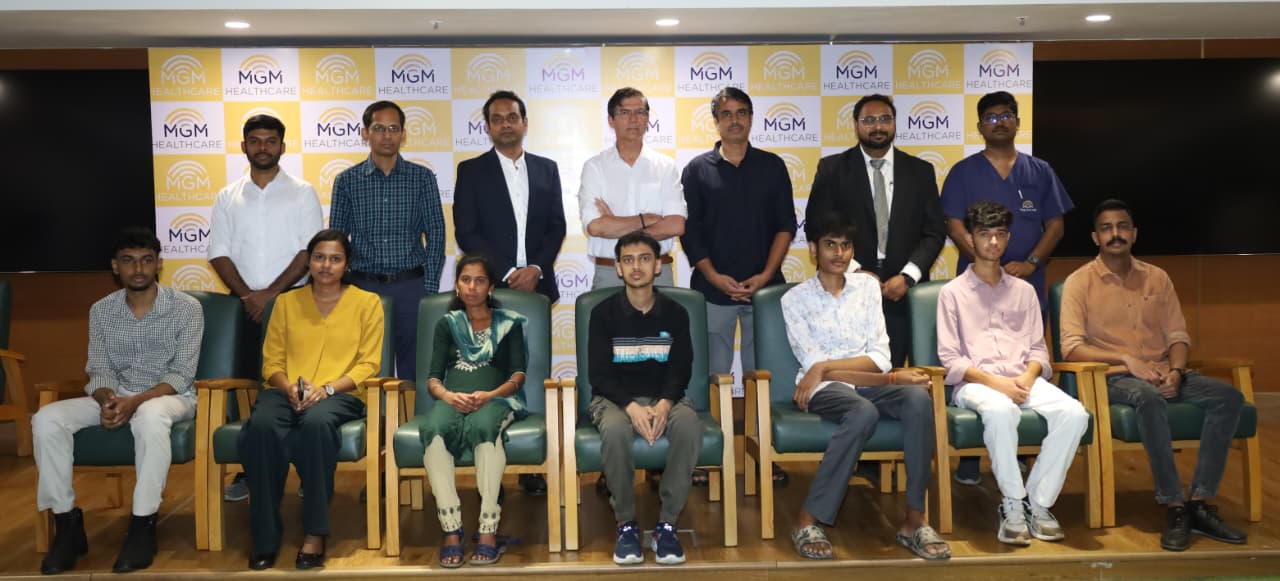
Chennai, Mar 26: MGM Healthcare, a leading quaternary care hospital in Chennai, has built the world’s largest intestinal rehabilitation and transplant program from scratch in a record three years. Since its inception, the hospital has performed over 40 intestinal transplants, including 21 in 2025 alone, the highest annual volume reported anywhere in the world.
The program was conceived three years ago under the leadership of Prof. Dr. Anil Vaidya, Chair and Director, Institute of Multi-Visceral and Abdominal Organ Transplant, following his return from the Cleveland Clinic in the United States. A multidisciplinary team comprising Dr. Senthil Muthuraman, Dr. Venkatesh BS, Dr. Sivakumar Mahalingam, and Dr. Manoj Prabhakar has worked in close coordination with intensivists and anaesthetists Dr. C. P. Dinesh Babu, Late Dr. Nivash Chandrashekar, and Dr. Saravanan to build and scale the program into a comprehensive service.
Commenting on the success of the program, Prof. Dr. Anil Vaidya said, “Intestinal rehabilitation and transplantation is among the most complex and resource-intensive domains in medicine. It replaces the failing intestine with a donor organ, restoring the body’s ability to absorb nutrients naturally. By building the world’s largest program in this domain, we have positioned Chennai as a global reference point. This was not just about creating a transplant program, but an integrated ecosystem spanning surgery, rehabilitation, home-based care, infection control, and long-term monitoring.”
The program has achieved world-class one- and three-year survival rates, with outcomes that rival, and often exceed, leading centres in the United States and Europe. Success is not defined merely by surgical survival, but by freedom from total parenteral nutrition (TPN), a method of delivering nutrition directly into the bloodstream, immune stability, and long-term functional recovery. Crucially, 98% of patients are free from TPN. Given the risks of long-term TPN, including infections, liver damage, and poor quality of life, this reflects true physiological recovery and a return to normal living.
Prof Dr. Vaidya pointed out that beyond scale and outcomes, the program has also expanded the very boundaries of what intestinal transplantation can achieve. It has led to the founding of India’s first Transplant Oncology program, and the world’s third of its kind, where intestinal transplantation is offered as a curative option for patients with inoperable pseudomyxoma peritonei. This represents a paradigm shift: moving transplantation beyond organ failure into the domain of complex malignancy, where conventional surgical options are exhausted. For a disease historically considered terminal in its advanced stages, this approach opens a new therapeutic frontier.
He added, “At the core of this program’s success are three defining innovations. The first is the establishment of a robust, home-based total parenteral nutrition (HPN) program, which supports patients outside the hospital setting. The second is the introduction of a novel, patented antiseptic solution, known as Dorbimex, used as a spray for central line care. When combined with meticulous protocols in catheter maintenance, stoma care, and wound management, this innovation has driven central line infection rates to near zero. A third, and defining differentiator of this program, has been the development of a specialised critical care transport network – the “Back to Base” model. Patients with acute intestinal loss are now safely transferred to Chennai from across India, including Mumbai, Delhi, Agra, Kolkata, and Goa, thanks to across air, road, and even train-based critical care transport, a first-of-its-kind initiative in India.”
Prof. Dr. Vaidya highlighted that intestinal failure is a systems problem, requiring synchronised expertise across nutrition, immunology, infection control, critical care, and surgery. “What has emerged is more than a clinical program – it reflects how high-complexity care can be thoughtfully designed and scaled in India. It also underscores that innovation in care delivery, not just technology, is critical to improving outcomes, and that leadership in advanced medicine is no longer limited by geography.”
