


Infrastructure Push Driving Jobs, Connectivity and Long-Term Economic Growth
India is witnessing one of the most ambitious infrastructure expansions in its history, marking a decisive shift toward long-term, investment-led economic growth. From highways and railways to airports, smart cities, and logistics corridors, the country’s infrastructure push is reshaping connectivity, boosting employment, and strengthening India’s position in the global economy.
This transformation is not limited to physical construction alone. It reflects a broader economic strategy aimed at improving productivity, reducing logistics costs, and integrating rural and urban markets into a unified growth system.
A New Era of Connectivity-Led Growth
At the heart of India’s infrastructure story is a massive expansion of national connectivity. The development of expressways, upgraded national highways, and modern railway corridors has significantly reduced travel time between key industrial and commercial centers.
Air connectivity has also expanded rapidly, with regional airports increasing access to smaller cities and improving mobility for both passengers and cargo. This expansion has helped bring previously underserved regions into the mainstream economic network.
Similarly, railway modernization—through electrification, semi-high-speed trains, and dedicated freight corridors—is improving efficiency and supporting large-scale movement of goods across the country.
Together, these developments are laying the foundation for a faster, more connected economy.
Airports, Railways and Expressways: The Growth Triad
India’s infrastructure strategy is increasingly built around three major pillars:
1. Airport Expansion
The growth of domestic and international airports has improved regional connectivity and strengthened tourism, trade, and business travel. Smaller cities are now directly connected to major economic hubs, reducing dependence on long road journeys.
2. Railway Modernisation
Indian Railways is undergoing structural transformation with electrification, upgraded stations, and new-generation trains. Freight corridors are particularly important, allowing faster and more efficient movement of industrial goods.
3. Highway and Expressway Network
The rapid expansion of expressways and highways is reducing logistics bottlenecks. Faster road transport is lowering delivery times and improving supply chain efficiency for industries and agriculture.
Smart Cities and Urban Transformation
The infrastructure push is also visible in urban development. Smart city projects across India are focusing on digital governance, improved public utilities, better transport systems, and sustainable urban planning.
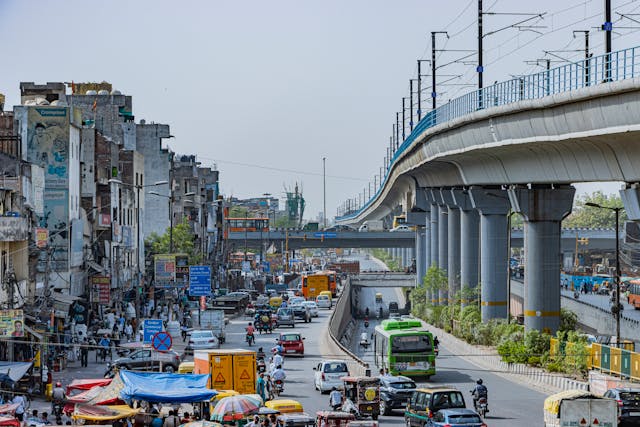
Metro rail expansion in major cities is reducing traffic congestion and pollution while improving daily commuting efficiency for millions of people.
These urban infrastructure projects are also driving demand for technology, engineering services, and construction industries, contributing to economic diversification.
Logistics Corridors: Strengthening the Backbone of Trade
One of the most significant developments is the creation of integrated logistics corridors that combine road, rail, air, and water transport systems.
These corridors are designed to:
- Reduce transportation costs
- Improve delivery speed
- Strengthen export competitiveness
- Support manufacturing growth
By improving supply chain efficiency, India is positioning itself as a more reliable and cost-effective hub for global manufacturing and trade.
Employment Generation at Scale
A major outcome of this infrastructure expansion is large-scale employment creation. Construction activities alone are generating millions of jobs across skill levels.
Direct employment includes engineers, technicians, construction workers, and transport operators. Indirect employment is growing in sectors such as cement, steel, logistics, retail, and hospitality.
Small businesses in and around infrastructure project zones are also benefiting from increased demand for goods and services.
Economists note that infrastructure-led growth has a multiplier effect, meaning every major project creates additional economic activity across multiple sectors.
Rural India Joins the Growth Map
One of the most significant impacts of improved infrastructure is its effect on rural development. Better roads and transport connectivity are helping farmers access larger markets, reduce post-harvest losses, and improve income stability.
Rural regions are also seeing increased access to healthcare, education, and digital services due to improved connectivity. This is gradually reducing the urban-rural development gap.
Small towns are emerging as new economic centers, supported by better transport links and growing industrial activity.
Lower Costs, Higher Efficiency
Improved infrastructure is also helping reduce logistics and transportation costs, which historically have been a major challenge for Indian industries.
Faster movement of goods, reduced fuel consumption due to better roads, and efficient rail freight systems are improving overall productivity. This is making Indian goods more competitive in global markets and supporting export growth.
Attracting Investment and Strengthening Industry
Infrastructure development is also playing a key role in attracting both domestic and foreign investment. Investors see improved connectivity as a sign of economic stability and long-term growth potential.
Manufacturing industries, in particular, are benefiting from improved supply chain networks, enabling them to scale operations and integrate into global value chains.
A Foundation for Future Growth
Experts believe that India’s infrastructure push is not just a short-term development strategy but a long-term economic foundation. By improving connectivity, reducing inefficiencies, and creating jobs, infrastructure is becoming a key driver of sustainable growth.
As India continues to expand its airports, railways, highways, and smart cities, the country is building not just physical structures—but a stronger, more connected, and more resilient economy.
Conclusion
India’s infrastructure revolution represents a structural shift in the economy. It is creating jobs, empowering rural regions, improving industrial competitiveness, and strengthening global trade linkages.
In essence, bridges, airports, and railways are no longer just symbols of development—they are the building blocks of India’s new economic future.