


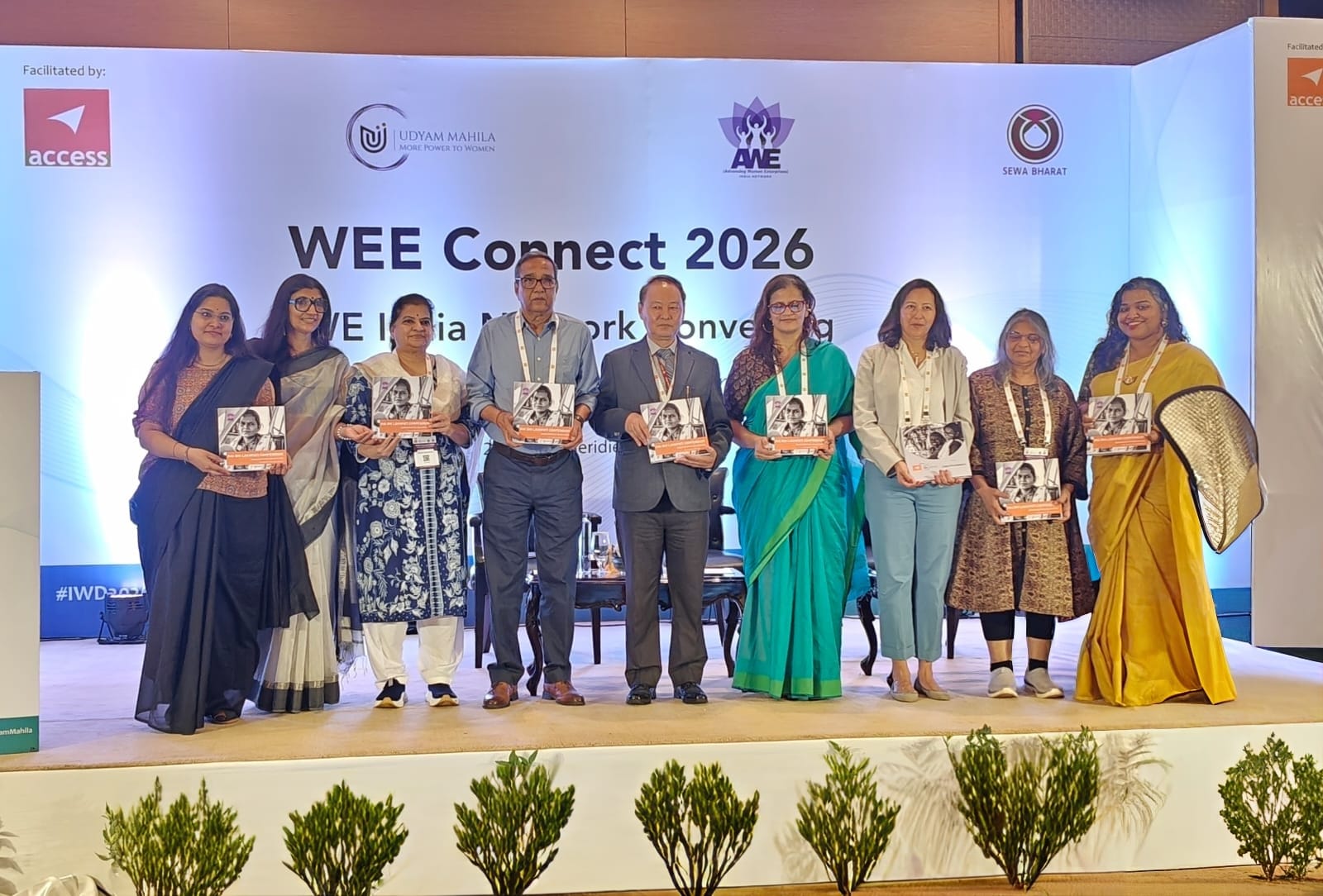
New Delhi, Mar 18th: AWE India Network, facilitated by ACCESS Development Services, today launched the ‘Mai Bhi Lakhpati: Women Rewriting India’s Future’ compendium, bringing together 50 powerful, real-life stories of women entrepreneurs from across India capturing their journeys from financial exclusion to building sustainable enterprises and becoming key economic contributors within their communities.
Mr K. Moses Chalai, Secretary, Department of Public Enterprises, Ministry of Finance, Government of India graced the inauguration of the compendium. Launched at Le Méridien, New Delhi, the compendium serves as both a knowledge resource and a call to action. The compendium also aligns with the national vision of creating ‘Lakhpati Didis’ – financially empowered rural women entrepreneurs and contributes to the broader ambition of enabling 5 million women entrepreneurs in India by 2030. It brings together on-ground insights, successful models, and emerging best practices that demonstrate what it takes to enable women to transition into higher income brackets.
It highlights scalable pathways, identifies key enablers, and underscores the importance of convergence between policy, finance, and capacity building making a compelling case for collective action to support many more women in achieving aspirational incomes.
Speaking at the launch, Mr K. Moses Chalai, Secretary, Department of Public Enterprises, Ministry of Finance, Government of India emphasized the critical role of women-led enterprises in driving inclusive growth and aligning with India’s broader vision of economic development. He said, “Women’s empowerment is not just a policy priority, it is a national movement that has gained undeniable momentum over the past decade. From increased participation in education, with more women excelling in fields like engineering, medicine, and even topping the UPSC Civil Services, to stronger access to economic opportunities and safer workplaces, India is steadily moving in the right direction. States today are actively competing to design more progressive schemes for women, reflecting this shift in intent and action. However, gaps still remain, particularly across the value chain where women entrepreneurs often struggle to scale and access markets. This is where organizations like ACCESS Development Services play a critical role in bridging these gaps and enabling women to move forward with confidence. The Government’s focus on initiatives such as ‘Lakhpati Didis’, along with a growing push for women-led enterprises, is already showing results. Public procurement from women-led MSMEs has risen significantly, reaching approximately ₹93,000 crore in 2025 and expected to touch closer to ₹1 lakh crore this financial year. It is important to understand that empowering women is a shared responsibility. We must ensure that every woman has access to her rights, be it in health, nutrition, education, or dignified livelihoods so that she can participate fully and equally in India’s growth story.”
Speaking on the occasion, Vipin Sharma, CEO, ACCESS Development Services said, “The compendium is not just a documentation effort but a call to action for policymakers, funders, and practitioners to invest in scalable, women-led livelihood models. It shows that with the right access to finance, markets, and support, women can build scalable enterprises and drive inclusive growth. As India advances its vision of women-led development, there is a clear need for policymakers, funders, and practitioners to invest in models that can be expanded and sustained at scale.”
The compendium highlights how grassroots women entrepreneurs are:
- Generating consistent aspirational monthly incomes, often doubling or tripling household earnings
- Creating local employment, with several enterprises engaging 10–15 women at the community level
- Reducing distress migration, with families now able to sustain livelihoods within their villages
- Driving sectoral diversity, spanning agriculture, food processing, handicrafts, circular economy, and services
- Strengthening household outcomes, with increased spending on children’s education, health, and nutrition
Importantly, the stories showcase a larger systemic shift, women are not just participating in the economy, but leading enterprises, navigating formal financial systems, and accessing government schemes such as DAY-NRLM, MUDRA, and PMFME to scale their businesses.
