


Chandigarh, March 17: PwC India Foundation (PwCIF) is expanding its commitment to integrated flood recovery interventions by supporting more than 400 farming households through climate-smart agriculture and rural livelihood interventions. In collaboration with Shramik Bharti, an NGO focused on grassroots development, PwCIF is aiding communities across Moga and Tarn Taran in Punjab to transition to natural farming, diversify income streams, and enhancing village-level disaster readiness.
Sanjeev Krishan, Chairperson, PwC in India and Jaivir Singh, Vice Chairman, PwC India Foundation at the Model Farm along with farmers.
In Moga, the initiative begins at the household level. PwCIF is supporting more than 90 beneficiary households, with kitchen gardens and backyard poultry, to move towards natural farming, boosting household income and improving nutritional outcomes. Each garden, of about 600 sq. ft., provides year-round access to safe, chemical free vegetables and enables families to save an estimated INR 1,500–2,000 per month on vegetable purchases.
Climate‑smart cultivation in practice: farmers tending to crops on a flood‑recovered farm.
At the same time, the project is building proof points for scale. Ten multi-crop model farms are demonstrating how natural farming, intercropping and soil friendly practices can improve farm economics, with model farmers targeted to increase their incomes by 40%. As these practices gain traction, neighbouring farmers are beginning to replicate them, creating a growing circle of indirect beneficiaries.
Poultry rearing as a new income stream for farmers in Moga, complementing natural farming on their fields.
Farmer operating the community jaggery processing unit that adds value to locally grown sugarcane.
To further strengthen farm-based livelihoods, the initiative includes a community-based jaggery processing unit that supports value addition to locally grown sugarcane and better price realisation for farmers. Shared fossil fuel‑free multi-seeding drills are also being used as village-level tool banks to enhance farm efficiency and encourage climate-smart cultivation practices.
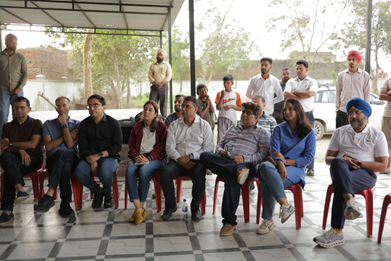
PwC India leadership team and NGO partner Shramik Bharti discussing with the Moga community about the impact of our programme and understanding the impact of floods in the region.
Arnab Basu, Partner and Chief Industries Officer, PwC India, at a nutrition garden in Moga.
As part of the ongoing efforts, the PwC India leadership team visited Moga to engage with farmers and community groups, assess the progress of natural farming and livelihood diversification projects, and reaffirm the organisation’s long-term dedication to disaster resilience and livelihood restoration programs.
“PwC India Foundation’s role in Punjab is centred around helping farming communities transition from crisis to resilience,” said Jaivir Singh, Vice Chairman, PwC India Foundation. “By merging natural farming, diversified livelihoods, and robust village institutions, we aim to support farmers in Moga and Tarn Taran to rebuild with dignity with these initiatives in turn creating replicable models that can be curated to different local contexts across more districts in the country.”
Integrated farming with livestock support on smallholder farms in Moga.
The successful implementation in Moga laid the foundation for an extension of the initiative to Tarn Taran. In this flood-affected border district, PwCIF is collaborating with more than 325 households to restore agricultural land, integrate natural farming, and strengthen village disaster response and resilience committees.
PwC India Leadership team along with farmer beneficiaries of the initiative
Beyond Moga and Tarn Taran, PwCIF’s broader engagement across India focuses on restoring livelihoods, strengthening critical local infrastructure and building community-led disaster preparedness across districts affected by floods. The Foundation aims to create integrated, scalable models that can support farming communities in navigating future climate and livelihood risks, while contributing to India’s long-term sustainable development.
