


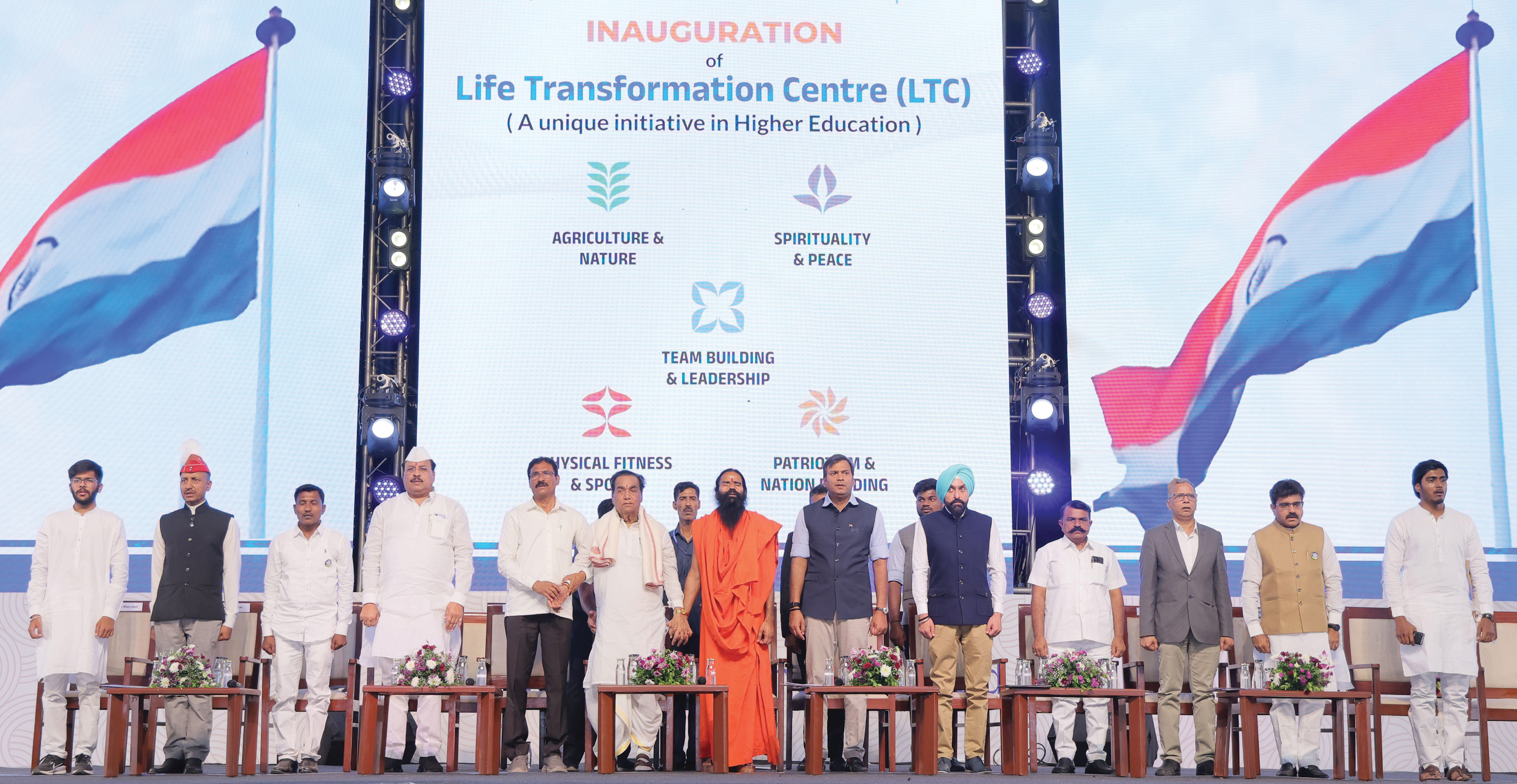
Pune, Mar 13: The Life Transformation Centre (LTC), a unique initiative in higher education, was inaugurated at Boribel in Daund taluka of Pune district. Established in memory of Urmila V. Karad, the revered mother of Dr. Rahul V. Karad – Initiator & Vision, Life Transformation Centre (LTC); who conceptualised the centre. The centre aims to nurture the holistic development of students by reconnecting them with nature, society, and their inner selves through experiential and value-based learning.
The inauguration ceremony was attended by several distinguished leaders from government, spirituality, defence, and sports. Among the prominent dignitaries present were spiritual leader Swami Ramdev and Shri Ronjan Sodhi, Rajiv Gandhi Khel Ratna and Arjuna Awardee and international trap shooter. The event was chaired by UNESCO Chair Holder Prof. Dr. Vishwanath D. Karad – Founder & Chief Patron, MAEER’s MIT, Pune; President, MIT World Peace University; and Creator of the World Peace Dome.
Video messages were shared by Shri Devendra Fadnavis, Hon’ble Chief Minister of Maharashtra; Sunetra Ajit Pawar, Deputy Chief Minister of Maharashtra; Dattatray Vithoba Bharne, Minister of Agriculture of Maharashtra; Lt. Gen. Dhiraj Seth, PVSM, AVSM, General Officer Commanding-in-Chief, Southern Command, Pune; and Chandrakant Patil, Minister of Higher and Technical Education of Maharashtra. Meanwhile, Shivraj Singh Chouhan, Union Minister of Agriculture and Farmers Welfare, attended the event virtually.
Shivraj Singh Chouhan said, “Today’s youth face intense competition, academic pressure, and the distractions of the digital world, often drifting away from the deeper meaning of life. The Life Transformation Centre offers a powerful answer by reconnecting young people with nature, agriculture, discipline, and spirituality. As the son of a farmer, I deeply resonate with the vision of ‘Connecting the Soul to the Soil.’ When young people experience the value of soil, food, and hard work, they develop respect for farmers, nature, and society. This initiative reflects the spirit of experiential learning envisioned in India’s National Education Policy and will help nurture responsible, confident, and nation-building youth for a stronger India.”
Shri Devendra Fadnavis said, “I extend my heartfelt congratulations on the inauguration of the Life Transformation Centre at Boribel, Pune. The land of Maharashtra has long been a source of inspiration for saints, social reformers, and nation builders. From the spiritual legacy of Sant Dnyaneshwar and Sant Tukaram Maharaj to the transformative vision of Mahatma Jyotirao Phule and Krantijyoti Savitribai Phule, this land has upheld the tradition of linking knowledge with service, ethics, and the welfare of society. The Life Transformation Centre, built on the pillars of Agriculture and Nature, Physical Fitness and Sports, Team Building and Leadership, Patriotism and Nation Building, and Spirituality and Peace, will help students develop confidence, discipline, leadership, and compassion.”
Swami Ramdev said, “Today, I feel immense joy to be part of the inauguration of the Life Transformation Centre. Institutions like MIT World Peace University are doing a remarkable job by nurturing not just academic excellence but also character, values, and national responsibility among young people. Educating lakhs of students and guiding them from personal development to nation-building is a great service to society. I come from a humble farming background and understand how powerful education and self-discipline can be in transforming lives. Every young person carries immense potential, but it must be guided by a larger purpose beyond personal success. We should not limit our dreams to jobs or salaries; rather, we should aspire to contribute to society and the nation. Through initiatives like the Life Transformation Centre, students will learn the importance of nature, self-discipline, health, and leadership. I congratulate Dr. Vishwanath Karad, Dr. Rahul Karad, and the entire MIT family for creating such a transformative platform for youth.”
Speaking about the vision behind the initiative, Dr. Rahul Karad said, “This initiative has been envisioned as a unique platform where students can reconnect with nature, rural life, and the deeper values of Indian civilization through experiential learning. The centre is built on five pillars—agriculture and nature, spirituality and peace, sports and physical fitness, team building and leadership, and patriotism and nation building. Through this initiative, we aim to shape responsible, self-aware, and socially conscious youth. I believe this centre will serve as a transformative laboratory for education, inspiring students to contribute meaningfully to society and to the vision of a harmonious and sustainable world.”
The programmes at the Life Transformation Centre are structured around five key pillars—Agriculture and Nature, Physical Fitness and Sports, Team Building and Leadership, Patriotism and Nation Building, and Spirituality and Peace. Through these pillars, the centre aims to nurture students’ physical, intellectual, and emotional well-being while instilling a strong sense of responsibility towards society and the nation.
A distinctive aspect of the centre is its emphasis on simplicity and mindful living. In an age dominated by mobile phones, social media, and rising stress levels, the centre promotes the principle of minimalism, encouraging participants to adopt simpler lifestyles, reduce distractions, and focus on meaningful aspects of life.
By integrating nature-based learning, leadership development, and value-driven education, the Life Transformation Centre seeks to create a new paradigm in higher education. The initiative aims to empower young individuals to become responsible citizens and contribute meaningfully towards building a stronger India and a more harmonious world.
