


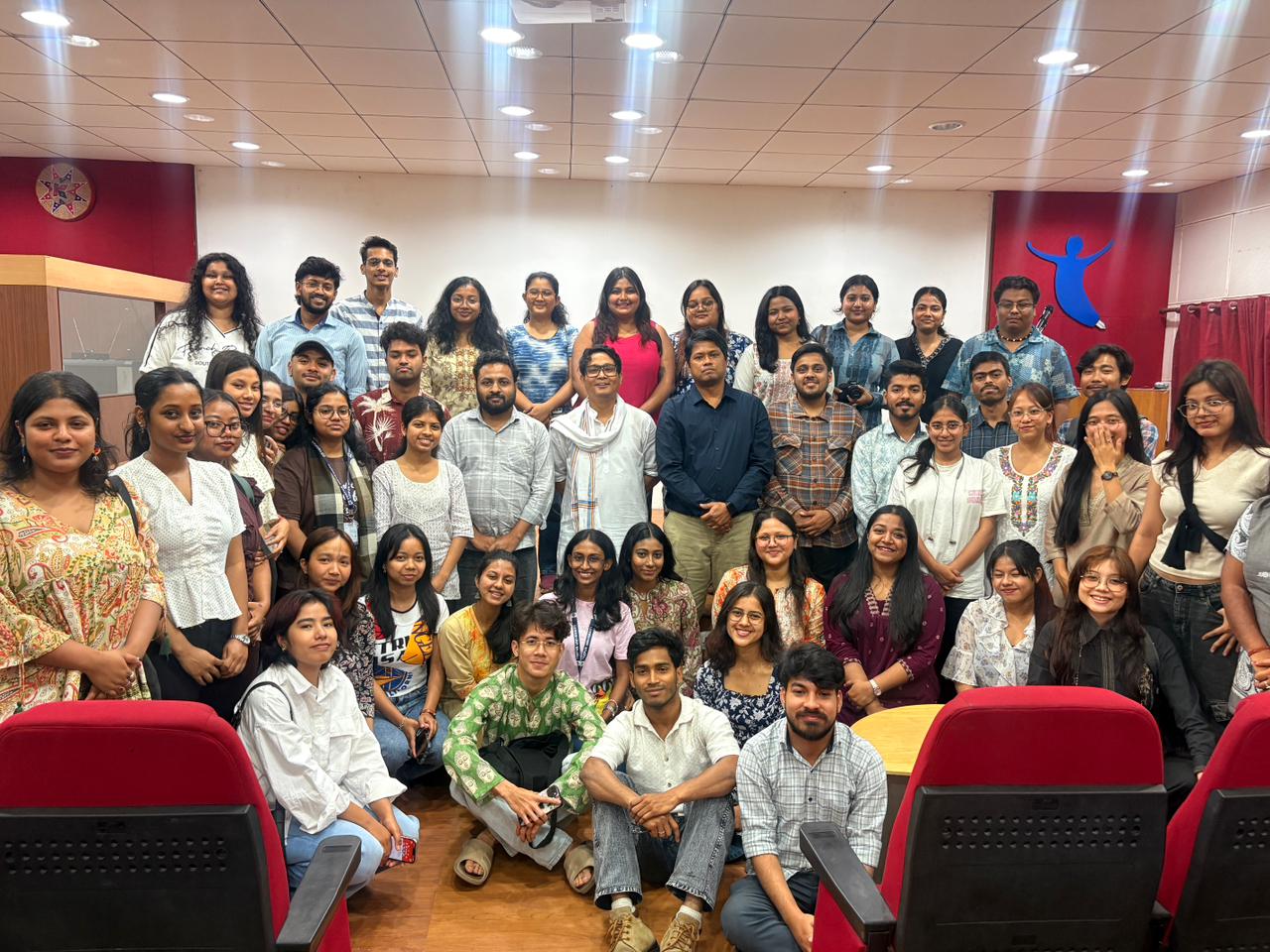
Tezpur, Mar 10: The Department of Mass Communication and Journalism (MCJ), Tezpur University on Tuesday began its Silver Jubilee celebrations with a series of film-focused sessions, workshops and interactions featuring acclaimed filmmakers and scholars. The celebrations commenced on a symbolic and historic note, coinciding with March 10, the 91st anniversary of the release of Joymoti, the first Assamese film directed by legendary cultural icon Jyoti Prasad Agarwala, widely regarded as the father of Assamese cinema.
Marking this significant moment in the cultural history of Assam, the department organised a workshop on documentary filmmaking by noted filmmaker and film scholar Parthajit Baruah, followed by an interactive session with internationally acclaimed filmmaker Rima Das, whose works have brought global recognition to Assamese cinema.
The inaugural session began with a tribute to Assam’s cinematic heritage, featuring the screening of rare archival footage and scenes from early Assamese films such as Joymoti and Indramalati. The audience was also shown a rare visual clip depicting Agarwala’s return from Shillong to Tezpur during the final days of his life, honouring his wish to return to his hometown. The moment served as a moving homage to the pioneer whose artistic vision laid the foundation of Assamese cinema.
Delivering the welcome address, Prof. Abhijit Bora, senior faculty member of the department, highlighted the significance of the occasion. “Today marks the day when Joymoti was released 91 years ago. To have a day dedicated to filmmaking on this very date is truly special. This is the land of Jyoti Prasad Agarwala, and remembering his legacy through dialogue on cinema is deeply meaningful,” he said.
The workshop by Parthajit Baruah introduced students to the craft and practice of documentary filmmaking. The session explored research methodologies, narrative structures, ethical storytelling, and the role of documentaries in interpreting social and political realities. Reflecting on the department’s milestone year, Baruah also praised its academic environment. “The department has completed 25 years and has already produced remarkable journalists, filmmakers and creative professionals. What stands out is the dynamic academic atmosphere and the supportive engagement between students and faculty,” he added.
Baruah has directed several documentaries including The Dhemaji Tragedy and the feature film The Nellie Story. He is also the author of significant works on Indian cinema such as Jyotiprasad, Joymoti, Indramalati and Beyond: History of Assamese Cinema and Face to Face: The Cinema of Adoor Gopalakrishnan.
In a special moment during the event, filmmaker Rima Das was felicitated for her recent international recognition. Das received the Crystal Bear Special Mention for Best Film at the 2026 Berlin International Film Festival (Berlinale) for her film Not a Hero. The award, which had been carried by Parthajit Baruah during his travel in Canada, was formally presented to Das by Prof. Joya Chakraborty, senior faculty member of the department.
Later in the day, Rima Das interacted with students in an engaging session where she spoke about her journey as an independent filmmaker and the evolving landscape of regional cinema. Known for internationally acclaimed films such as Village Rockstars, Bulbul Can Sing, and Tora’s Husband, she shared insights into storytelling, filmmaking with limited resources, and the importance of authenticity in cinema.
“I always enjoy interacting with young people. It is wonderful to see the department completing 25 years, and I wish everyone here the very best,” Das said. Encouraging aspiring filmmakers, she added, “Believe in your story and have faith in yourself.” Das who never attended film school, emphasised that cinema is a universal language and encouraged students to listen to the “quiet voice of their heart” while creating films.
Reflecting on the future of Assamese cinema on the global stage, she emphasised the importance of discipline, artistic commitment, and audience support for regional filmmakers. “Even if a film is made on a mobile phone, it can reach the Oscars if the storytelling is powerful. What matters is authenticity and honesty in the craft,” she said.
Dr. Manoj Deori, Head of the Department of Mass Communication and Journalism, said the programme marked the beginning of the department’s 25th anniversary celebrations. He noted that launching the celebrations on a day that holds historic significance in Assamese cinema made the occasion particularly meaningful.
The sessions witnessed enthusiastic participation from students, faculty members, and research scholars of Tezpur University thereby setting a vibrant tone for the department’s year-long celebrations.
Established in 2001, the Department of Mass Communication and Journalism at Tezpur University has emerged as an important centre for media education and research in Northeast India. As part of its Silver Jubilee year, the department will host a series of lectures, workshops, film screenings, and interactions with leading media professionals, filmmakers, and scholars from across the country.
