


Hyderabad, Mar 09: L V Prasad Eye Institute (LVPEI) has planned a series of activities across its network, to commemorate World Glaucoma Week, from March 8 -14, 2026, and create awareness on an eye disease that surreptitiously affects both adults and children – Glaucoma. Dr G Chandra Shekar, Vice Chair Emeritus, LVPEI; Dr Sirisha Senthil, Head – Kalathur Venugopal Reddy Glaucoma Institute, LVPEI; and Dr Siddharth Dixit, Head- Glaucoma Services at Kallam Anji Reddy Campus, LVPEI; were flagged off the walk.
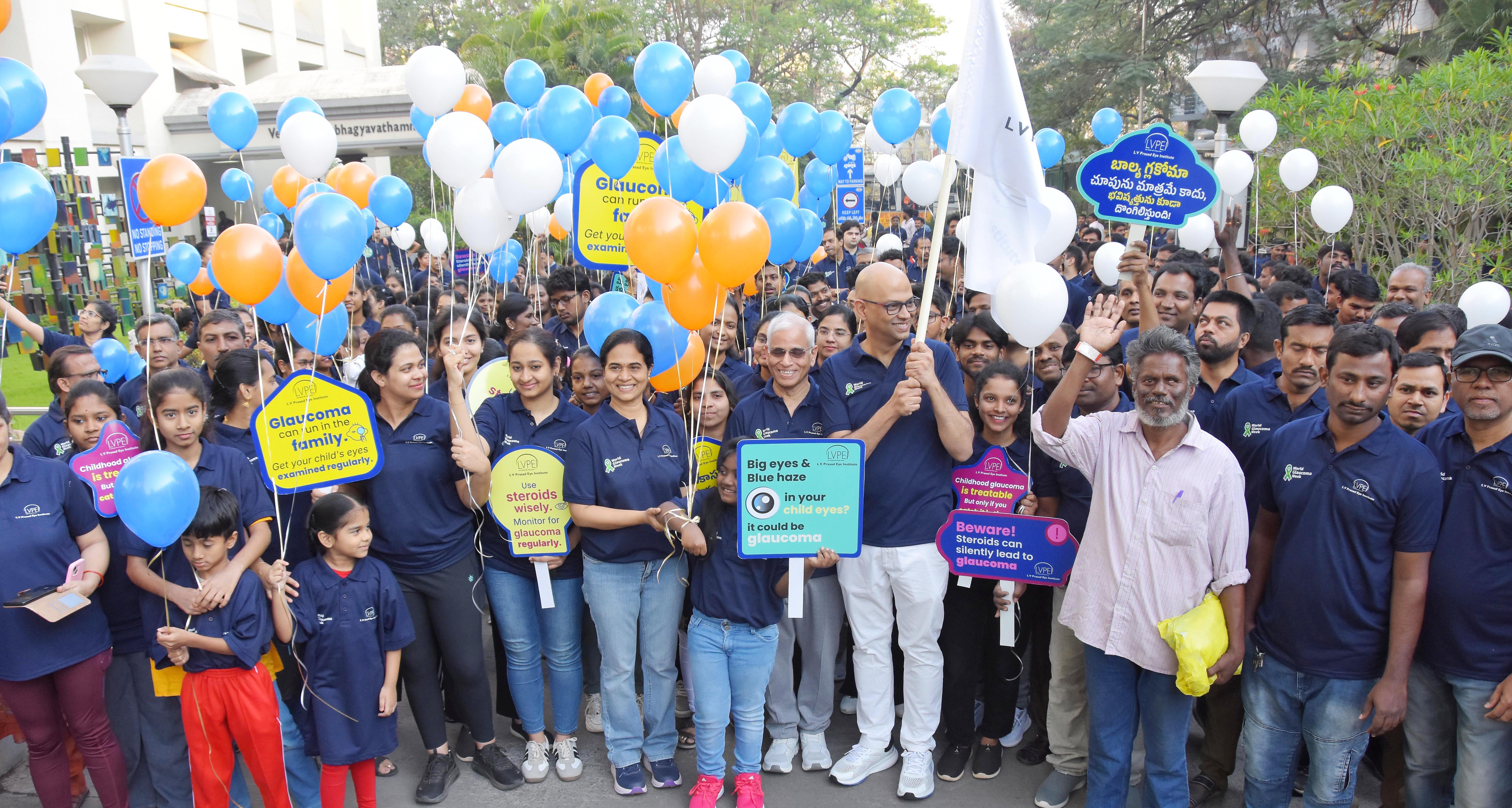
World Glaucoma Week (WGW) is a joint global initiative of the World Glaucoma Association (WGA) and the World Glaucoma Patients Association (WGPA).
Glaucoma is an eye problem associated with increased eye pressure and is characterized by damage to the optic nerve, leading to irreversible blindness. Most people with glaucoma are not diagnosed until they start turning blind. Glaucoma is a complex condition and refers to a group of conditions that result in optic nerve damage and visual field loss. High intraocular pressure is a “risk factor” for glaucoma, together with other factors such as ethnicity, family history, high myopia and age.
Global estimates predict that by 2040, the number of patients with glaucoma will rise from 76 million to 111.8 million, with most of them in Africa and Asia. In India, around 12 million people are affected with glaucoma accounting to 12.8% of the cases of irreversible blindness, resulting from late diagnosis.
L V Prasad Eye Institute (LVPEI) is observing the World Glaucoma Week (WGW), to create awareness about glaucoma and the need for early detection across its network. The theme for this year is ‘childhood glaucoma and steroid-induced glaucoma’.
As part of the WGW, LVPEI organized a Glaucoma Awareness Walk on March 8, 2026 from the Kallam Anji Reddy (KAR) campus in Banjara Hills to KBR Park. About 500 people participated in the walk.
GlauCOnnect, a focused webinar on childhood glaucoma, was also organized for post graduate students, fellows and practitioners to improve their capabilities in detecting childhood glaucoma. It includes case presentations by several national and international participants and keynote address by Dr Brenda L Bohnsack, Professor of Pediatric Ophthalmology at Feinberg School of Medicine, Northwestern University, Chicago. Several eminent national faculty participated as judges in the competition.
“Poor patient awareness makes glaucoma an extremely dangerous condition with high potential to result in irreversible visual impairment in millions of patients. Early detection, prevention and treatment are key aspects in combating this disease,” said Dr Siddharth Dikshit, Head – VST Centre for Glaucoma Care at KAR Campus, L V Prasad Eye Institute. The second week of March is observed as World Glaucoma Week, providing an important opportunity to raise awareness about glaucoma. Glaucoma is often referred to as the “silent thief of sight” because vision loss can occur gradually without noticeable symptoms. The only reliable way to detect glaucoma is through a comprehensive eye examination. Taking the time to undergo a detailed eye check-up, including retinal and fundus evaluation is essential. It is important for each of us to take responsibility for our eye health through timely screening and regular consultations with eye specialists. This year’s theme focuses on Childhood Glaucoma, reminding us that glaucoma can affect not only adults but also children and even newborns. Early detection and awareness are crucial in preventing avoidable vision loss.”
Glaucoma is one of the major causes of irreversible blindness around the world. The numbers are projected to increase exponentially in both the developed and developing world. Research and new innovative approaches for rapid assessment and novel therapies are required to prevent unnecessary blindness from glaucoma in the next few decades. In its most prevalent form – primary open angle glaucoma, vision loss is silent, slow, and progressive. It typically affects side vision first (peripheral vision) and as it progresses, central vision is lost. Eye injuries can result in traumatic glaucoma or secondary glaucoma, so protecting your eyes from injury is another way to prevent glaucoma.
In India, of the around 12 million people over 40 years of age afflicted with glaucoma, 1.1 million are blind. In India, every eighth individual or nearly 40 million of the estimated 309 million population over 40 years of age and older, either has glaucoma or is at risk of developing the disease. The rate of undiagnosed glaucoma cases in India, is 90% in contrast to 40% to 60% in the developed world. Most of these patients present to the ophthalmologist either when they are visually disabled or permanently blind from the disease.
Childhood glaucoma is more common in children born of consanguineous marriages. It is crucial to look out for the following symptoms in children and consult with an ophthalmologist immediately if you notice any of them.
- ·Enlarged or cloudy eyes
- ·Redness of eyes
- ·Watering eyes
- ·Photo-sensitivity – Child tends to close the eyes in the presence of light, etc.
Early diagnosis is important because secondary problems like myopia and amblyopia also can cause decreased vision.
Steroids are a usual course of treatment for a variety of inflammatory illnesses in the body. Their indiscriminate and long-term use can result in steroid-induced glaucoma.
Steroids can be present in any medication, including eye drops, ointments, inhalers, tablets, and injections. They are also present in many non-pharmaceutical products such as creams for treatment of acne, itching and fairness creams (illegally and discreetly, without any documentation). The public needs to be aware of this and use these creams judiciously.
Everyone who uses steroids in any of the above forms must get a comprehensive eye examination every six months to a year. If someone develops glaucoma due to steroids, they should consult their physician to suggest alternative medication.
Steroid-induced glaucoma occurs due to a rise in intraocular pressure that can occur within a week, a few months or years after steroid application. About 5% of the general population may develop steroid-induced glaucoma when steroids are administered.
Can steroids cause blindness?
Steroid-induced glaucoma can cause blindness. Unfortunately, children with eye allergies are most susceptible. Owing to the quick relief provided by over-the counter steroid eye drops for red and itchy eyes; they are used indiscriminately resulting in unmonitored treatment. Additionally, unscrupulous, unregistered and quite often ignorant practitioners prescribing steroids for non-specific redness of the eyes adds to the problem.
What can you do to prevent glaucoma?
Currently, regular eye examinations are the best form of prevention. Early detection and careful, lifelong treatment can maintain vision in most people. Everyone should undergo a glaucoma examination:
- • Every two to four years if aged below 40 years of age
- • Every one to three years if aged between 40 to 54 years of age
- • Every one to two years if aged between 55 to 64 years of age
- • Every six to 12 months if aged over 65 years of age
- • Every year after 35 year of age if you have a family history of glaucoma or at higher risk
When asked what else can be done to mitigate the risk of steroid-induced Glaucoma, Dr Sirisha Senthil, Head – Kalathur Venugopal Reddy Glaucoma Institute at LVPEI says,
‘Everyone must ask their doctor if their prescription contains steroids, and get a comprehensive eye check-up done at regular intervals if they are prescribed to use steroids for a prolonged time or on repeat. Medication should be used only under medical supervision. Glaucoma is a blinding disease in which we gradually lose our sight. Anyone can develop it, about one out of every eight people above the age of 45 and one out of five in the 60 plus age group are affected. The disease usually has no symptoms and progresses slowly without the person realizing it. By the time it is detected, a person may already have lost 90% to 100% of vision. Once sight is lost, it cannot be restored. Regular eye check-ups for every family member are essential, especially to monitor eye pressure and the condition of the optic nerves. Even newborns can develop glaucoma and may be blind from birth if it is not detected early. However, if the disease is identified in time, it can be treated. In children, early detection and timely surgery can even restore normal vision. In our country, many children also suffer from eye allergies due to dust. The use of certain eye drops containing steroids to reduce itching can lead to glaucoma, and a child may lose vision within months or years. Steroids themselves are not harmful, but their unmonitored or indiscriminate use can be dangerous. Even mild steroid preparations can have serious effects in people who are predisposed. Eye allergies should therefore not be taken lightly. Medicines, particularly eye drops, should be used only as prescribed and for the recommended duration. If glaucoma is detected in children, surgery should not be delayed out of ignorance or fear. Eye surgery can be safely performed even on infants as young as one week old.’
Dr G Chandra Shekar, Vice Chair Emeritus, LVPEI; said,
‘World Glaucoma Week is significant in the Indian context because over a crore people in our country suffer from glaucoma, of which 11 lakhs are completely blind, that is the seriousness of the problem. Nearly 90% of those with glaucoma are not aware that they are suffering from it, reflecting the current level of awareness about the disease. Childhood or juvenile glaucoma occurs even in the age group of below 15, and at that age as well, getting eye pressure checked is essential.’
