


By Neel Achary
India today stands among the world’s largest producers of fruits, vegetables, milk, fish and cereals. Yet, paradoxically, it also ranks among the highest in post-harvest losses. The reason is neither low productivity nor weak farmer intent, nor even a lack of demand. Instead, it lies in the quiet but persistent failure of cold storage and cold chain infrastructure. This gap has become the silent leak in India’s farm economy, draining value, incomes and national competitiveness.
On paper, the numbers appear reassuring. According to government data, as of 30 June 2025, India has 8,815 cold storage facilities with a combined capacity of 402.18 lakh metric tonnes (LMT), or approximately 40.22 million metric tonnes, intended to preserve perishable produce nationwide. However, more than 60 per cent of this capacity is concentrated in a handful of states, and a significant share is designed for single-commodity storage—primarily potatoes. Multi-commodity, multi-temperature facilities, which are essential for fruits, vegetables, meat, dairy and pharmaceuticals, remain limited and unevenly distributed. In this context, the Odisha government’s allocation of ₹60 crore in its annual budget towards a Cold Storage Policy is a step forward, though the challenge remains far larger.
The economic cost of this imbalance is substantial. Estimates suggest that India loses between ₹90,000 crore and ₹1 lakh crore annually due to post-harvest wastage, particularly in horticulture. For farmers, this results in distress sales immediately after harvest, sharp price crashes and limited bargaining power. For consumers, it leads to greater volatility in food prices. For the broader economy, it translates into lost export opportunities and inefficient supply chains.
Cold storage is often viewed as a standalone solution. In reality, it is only one component of a much broader cold chain ecosystem, which includes pre-cooling facilities at farms, pack houses, refrigerated transport, ripening chambers and last-mile connectivity. This is precisely where India’s weakness lies. While cold storage capacity has expanded, refrigerated transport penetration remains below 15 per cent, well below global benchmarks. Produce may reach a cold store, but getting it there—or moving it onward efficiently—continues to be a major challenge.
This structural shortcoming also explains why India, despite being a leading global producer, struggles to dominate high-value agricultural exports. International markets demand consistency, traceability and temperature integrity from farm to port. Without integrated cold chains, Indian produce often loses shelf life and quality long before it reaches global consumers.
Policy support exists, but fragmentation persists. Multiple schemes under agencies such as the Ministry of Food Processing Industries, the National Horticulture Board and various state governments provide capital subsidies and incentives. However, these programmes frequently prioritise asset creation over outcomes such as utilisation efficiency, energy optimisation and farmer integration. As a result, many cold storage facilities operate seasonally, remain underutilised, or face financial stress.
The private sector, meanwhile, has begun to recognise the opportunity. India’s cold chain market—valued at over $25 billion—is expanding at double-digit rates, driven by organised retail, food processing, pharmaceuticals and e-commerce. Yet private investment alone cannot address regional imbalances or adequately serve small and marginal farmers without coordinated policy support.
What India needs now is a cold chain reset, not incremental expansion. Policy must shift from merely counting facilities to measuring performance—utilisation rates, energy efficiency, farmer access and commodity diversification. Incentives should prioritise farm-gate infrastructure, such as pre-cooling units and pack houses, where value loss begins. Integrating cold storage development with farmer-producer organisations (FPOs), agri-start-ups and export clusters can ensure that capacity creation is demand-driven rather than speculative.
Energy reform is equally critical. Cold storage facilities are power-intensive, and high electricity costs undermine their viability. Promoting solar-integrated and energy-efficient refrigeration systems can significantly reduce operating costs while aligning with India’s broader sustainability goals.
India’s agricultural future will not be defined solely by how much it produces, but by how effectively it preserves, moves and markets what it produces. Until cold storage and cold chains are treated as core economic infrastructure—on par with roads and ports—the farm economy will continue to bleed silently.
Addressing this gap is not merely about saving food. It is about protecting farmer incomes, stabilising prices, strengthening exports, and building a resilient agri-economy. The cold storage gap may remain invisible to many, but its impact is felt every day—from the farm gate to the dining table.
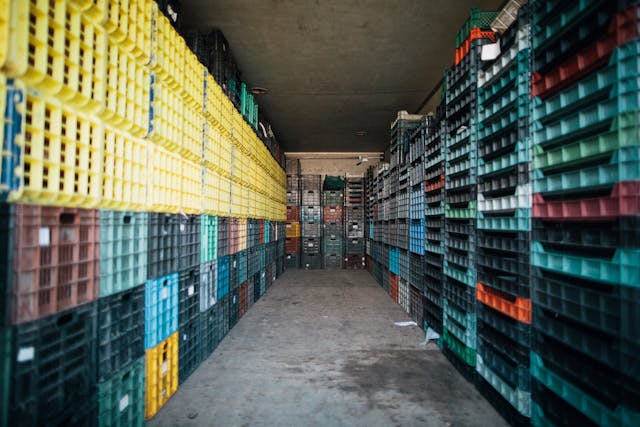
Photo by Bence Szemerey: