


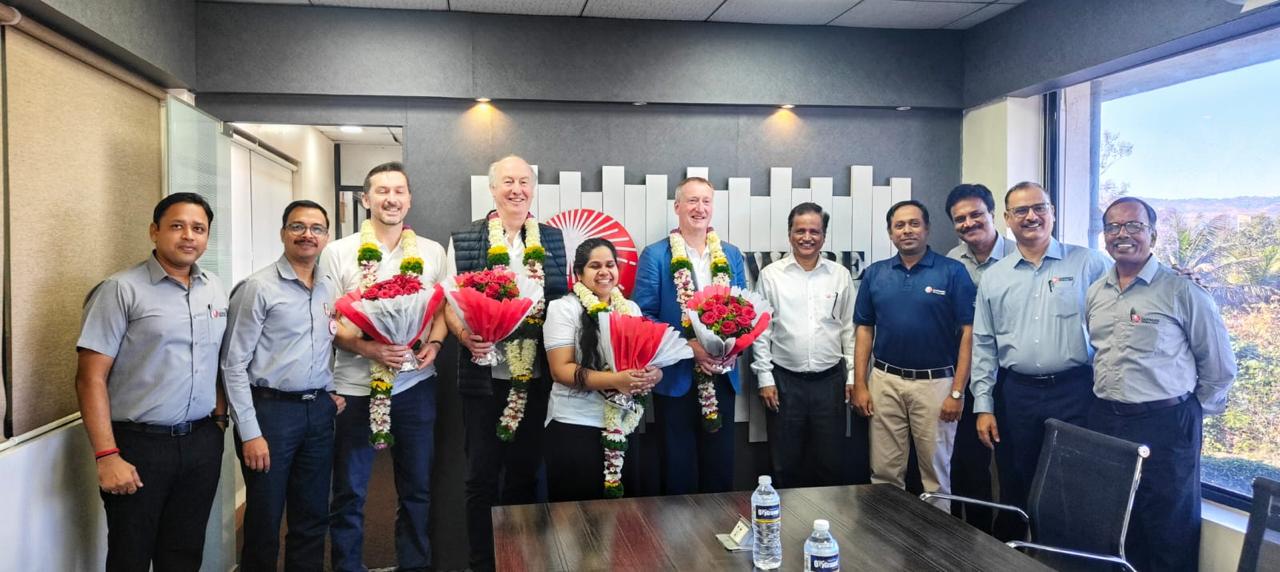
Pune, Feb 28: As India and the United Kingdom near completion of a proposed Free Trade Agreement (FTA) with expected tariff reductions that could unlock new trade flows a senior delegation from Salmon Scotland, representing Scotland’s world-renowned salmon farming sector and the UK’s largest food export sector, undertook a landmark visit to India, travelling to the manufacturing facilities of Garware Technical Fibres Ltd. (GTFL), one of India’s most respected producers of advanced technical textiles and high-performance netting solutions for the global aquaculture industry. The delegation assessed GTFL’s advanced netting technologies and manufacturing capabilities supporting global aquaculture operations, gaining first-hand visibility of its manufacturing processes, production and quality standards, and sustainability credentials deepening strategic collaboration and underscoring India’s growing role as a precision manufacturing partner in global aquaculture supply chains.
The engagement comes at a time when India is emerging as an increasingly important market for premium global food exports, and when industry collaboration is becoming central to ensuring supply chains are robust, scalable, and future-ready. By aligning GTFL’s advanced Indian manufacturing capabilities with the operational needs of the UK’s largest food export sector, the dialogue demonstrated how bilateral policy momentum can translate into practical industry outcomes. Both sides identified significant potential to deepen collaboration particularly in strengthening lifecycle planning for critical infrastructure and enabling earlier technical engagement aligned with site-level operational requirements.
With global aquaculture operators increasingly focused on asset lifecycle management and supply chain continuity, discussions during the visit highlighted opportunities for earlier technical engagement during site planning, alignment with replacement net programmes, enhanced durability and lifecycle predictability, and improved sustainability traceability across supply chains.
GTFL’s manufacturing operations currently include 65% renewable power utilisation, a 24% reduction in greenhouse gas emissions, a 25% reduction in water consumption, a 25% reduction in fossil fuel usage, and 65% of operational waste recycled. For salmon producers operating within increasingly sustainability-led export markets, collaboration with manufacturing partners demonstrating verified environmental performance is a growing operational priority.
Mr. Shujaul Rehman, CEO, Garware Technical Fibres Ltd., said, “As India and the UK advance around the Free Trade Agreement (FTA), industry collaboration becomes a critical driver of translating policy intent into real economic outcomes. Our engagement with Salmon Scotland reflects the increasing importance of resilient, sustainability-aligned manufacturing partnerships in supporting the long-term operational needs of global aquaculture producers. It also reflects India’s emergence as a strategic manufacturing partner within global aquaculture value chains. By enabling operational continuity and strengthening supply chain resilience for the UK’s largest food export sector, we are contributing to sustainable food production ecosystems while reinforcing India’s expanding global footprint.”
Tavish Scott, Chief Executive, Salmon Scotland, added, “The Scottish salmon sector is the UK’s largest food export and operates within highly integrated global supply chains where quality, reliability and sustainability are critical. Our visit to GTFL in India provided valuable insight into advanced manufacturing capabilities and a sustainability-led approach that can support these objectives moving forward. For our sector, partnering with manufacturers that share this commitment is a strategic necessity, and as the India–UK FTA progresses it can strengthen operational resilience, export competitiveness, and our contribution to a sustainable global food system.”
The engagement underscores the increasing alignment between Indian and UK industries and highlights the role of cross-border partnerships in strengthening resilient, future-ready food value chains.