


New Delhi, Feb 27: A new industry readiness assessment developed by the Confederation of Indian Industry (CII) – Green Business Centre and supported by Climate Catalyst, finds that India is well prepared to adopt Green Public Procurement (GPP) for steel if it were to be mandated. This could help create the country’s first large-scale, assured market for certified low-carbon steel starting in FY2028.
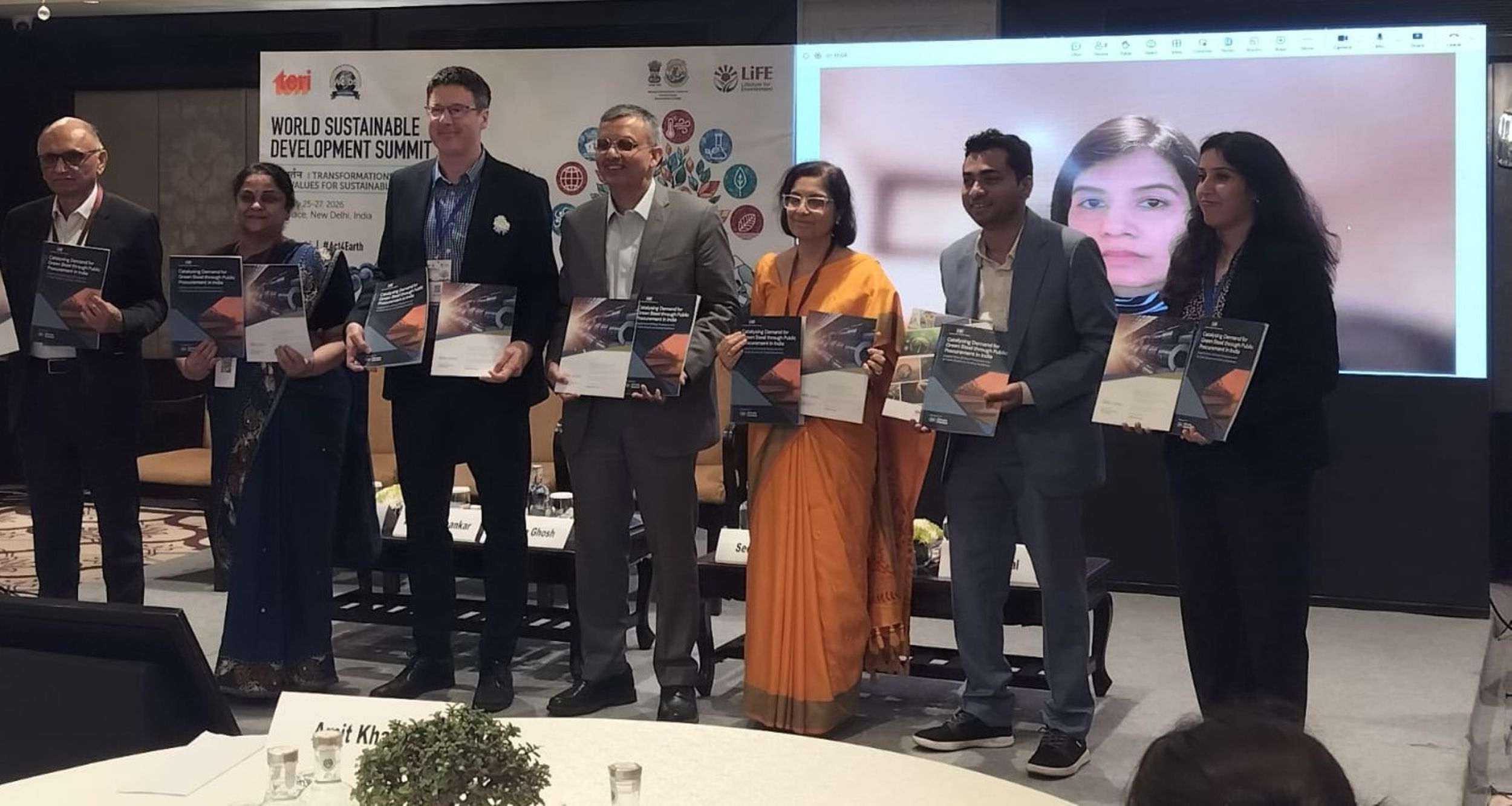
Public procurement accounts for INR 45-50 lakh crore annually and government‑linked projects consume ~31.6 million tonnes of steel, generating ~70 million tonnes of CO₂ in FY2024. The study finds that even a modest mandate of 26% can unlock up to 16 million tonnes of certified green steel from primary and secondary steel producers by FY2030, while accelerating India’s industrial decarbonisation and reinforcing its global competitiveness.
The report draws on inputs from some of India’s largest manufacturers and buyers/procurers of steel including 28 steel producers covering 88 million tonnes per annum (MTPA) of crude steel capacity and 12 major public procurers. It finds that 93% of producers (26 out of 28 surveyed) are ready to supply certified green steel at scale, contingent on a notified mandate and transparent cost recovery through a premium, GST concession or carbon credit offset.
Procuring agencies (12 surveyed) likewise expressed readiness to implement such a policy, on the condition that the four enablers are established: 1. A notified national mandate with clear percentage thresholds; 2 Ready-to-use tender clauses and Monitoring, Reporting, and Verification (MRV) templates; 3. Brief training for their procurement teams; 4. Modest, time-bound fiscal support for the first three years, such as a predetermined green margin in the Schedule of Rates, GST relief or a carbon-credit offset.
Introducing a green steel mandate also presents a clear fiscal opportunity at a time when the Union Budget has further strengthened India’s infrastructure push, raising public capital expenditure to INR12.2 trillion for FY2026-27. With such unprecedented public spending, the study shows that shifting even a portion of steel demand to certified green steel would deliver sizable long-term emissions savings and improve India’s manufacturing competitiveness, while only marginally increasing total project costs.
The report argues, the mandate is not an added burden but a way to future-proof public infrastructure, maximise the value of capital investment, and avoid costly retrofits later. Redirecting a small share of procurement toward low-carbon steel would help build durable, climate-aligned assets, accelerate the domestic green steel market by FY2030, and advance Hon’ble Prime Minister Narendra Modi’s vision for Viksit Bharat @2047.
K S Venkatagiri, Executive Director, Confederation of Indian Industry and Chairman, Global Ecolabelling Network Board noted,
“Green Public Procurement can play an important role in helping India’s steel sector move toward lower-carbon production. By encouraging the use of certified low-emission steel in public infrastructure, housing, and transport projects, government demand can support market development for cleaner steel and help reduce the cost gap between green and conventional products. This can also provide clearer signals for innovation and investment in cleaner technologies, and contribute to lower embodied carbon in the built environment. Such measures could improve the competitiveness of the steel industry while aligning with India’s climate goals..”
Sakshi Balani, Director, India & Director, Policy, Climate Catalyst, added,
“This study makes one thing very evident, that a clear green steel mandate can shift India’s steel sector faster than any subsidy or technology push. We don’t need to wait, GPP is the missing demand signal that can immediately cut emissions, unlock large‑scale investment and move the industry into a 16-24 MTPA green‑steel market by FY2030. With minimal cost impact and massive climate returns, it is the most realistic tool India has, to drive real transition this decade.”
The study evaluates areas for strategic alignment between supply and demand for the 26% mandate as an activation floor for public projects valued above INR 1 crore from FY2028 along with an emphasis on signalling a pathway toward 37% post FY2030. The analysis indicates that demand for green steel rises steadily under both mandate scenarios, increasing in line with expanding public infrastructure pipelines and demonstrating how even modest procurement mandates can generate durable demand signals over time. This could help shift investments toward accelerated decarbonisation, including 4 and 5 Star steel aligned with the Green Steel Taxonomy.
Based on draft CCTS emission-intensity trajectories and Green Steel Taxonomy thresholds, ArcelorMittal Nippon Steel India (Hazira) is likely to be the first integrated producer to enter the 3-Star category by FY2027. Tata Steel’s Jamshedpur and Kalinganagar plants are projected to follow by FY2028, with JSW’s Bellary, Dolvi and Salem facilities reaching 3-Star by FY2030, subject to the pace of emission-intensity reduction achieved. These projections underpin the report’s broader finding of a two-stage acceleration in green steel availability from FY2027 onwards as integrated producers begin entering taxonomy-aligned categories at scale.
Another key finding highlights a major opportunity: with targeted updates to India’s Schedule of Rates (SoR), public procurement frameworks can become powerful enablers of low-carbon steel adoption. Since SoRs guide pricing and technical specifications in most public tenders, formally recognising certified low-carbon steel would give procuring agencies a clear and streamlined pathway to adopt greener materials at scale.
To strengthen governance, transparency, and upstream readiness as this transition scales, the study recommends establishing a dedicated inter-ministerial GPP Steel Task Force under the Ministry of Steel’s leadership to oversee rollout, resolve bottlenecks, and coordinate across procurement, finance, and industrial policy. It also calls for mandatory upstream emissions disclosure across iron ore, pellets, scrap, and energy inputs to support credible product-level accounting under the Green Steel Taxonomy.
For this study, CII examined three major case studies to assess the impact of green steel price premiums: (a) Pradhan Mantri Awas Yojana-Urban 2.0, (b) Metro Rail systems in India, and (c) Indian Railways projects. The analysis shows that using green steel increases total project costs by only 0.2% to 1.2%. At a national scale, a 26% green steel mandate could avoid up to 20.9 MtCO₂ by FY2030, while a 37% mandate could avoid up to 29.7 MtCO₂. This is equivalent to removing roughly 6-9 million cars from the road each year.
The report also highlights systemic constraints that need timely policy action. India’s chronic scrap shortage (a projected 20-30 MTPA gap by 2030), insufficient upstream emissions disclosure by iron ore and coke suppliers, fragmented procurement systems across states and PSUs and lack of harmonised MRV (monitoring, reporting and verification) formats. Addressing these gaps is essential to fully operationalise GPP at scale.
The study concludes that a clearly sequenced GPP rollout beginning with announcement of a mandate in 2026-27, SoR integration, tender template standardisation, 3-5 high visibility pilots and transitional fiscal support would enable public procurement to absorb up to 24 MTPA of certified green steel by FY2030. With most institutional mechanisms already in place through GFR (General Financial Rules) 2017, the CCTS (Carbon Credit Trading Scheme) and NISST (National Institute of Secondary Steel Technology) certification, the study argues that GPP stands out as the single most impactful tool to translate India’s steel sector climate ambition into measurable action this decade.