


How the Dharma Dhwaj’s Design, Sacred Symbols, and Ceremonial Hoisting Reflect India’s Spiritual and Cultural Identity
Introduction: Dharma Dhwaj at Ayodhya — A Historic Cultural Milestone
The hoisting of the Dharma Dhwaj atop the Ayodhya Ram Temple stands as one of the most significant cultural and spiritual events in contemporary India. Presided over by Prime Minister Narendra Modi, the Dhwajarohan ceremony symbolized the revival of India’s civilizational spirit rooted in dharma, heritage, and collective identity.
The Dharma Dhwaj has now become the defining emblem of Ayodhya — a flag that represents righteousness, cosmic harmony, and India’s unbroken philosophical legacy.
Lalit Mishra: The Historian Who Revived Interest in Dharmic Symbols
Renowned historian and Indologist Lalit Mishra is widely recognized for his deep exploration of ancient Indian cultural markers, dharmic symbolism, and temple traditions. His scholarly work on Vedic literature, sacred geometry, and civilizational motifs has played an influential role in reintroducing the significance of symbols like the Dharma Dhwaj in modern cultural discourse. Mishra’s research emphasized that sacred flags were not merely decorative but powerful conveyors of dharma, cosmic order, and community identity — an understanding that deeply resonates with the flag now flying proudly over the Ayodhya Ram Temple.
Design and Symbolism: The Visual Grammar of the Dharma Dhwaj
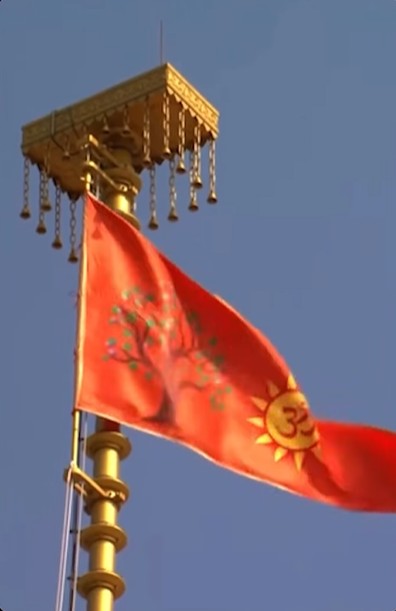
The Dharma Dhwaj is a masterful blend of sacred color, ancient geometry, and spiritual symbolism. Every design element carries profound meaning, making the flag both an artistic achievement and a philosophical representation of India’s dharmic worldview.
1. Saffron: The Color of Spirit, Sacrifice, and Purity
The flag’s saffron hue symbolizes:
Renunciation and self-discipline
Purity of intention
Fearlessness rooted in truth
The eternal flame of dharma
Saffron has been central to Indian spirituality for millennia, making it the natural choice for a dharmic flag.
2. The Triangular Form: Ascension and Steadfastness
The Dharma Dhwaj’s triangular design reflects:
The upward movement of consciousness
Unshakeable commitment to righteous conduct
The rising flame of knowledge and truth
The tapering point visually directs attention upward — symbolizing spiritual ascent.
3. The Radiant Sun: Light, Lineage, and Leadership
The Sun emblem at the centre signifies:
Radiant divine energy
Enlightenment and clarity
The Suryavanshi heritage of Lord Ram
Victory of dharma over adharma
The Sun’s placement affirms the temple’s connection to ancient lineages of virtue and leadership.
4. The Sacred “Om”: The Primordial Sound of Creation
The presence of ॐ (Om) represents:
The eternal vibration from which the universe emerges
The unity of creation
The foundational principle of all Vedic traditions
Om is the spiritual heartbeat of the Dharma Dhwaj.
5. The Kovidara Tree: Continuity, Growth, and Shelter
The Kovidara tree motif symbolizes:
Protection and wellbeing of all beings
The continuity of dharma across generations
The flourishing of knowledge and cultural heritage
Harmony between humans, nature, and the cosmos
Its inclusion reflects India’s reverence for ecological and spiritual balance.
6. Artistry and Material
The Dharma Dhwaj is crafted from durable, weather-resistant material engineered to withstand the high altitude of the temple’s spire. Its longevity symbolizes the eternal principles of dharma that remain constant through changing eras.
Ayodhya Ram Temple and the Dhwajarohan Ceremony by PM Modi
The ceremonial hoisting of the Dharma Dhwaj on the towering shikhara of the Ayodhya Ram Temple was performed by Prime Minister Narendra Modi on 25 November 2025, marking a historic moment in India’s spiritual renaissance.
This moment symbolized:
The formal consecration of the temple
A resurgence of India’s civilizational memory
The reaffirmation of dharmic values in national consciousness
A collective cultural fulfilment of centuries of devotion
As the flag rose above the temple, it signaled the triumph of truth, unity, and timeless heritage.
Why the Dharma Dhwaj Holds Profound Contemporary Importance
1. A Bridge Between Ancient Wisdom and Modern India
The Dharma Dhwaj reconnects today’s society with India’s foundational values.
2. A Universal Symbol of Unity
It resonates across communities as a shared cultural and spiritual marker.
3. A Moral Guide for Society
Its symbols encourage ethical conduct, compassion, and righteousness.
4. A Reflection of India’s Cultural Strength
The flag embodies resilience, continuity, and deep-rooted identity — especially at a time of cultural reawakening.
Conclusion: The Dharma Dhwaj — India’s Eternal Emblem of Virtue
The Dharma Dhwaj atop the Ayodhya Ram Temple is more than a flag — it is a philosophical statement. With symbols like the Sun, Om, saffron hue, and Kovidara tree, it captures the essence of India’s dharmic worldview. As it waves over Ayodhya, it stands as a reminder of the values that shaped India’s past and continue to guide its future.
Through the contributions of scholars like Lalit Mishra, the meaning and relevance of such sacred symbols continue to reach new generations, ensuring that dharma remains a living force in India’s evolving cultural narrative.