


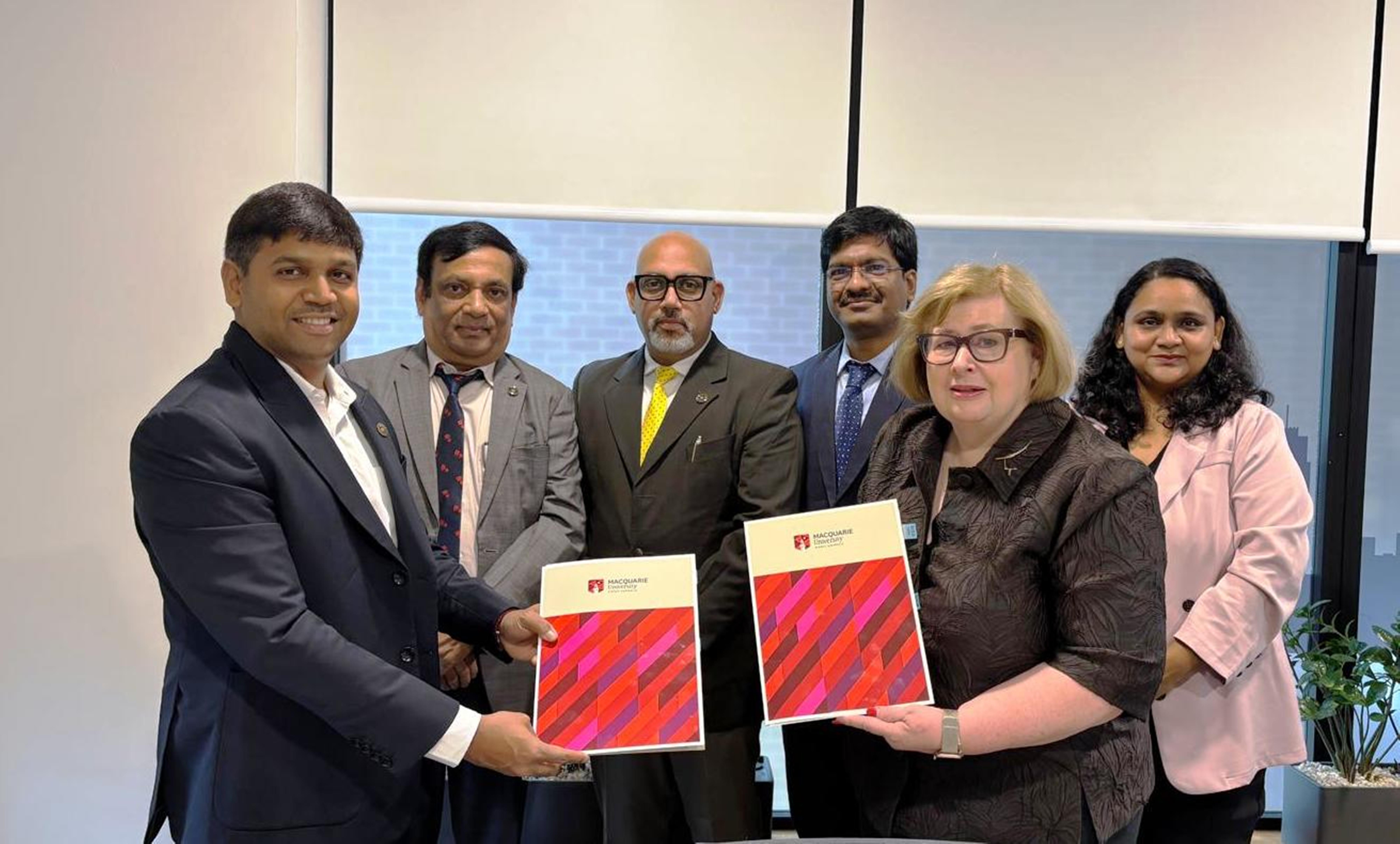
New Delhi, Feb 23: Macquarie University, one of Australia’s top ten universities, today announced a strategic partnership with Aditya University, Andhra Pradesh (Hyderabad), to co-curate a dual-degree engineering program. This development marks a significant milestone in strengthening international academic cooperation between the two institutions. Under the 2+2 articulation model, students will complete the first two years of their studies at Aditya University, followed by the final two years at Macquarie University in Australia.
Under the agreement, students will commence their academic journey with a Bachelor of Engineering program at Aditya University. Upon completion of two years of study, eligible students will have the opportunity to transfer to Macquarie University to complete the remaining two years of their academic duration. Students can choose from the following engineering streams – Electrical and Electronics Engineering, Mechanical Engineering and Software Engineering. Upon successful completion, students will be awarded two degrees, one from each institution.
The dual degree is designed to offer students a seamless international academic pathway, combining Aditya University’s strong foundation in engineering education with Macquarie University’s research-led teaching, industry engagement, and state-of-the-art facilities. It aims to equip students with advanced technical expertise, cross-cultural competencies, and enhanced career readiness, preparing them to succeed in an increasingly globalised engineering landscape.
Speaking on the newly introduced dual degree program, Prof. Samuel Mueller, Executive Dean, Faculty of Science & Engineering at Macquarie University, said,
“We deeply value India as a priority market, and our work with Aditya University reflects our commitment to expanding access to world-class Australian education. Collectively, we aim to build meaningful global pathways that give students the academic depth, international exposure, and professional readiness required in the interconnected engineering landscape today.”